Narayana Business School and SMIT Foundation Sign MoU to Advance Social Responsibility and Experiential Learning 

Ahmedabad, Gujarat – At a time in 2026 when management education is increasingly being measured by outcomes alone, Narayana Business School (NBS), Ahmedabad, has entered into a Memorandum of Understanding (MoU) with SMIT Foundation, a registered non-governmental organisation dedicated to social empowerment, skill development, and community service.  

The agreement formalises a long-term collaboration aimed at integrating structured social initiatives, research, and community engagement into management education.  

The partnership was born out of a shared belief that professional education cannot exist in isolation from the society it serves. By bringing together academic rigour and grassroots engagement, the collaboration aims to create learning experiences that are grounded in real-world challenges while contributing meaningfully to community development.  

The MoU outlines several areas of joint engagement, including: 

  • Training and Awareness Programmes:

    SMIT Foundation will conduct structured training sessions and awareness campaigns for NBS students on key social issues, promoting informed participation and social sensitivity. 
  • Joint Social Initiatives and Community Outreach:

    Both institutions will co-organise fieldwork, community engagement activities, and social drives aimed at addressing pressing societal needs. 
  • Student Participation and Practical Exposure:

    NBS students will actively participate in SMIT Foundation–led initiatives, gaining hands-on experience in social work, community engagement, and impact-driven projects. 
  • Resource and Infrastructure Support:

    NBS will provide logistical and infrastructural support, including campus facilities and volunteer participation, to facilitate the successful execution of social programmes. 
  • Research Collaboration on Social Issues:

    The partnership will also focus on joint research initiatives related to social development and community impact. Faculty and students from NBS will collaborate with SMIT Foundation on data collection, analysis, case studies, and reports aimed at generating actionable insights and policy-relevant recommendations. 
  • Knowledge and Expertise Exchange:

    Both parties will share insights, methodologies, and best practices to enhance the effectiveness and reach of their respective initiatives. 
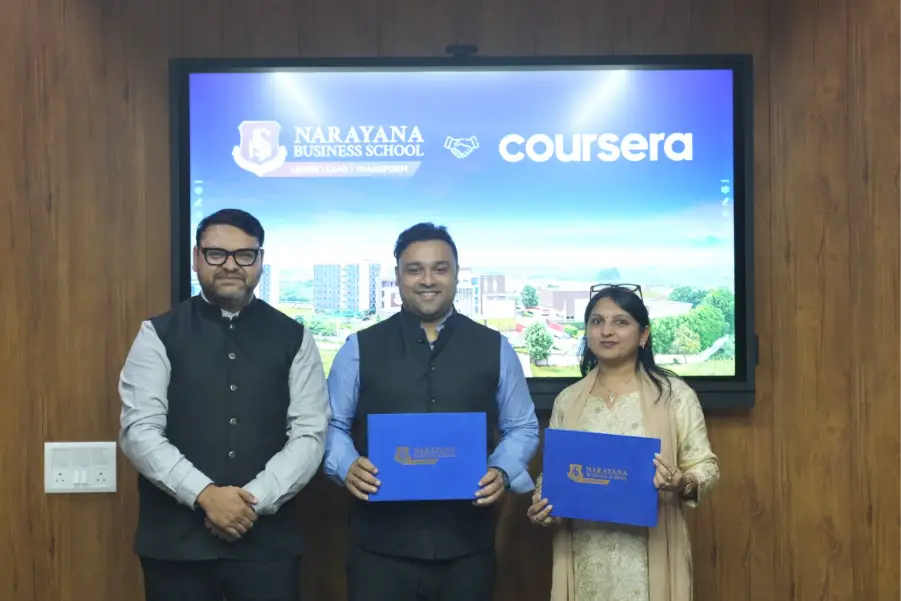
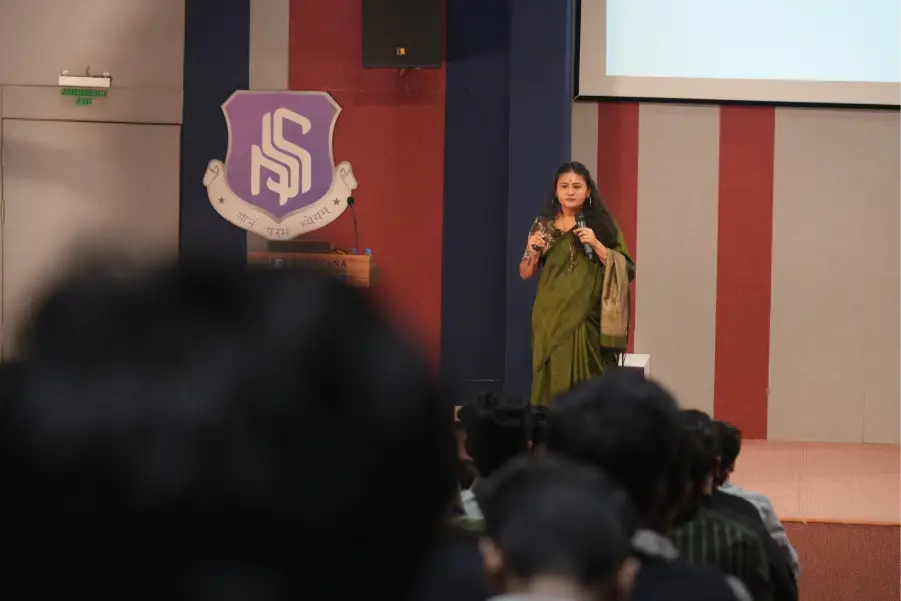
MoU signing between NBS Ahmedabad and SMIT Foundation

The collaboration is expected to create multi-dimensional outcomes, including: 

  • Enhanced student awareness of social realities and community challenges
  • Practical exposure that complements academic learning 
  • Research-backed insights into social development and capacity building 
  • Strengthened culture of social responsibility within management education 

By engaging directly with social initiatives, students will gain a deeper understanding of inclusive growth, ethical decision-making, and leadership beyond profit-centric frameworks.

SMIT Foundation is a registered NGO dedicated to spreading awareness, enabling skill development, and supporting social empowerment initiatives across communities. Guided by its ethos of “Spread the Smile,” the Foundation works on issues related to health, education, environmental sustainability, women’s empowerment, and community well-being. 

With hands-on experience at the grassroots level, SMIT Foundation brings practical insight into social challenges, making it an ideal partner for academic institutions seeking to translate learning into action. 

Both institutions have committed to structured planning, documentation, and evaluation of initiatives to ensure sustained impact and continuous learning. For NBS, the collaboration is not an add-on activity but an extension of its broader educational approach. By integrating social responsibility into academic and extracurricular frameworks, the institution ensures that students develop empathy, cultural sensitivity, and ethical awareness alongside managerial skills. 

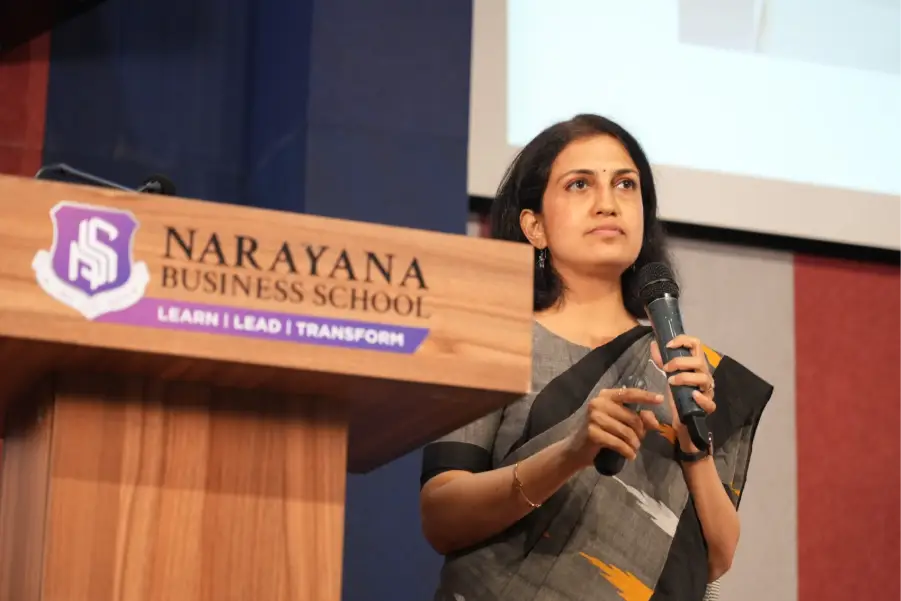
Dr Purvi Gupta with Jeet Parekh

Narayana Business School listed in Outlook India’s Iconic Institutions to look out for in 2026 is a premier B school offering MBA/PGDM programs integrated with industry 5.0 practices, real world learning and 100% placement assistance. This collaboration signals the continued focus of the B school on developing professionals who are not only competent managers, but also conscious socially responsible citizens. As the boundaries between business, society, and responsibility continue to blur, such partnerships play a critical role in shaping leaders who can navigate complexity with empathy and purpose. 

Narayana Business School CMAT Cut Off 2026: Eligibility, Selection Process & Scholarships 

More than 63,000 candidates appeared for the 2025 CMAT exam and the number is expected to cross 70,000 for the 2026 attempt. For MBA aspirants who appear in the Common Management Admission Test (CMAT 2026), NBS CMAT Admission 2026 offers an accessible and credible pathway into MBA/PGDM programs. CMAT is a widely recognised national-level MBA entrance exam conducted by the National Testing Agency (NTA) and accepted by all reputed AICTE-approved institutions across India, almost 1300, making it a valuable score for students targeting reputable B-schools.  

For aspirants desiring admissions in Ahmedabad, Narayana Business School is considered one of the best colleges from admissions via CMAT scores in Ahmedabad.  

Our team has put together a guide which will guide the aspirants through what CMAT is, why it matters, how it works for NBS admissions, the required CMAT cutoff and eligibility, the selection process, and scholarship opportunities for students using CMAT scores. 

The Common Management Admission Test (CMAT) is a national-level entrance exam designed to evaluate candidates on key management aptitude areas such as Quantitative Techniques, Logical Reasoning, Language Comprehension, General Awareness, and Innovation & Entrepreneurship. It is conducted in computer-based test (CBT) mode by the National Testing Agency (NTA) with 100 questions across 5 sections each year for admissions into MBA/PGDM programs across India.  

CMAT is especially useful for students who are seeking admission into multiple AICTE-approved colleges without appearing only in exams like CAT or XAT. Its broad acceptance, reasonable exam pattern, and accessibility make it an attractive option for many MBA aspirants.  

To be considered for NBS admission through CMAT 2026, candidates must fulfil the basic eligibility criteria set by Narayana Business School: 

  • Educational qualification: A bachelor’s degree from a recognised university with at least 50% aggregate marks (or equivalent CGPA). Final-year students awaiting results are also eligible.  
  • Age limit: An upper age limit of 28 years is applicable for admission.
  • Accepted exams: NBS accepts scores from multiple national exams including CMAT, CATXAT, NMAT, and its own in-house MBA entrance exam NBSAT.

CMAT Cutoff and Exemption from NBSAT 

Narayana Business School allows exemption from its in-house entrance test (NBSAT) for candidates who meet the required CMAT cutoff: 

  • Candidates scoring CMAT ≥ 80 percentile are exempted from taking NBSAT and can proceed directly to the next stages of the selection process.  
  • Aspirants below this percentile will need to appear for NBSAT to remain eligible for admission.  

This system gives CMAT candidates a streamlined route into NBS, cutting out the extra exam stage if the percentile requirement is achieved. Even high achievers with CMAT scores more than 90 percentile prefer Narayana Business School and Ahmedabad as their educational destination as compared to go-to cities like Delhi and Pune. The reason aspirants prefer NBS Ahmedabad over cities like Delhi and Pune is the industry relevant curriculum and ROI.  

The NBS MBA program fees is 9.8 L approx. while the average MBA package is 8.4 L making the ROI one of the best in the industry. This coupled with global exposure, 3 layer mentorships and specialized programs, makes NBS a top choice for students in 2026.  

Selection Process After CMAT Shortlist 

Even after meeting the CMAT eligibility and cutoff, final admission to Narayana Business School involves a holistic evaluation: 

  1. Psychometric profiling – To assess behavioural traits, leadership potential, and personality fit.  
  1. Personal interview (PI) – To understand communication skills, motivation, career vision, and overall suitability.  
  1. Academic record and overall profile – Performance in graduation and previous academic history also plays a role.

NBS does not measure a candidates performance based on scores alone as the B school believes that talent and ambition go a long way than just exam scores. This is an extensive of the same ideology which the B school follows in its programsThis ensures that NBS admits students who not only have good entrance exam performance but are also ready for business leadership. 

NBS offers a structured scholarship framework that rewards excellence, encourages diversity, and supports students with financial needs: 

  • Merit-based scholarships are available for students based on composite performance (entrance scores plus academic history). 
  • Scholarship slabs include significant fee waivers for top performers: 
  • Above 95th percentile → ₹4,00,000 waiver 
  • Above 90th percentile → ₹3,00,000 waiver 
  • Above 85th percentile → ₹2,00,000 waiver 
  • Above 80th percentile → ₹1,00,000 waiver 

These scholarships apply to students admitted through all accepted test scores including CMAT, helping reduce the cost of MBA/PGDM education. 

  • CMAT 2026 offers a valuable chance to enter NBS Ahmedabad if you score above the required percentile and meet eligibility criteria.  
  • CMAT allows you to bypass the NBSAT if your score meets the cutoff, saving time and focusing your selection efforts on profile-based rounds.  
  • Scholarships enhance the value of admission for high-performing students.  
  • A well-balanced selection process makes sure admissions are based on aptitude, personality, and potential.  

For MBA and PGDM aspirants aiming at NBS CMAT Admission 2026, CMAT 2026 presents a credible and effective entry point into Narayana Business School’s management programs. With over 670 recruiters the highest Narayana Business School MBA package crossed 20 LPA. By understanding the exam’s structure, meeting the CMAT cutoff (≥ 80 percentile), and preparing for the subsequent stages of evaluation, students can position themselves strongly for admission and scholarship opportunities.  

With CMAT acceptance, NBS Ahmedabad opens a flexible and rewarding admission pathway for aspirants across India. 

NBS XAT Admission 2026: Eligibility, Cutoffs And Scholarships

NBS admissions via XAT 2026 scores, including XAT eligibility, XAT cutoff, and scholarship opportunities present a clear and structured admission route for the aspirants of MBA and PGDM programs. The Xavier Aptitude Test (XAT), conducted by XLRI Jamshedpur on behalf of XAMI members for over 75 years, is one of India’s most trusted national-level MBA entrance exams for admission to MBA/PGDM programs. With acceptance of XAT scores along with other national-level exams, NBS gives you the flexibility to convert your exam performance into a seat, provided you meet eligibility criteria. If not, the candidate is required to appear for NBSAT exams.  

  • Narayana Business School accept XAT scores for admissions to its MBA/PGDM programs 
  • XAT registration closes on 11th December 2025 and the exam is scheduled for 4th January 2026 
  • XAT cutoff at Narayana Business School is ≥ 70 percentile.  
  • XAT 2026 scores will be accepted at NBS Ahmedabad 
  • XAT eligibility criteria is a 3-year Bachelor’s degree (any discipline) or be in your final year, with no mandatory minimum percentage for the exam itself. 
  • If XAT cutoff is not met, to secure admissions at NBS, the candidate must appear for NBSAT entrance exam 
  • NBS offers fee waivers / merit-based scholarships

To be eligible to get admission at NBS Ahmedabad via XAT 2026 scores, the candidate must hold a bachelor’s degree from a recognized university, with at least 50% aggregate marks (or equivalent CGPA). Final-year students awaiting results are also eligible. There is an upper age limit at Narayana Business School i.e., 28 years. 

NBS accepts XAT 2026 scores along with admissions via CAT, NMAT, CMAT, or its own exam NBSAT as an entrance route. 

XAT is a competitive national-level exam, and NBS uses XAT performance to allow direct entry into its selection rounds.

  • XAT ≥ 70 percentile – You are exempted from writing NBSAT 
  • XAT < 70 percentile – You must appear for NBSAT 

This cutoff applies to all eligible programs under the MBA + PGPCE and PGDM categories.

Unlike regular notion of colleges requiring 90+ percentiles, NBS keeps the cutoff practical to ensure opportunities for students who may not hit elite-percentile ranges but have strong communication, managerial and analytical potential.

This gives XAT aspirants who fall in the mid-70s percentile range a clear and realistic pathway.

Students applying via NBS admission through XAT 2026 can choose from the following flagship programs:

  • MBA + PGP in Corporate Excellence 
  • PGDM Dual Specialization 
  • PGDM in Quantitative Finance 
  • PGDM in Data Science & Business Analytics 

Each program includes industry certifications, practical learning modules, corporate connect initiatives, and experiential projects.

NBS offers one of the most comprehensive scholarship structures among private B-schools. These scholarships apply even for students entering through XAT score for NBS, subject to fulfilling additional criteria.

  1. Merit-Based Scholarships 
    Based on XAT percentile + academic history + NBS evaluation. 
  1. Need-Based Financial Support 
    For students requiring financial assistance to pursue management education. 
  1. Special Category Scholarships

a. Women in STEM
b. Rural background girls
c. Siblings of NBS students/alumni
d. Defence wards
e. PwD candidates
f. Sports, entrepreneurship and social impact achievers

Depending on percentile/score (XAT or NBSAT):

  • Above 95 percentile → ₹4,00,000 waiver 
  • Above 90 percentile → ₹3,00,000 waiver 
  • Above 85 percentile → ₹2,00,000 waiver 
  • Above 80 percentile → ₹1,00,000 waiver 

Government scholarships cannot be adjusted against NBS scholarships but can be availed separately.

For aspirants targeting admission through XAT 2026, Narayana Business School offers a structured and flexible pathway. With a realistic XAT cutoff of 70 percentile, transparent eligibility criteria, multiple scholarship options and a balanced evaluation method, NBS becomes a strong option for students seeking growth, industry exposure and a competitive start to their career.

Whether you aim for MBA or PGDM, the NBS XAT Admission 2026 route ensures that your XAT score opens doors to programs designed for real-world readiness and strong placement outcomes.

Narayana Business School Average MBA Package is ₹ 8.4 LPA. It has been awarded for Excellence in Employability & Placement Performance By IIRF Education Impact Award 2026.

You get exemption from NBSAT exam if you clear the XAT cut off 2026 of Narayana Business School. The XAT cut off is ≥ 70 percentile.

Yes. Students in the final year of their bachelor’s degree can apply, as long as they complete all requirements before the final admission process.

For the XAT exam itself, some top colleges (e.g., XLRI) may apply sectional minima, but for NBS, the focus is on overall XAT percentile (≥70) for eligibility.

NBS XAT Admission 2026 refers to applying for MBA/PGDM programs at Narayana Business School using your XAT 2026 score. Candidates who achieve the required XAT cutoff are eligible for admission consideration without taking the institute’s own exam.

Narayana Business School Average MBA Package: Placement Statistics

For every ambitious and aspiring student, before applying to the best MBA programs, average packages and outcomes do become one of the most deciding factors. Good news is that Narayana Business School average MBA package has delivered a consistent reflects strong industry demands and career appreciation for the students of NBS. With companies hiring across analytics, finance, consulting, digital business, and marketing roles, NBS has positioned itself among the top MBA colleges in Gujarat for the best career outcomes.  

As per the placement statistics, Narayana Business School average MBA package for the recent batch was ₹ 8.4 LPA. The data states also states that the highest package in that cycle was ₹ 20 LPA with more than 670 recruiters participating like Coca-Cola, HDFC Bank, Zomato and more, giving students a wide range of career opportunities.

Narayana Business School is an AMBA global member B school and offers a 2-year full-time MBA program (MBA + PGP in Corporate Excellence), NAAC A+ GRADE accredited. Alongside core MBA curriculum, the program includes corporate-focused certifications, industry-aligned electives, and a strong mentor/faculty network with its PGPCE component, factors that directly influence employability and placement outcomes.  

Narayana Business School MBA fees is ₹ 9.85 Lakhs. This suggests that a good fees to placement ratio thus offering one of the best ROI on higher education in Gujarat.  

The top package (₹ 20 LPA) shows that there is scope for high returns, depending on specialization, performance, and employer demand.

The MBA college offers flexible admissions for MBA & PGDM programs through CAT, XAT, CMAT, NMAT, or NBSAT – India’s First Holistic Management Entrance Test.

Notable alumni of the MBA program at Narayana Business School are Sandeep Bharadwaj, MD & CEO – PayTM Money, Jay Trivedi – Founder, ValServe Group etc.

NBS Admissions Via CAT 2025 Scores: Eligibility, Cutoffs And Scholarships

We understand how your CAT 2025 attempt went; it was unexpected for each one of us. The pressure is palpable and there are a million things going inside your head. Which college should I choose? Will my CAT scores will be enough for good B schools? What options will I have in the end? Narayana Business School, one of India’s fastest growing B schools founded by academicians has you covered. Offering industry relevant, AI-enabled specialized MBA/PGDM programs, NBS Ahmedabad has multiple gateways open for admissions. The B school conducts its own MBA entrance exam called NBSAT which is India’s first holistic management entrance test. Last date to apply via CAT 2025 scores is 20th January 2025. For CAT applicants, our team has put together a complete guide on NBS Admissions via CAT 2025 to help you choose the right B school for your aspirations and widen your options.  

To secure admissions at NBS via CAT 2025 scores, the candidate must score 75 or above in their CAT exam. Narayana Business School admissions 2026 for MBA and PGDM programs

  • You must have a bachelor’s degree from a recognized university with at least 50% aggregate marks (or equivalent CGPA).  
  • Final-year students (or those awaiting their graduation results) are also eligible to apply. 
  • There is an upper age limit of 28 years for applying. 
  • If you score 75 percentile or more in CAT, you become eligible for exemption from the NBSAT exam.
  • If your CAT score is below 75 percentile, you must take the NBSAT.
  • Even after meeting the CAT cutoff (≥ 75), selection involves: Psychometric profiling and Personal interview.
  • These help assess your personality, decision-making ability, and communication, not just test scores.

CAT 2025 expected cut-offs vary depending upon your category like EWS, SC, OBC, ST and general.

You can bypass NBSAT entrance exam with a score of ≥ 75. Narayana Business School (NBS) offers a streamlined admission pathway for applicants who have performed well in the Common Admission Test (CAT).

Candidates who secure a CAT score of 75 percentile or higher are granted an automatic exemption from the NBSAT, the institution’s in-house entrance examination.

Narayana Business School provides merit scholarships to students who demonstrate outstanding academic or competitive exam performance. These scholarships are awarded at the time of admission and are meant to encourage high achievers to pursue management education without financial burden.

  • NBS scholarships are broadly merit-based, but there is also need-based financial help.
  • Entrance exam performance (like CAT) and past academic scores (graduation) both factor into certain scholarships.
  • There are special scholarships for rural background girls, women in STEM fields, and siblings of NBS students and alumni.
  • Special category scholarships in sports, entrepreneurial achievement and social initiatives available.
  • The composite score is calculated using CAT or NBSAT along with admission parameters defined by NBS (subject to ≥80% in X, XII, and Graduation).

Every scholarship value is an absolute amount, not a percentage, ensuring true transparency and measurable impact.

NBS offers very significant fee waivers for students who perform exceptionally well in its admission tests (CAT or NBSAT) combined with other admission parameters.

The scholarship slabs are: 

  • Above 95th percentile → ₹ 4,00,000 waiver
  • Above 90th percentile → ₹ 3,00,000 waiver
  • Above 85th percentile → ₹ 2,00,000 waiver
  • Above 80th percentile → ₹ 1,00,000 waiver

Up to ₹ 2,00,000 for EWS / PwD / Defence Wards
(≥ 80% in X, XII & Graduation + supporting documents).

There are multiple types of scholarships offered by Narayana Business School.

Please note that the government-aided external scholarships will not be adjusted against NBS scholarships.

Step 1: Fill NBS online application form 
Step 2: Upload documents + CAT percentile 
Step 3: PI & psychometric round 
Step 4: Merit List 
Step 5: Offer letter + fee payment 

The flagship programs eligible under CAT admission at Narayana business school are:

  • MBA + PGP in Corporate Excellence
  • PGDM in Dual Specialization
  • PGDM in Quantitative Finance
  • PGDM in Data Science & Business Analytics

Explore all programs: https://nbs.edu.in/academic-programs/  

CAT 2025 was a reality check and an eye opener for all of us, the difficulty levels in different slots were unexpected. While it might feel like an end to things, it really isn’t. What will matter is if you chose the right B school based on your skills and not scores. But at Narayana Business School, the path ahead is designed to be transparent, flexible, and genuinely student centric. Whether your CAT percentile is above 75 and you wish to bypass NBSAT, or you plan to explore multiple entry routes, NBS ensures that every deserving candidate gets a fair chance to shine.

With its holistic selection process, robust scholarships, and industry-aligned MBA and PGDM programs, NBS Ahmedabad opens doors to a future shaped by innovation, skill, and real-world readiness.

The future is unfolding right in front of you, and students who choose their careers based on specializations and skills statistically do better in long term. One thing is valid for few years, but the other will take you far and will last 20 years.

Your CAT attempt may be over, but your next big chapter begins here.

Yes, you are eligible to take admission at NBS with your CAT 2025 exam scores if you score ≥ 75. Below the cutoff, you must appear for NBSAT exam.

NBS takes admissions via CAT percentile only. The candidate must convert their final score into percentile and score above 75 to be eligible for admissions.

Yes, you can use your CAT 2025 percentile to secure admissions at NBS for 2026 batch.

No, you cannot combined government-aided external scholarships against NBS scholarships. However, external scholarships can be combined with NBS scholarships.

You can connect with the scholarship team of NBS by dropping a mail at accounts@nbs.edu.in or calling on +91-9106822579.

No there is no deadline to appear for NBSAT. The candidates can apply for NBSAT from the official portal by submit an application form fee.

Narayana Business School Admissions 2026 for MBA & PGDM programs: Complete Details on entrance exam, eligibility, cutoffs and admission process

Offers Industry-aligned programs, conducts India’s first holistic NBSAT entrance exam; accepts national-level exams scores like CAT, XAT, NMAT & CMAT.  

Ahmedabad, November 2025 – Narayana Business School Ahmedabad has officially announced that it is now accepting applications for its 2026 admission intake. Deemed as Gujarat’s fastest growing B school by IIRF 2025, its India’s first B school founded by academicians. To seek admissions at NBS, the candidate must qualify for one of the aforementioned national entrance exams i.e., NBSAT, CAT, NMAT, CMAT and XAT.  

Understanding that talent always comes in diverse forms, NBS Ahmedabad conducts its own holistic national level NBSAT (Narayana Business School Aptitude Test) entrance exam, and also is accepting entrance exam scores from multiple national-level exams like CAT (score ≥ 75), XAT (score ≥ 70), NMAT (score ≥ 180) and CMAT (score ≥ 80).

entrance exam scores accepted at NBS

Candidates who score below these cutoffs in national examinations can pursue admission through NBSAT. 

Eligibility extends to bachelor’s degree holders with minimum 50% marks, final-year students, and professionals holding CA, CS, or ICWA qualifications. With an upper age limit of 28 years, the programs welcome working professionals seeking career transformation.

“Our admission process with NBSAT is thoughtfully and holistically designed to test the acumen of the students beyond the exam scores. The multi-dimensional assessment evaluates leadership readiness, creativity, ethical reasoning, and decision-making abilities.” said, Dr Purvi Gupta – Dean of Academic Affairs.

Unlike traditional testing models, NBSAT’s structure ensures that candidates with diverse strengths, unconventional backgrounds, and real-world experience have equal opportunity to demonstrate their potential.

The process unfolds in distinct phases:

  • Application submission online 
  • Aptitude testing (Appear for NBSAT or apply via accepted national exams) 
  • Psychometric profiling  
  • Personal interview (Online)  
  • Selection & Enrolment  

Established in the financial capital of western India, Ahmedabad, Narayana Business School has established itself as a powerhouse in business education through measurable outcomes and consistent recognition. The institution currently holds the #1 position as India’s fastest-growing B-School (IIRF 2025) and ranks #2 among the state’s private business schools (Education World 2025). Nationally, it stands #4 among fastest-growing private B Schools (IIRF 2025).

With 670+ corporate recruiters actively hiring NBS graduates, the institution has cultivated relationships with industry leaders including PwC, Coca-Cola, S&P Global, L&T, ITC Limited, and Zomato. NBS was awarded with Excellence in employability and placement performance by IIRF education impact awards 2026.

Recent placement stats revealed ₹20 LPA as highest package and ₹8.4 LPA average package with 100% placement assistance and NEEP (Narayana Employability Enhancement Program) career support.

Built on the idea of attracting talent from the corners of the country, Narayana Business School is a combination of 10+ acre of lush green campus, 100% digital and AI infrastructure, comprehensive mentorship programs and student-led clubs.

NBS offers four specialized post graduate programmes:

  • PGDM in Quantitative Finance (Partnered with EY CAFTA) – India’s only EY-partnered quant finance program, this program integrates advanced quantitative methods with EY’s Centre for Advanced Financial Technology and Analytics framework to develop specialized competencies in financial modeling and risk management.
  • PGDM in Data Science & Business Analytics – Specialized for AI, big data, and analytics driven decision making, this program equips graduates with skills the world’s top companies demand turning.
  • PGDM in Dual Specialization – This program allows students to create their own custom career blueprint by simultaneously choosing two high demand business disciples. Built on AI-enabled learning, experiential exposure, and an entrepreneurial mindset.
  • MBA + PGP in Corporate Excellence – MBA education with professional graduate certification, designed to accelerate leadership development through integrated academic and advanced corporate training.

Explore All Programs Here

Commenting on the launch of the 2026 admissions, the NBS leadership emphasized the school’s mission of nurturing talent that contributes to the rising India and elevates its business and society alike. “As a global member of AACSB and BGA, we believe education is not just about degrees but lifelong learnings and holistic transformation”.

Every program is structured to instil analytical thinking, ethical decision-making, and innovative problem-solving. With the 2026 intake, we look forward to shaping the next generation of leaders who will fuel the growth engine of the rising India and drive impact globally.”

Interested candidates can submit their applications online at https://applications.nbs.edu.in . The admissions team is available to address queries and guide prospective students through the application process.

Best CAT Study Material 2025 (Updated): PDF Free Download & Complete Guide

The CAT (Common Admission Test) is a crucial exam for MBA aspirants in India, it is a nation-wide conducted exam annually. The primary goal of this exam is to select candidates for admission into various management programs, especially MBA and to excel in this competitive exam, having the right cat study material is essential. We at Narayana Business School always ask the CAT aspirants to keep the imperative CAT prep tips in mind, which relate to understanding the syllabus thoroughly, always keeping mock tests handy and carefully analysing the shortfalls to improve them. 

This comprehensive article provides an in-depth guide to cat preparation, focusing on free resources, study plans, and proven strategies to ace the cat exam 2025. 

The first step in your preparation journey is to understand the CAT exam pattern thoroughly. The exam is divided into three main sections: Quantitative Aptitude (Quant), Logical Reasoning and Data Interpretation (LRDI), and Verbal Ability and Reading Comprehension (VARC). Each section contains different types of questions, making it crucial to have a structured study plan that addresses all areas comprehensively.    

The cat syllabus for 2025 remains consistent with previous years, covering: 

  • Quantitative Aptitude: Arithmetic, Algebra, Geometry, Number System, and Modern Math 
  • Data Interpretation & Logical Reasoning: Charts, Tables, Logical Puzzles, and Critical Reasoning 
  • Verbal Ability & Reading Comprehension: Grammar, Vocabulary, Para Jumbles, and Reading Comprehension 

Understanding this pattern helps you allocate time effectively and focus on areas that need the most attention during your cat preparation journey.

Looking for the best CAT study material for free? There are numerous online resources available that can significantly enhance your preparation without breaking the bank. Quality study materials include CAT books, CAT mock tests, CAT previous papers, Quant formula PDFs, CAT daily targets, sectional tests for each section, and revision videos to ensure thorough preparation.

Essential Free Resources for CAT Paper 2025   

  1. Previous Year Papers and Question Banks: The most valuable free study material comes in the form of previous year papers. These cat previous year papers provide insight into the exam format, difficulty level, and question patterns. You can find cat question papers from 2017 to 2024, complete with detailed solutions. 
  1. Topic-wise Practice Questions: For focused preparation, access cat question banks organized by topics. This allows you to practice specific areas like cat quant, cat varc, or DILR sections individually, helping you identify and strengthen weak areas. 
  1. Mock Tests and Sectional Tests: Regular cat mock tests are crucial for tracking your progress and building exam temperament. Many platforms offer free cat mock tests that simulate the actual exam environment. Additionally, cat sectional tests help you focus on individual sections and improve accuracy. 

Free PDF Download and PDF Resources  

Many educational platforms offer cat study material pdf resources that can be downloaded for offline study. These include: 

  • Formula sheets for quick revision 
  • Cat preparation books in PDF format 
  • Section-wise question compilations 
  • Cat study material 2025 updates with latest patterns 

The availability of pdf free download options makes quality preparation accessible to everyone, regardless of their financial constraints.

Download your free CAT study material for 2025 at Narayana Business School’s expert curated CAT content. 

Investing in the best cat preparation books can significantly enhance your study experience. Look for books that cover all sections of the cat exam comprehensively and include practice questions with detailed explanations.  

Recommended Books for Each Section

For Quantitative Aptitude: 

  • “How to Prepare for Quantitative Aptitude for CAT” by Arun Sharma 
  • “CAT Quantitative Aptitude” by Sarvesh Kumar Verma 
  • “Quantitative Aptitude for Competitive Examinations” by R.S. Aggarwal 

For VARC Section: 

  • “How to Prepare for Verbal Ability and Reading Comprehension” by Arun Sharma and Meenakshi Upadhyay 
  • “Word Power Made Easy” by Norman Lewis 
  • “High School English Grammar and Composition” by Wren & Martin 

For DILR Section: 

  • “How to Prepare for Data Interpretation for CAT” by Arun Sharma 
  • “Logical Reasoning and Data Interpretation for CAT” by Nishit Sinha 
  • “A Modern Approach to Logical Reasoning” by R.S. Aggarwal 

The best cat study material combines these books with online resources and practice tests to create a comprehensive preparation strategy. 

Regularly taking cat mock tests is essential for effective preparation. These tests serve multiple purposes in your cat exam study routine:

Benefits of Mock Tests

Exam Simulation: Mock tests replicate the actual cat exam environment, helping you manage time effectively and reduce exam anxiety. They familiarize you with the computer-based format and interface. 

Performance Analysis: After each mock test, analyze your performance to identify strengths and weaknesses. Focus on areas where you’re consistently making mistakes and adjust your study plan accordingly. 

Time Management: Learn to allocate time efficiently across sections. Practice switching between different types of questions and maintain your speed and accuracy throughout the test duration. 

Cat sectional tests allow you to focus on individual sections intensively. This approach helps you: 

  • Improve section-specific strategies 
  • Build stamina for each section 
  • Identify optimal question selection patterns 
  • Enhance accuracy in weaker areas 

Developing a robust preparation strategy is vital for success. Your approach should be systematic and cover all aspects of the cat syllabus effectively.  

Daily Study Routine and Targets

Creating cat daily targets helps maintain consistency and ensures comprehensive coverage of the syllabus. A typical daily routine should include: 

Morning Session (2-3 hours): Focus on your strongest section to build confidence

Afternoon Session (2-3 hours): Tackle your weakest section when your mind is fresh

Evening Session (1-2 hours): Practice mixed questions and take sectional tests Night Session (30 minutes): Review mistakes and revise key concepts 

Monthly Preparation Timeline 

Months 1-2: Foundation Building 

  • Complete basic concepts in all three sections 
  • Start with easier topics in each section 
  • Begin reading newspapers and magazines for VARC preparation 
  • Take diagnostic tests to identify baseline performance 

Months 3-4: Skill Development 

  • Progress to intermediate and advanced topics 
  • Increase the difficulty level of practice questions 
  • Start taking cat mock tests regularly 
  • Focus on accuracy improvement 

Months 5-6: Intensive Practice 

  • Take full-length mocks every alternate day 
  • Analyze performance and work on weak areas 
  • Revise important formulas and concepts 
  • Practice previous year papers extensively 

Section-wise Preparation Strategy 

  1. Quantitative Aptitude Preparation:  

CAT quantitative aptitude requires a strong foundation in basic mathematics.  

Focus on: 

  • Building speed in calculations 
  • Learning shortcut techniques 
  • Practicing different question types regularly 
  • Memorizing important formulas and theorems 

VARC Section Strategy:  

Success in cat varc depends heavily on reading habits and vocabulary: 

  • Read diverse content daily (newspapers, magazines, blogs) 
  • Practice para jumbles and sentence completion regularly 
  • Improve reading speed without compromising comprehension 
  • Build vocabulary through word lists and contextual reading 

DILR Section Approach:  

The DILR section requires analytical thinking and logical reasoning: 

  • Practice different types of data interpretation questions 
  • Work on logical reasoning puzzles regularly 
  • Develop quick calculation skills 
  • Learn to identify solvable sets in the actual exam 

Online cat preparation has gained tremendous popularity, offering flexibility and comprehensive resources. Many platforms provide extensive free resources including: 

Digital Learning Advantages

  • Flexibility: Study at your own pace and schedule  
  • Comprehensive Content: Access to video lectures, interactive tests, and study materials  
  • Performance Tracking: Detailed analytics of your preparation progress  
  • Regular Updates: Stay updated with latest exam patterns and questions 

Free Live Sessions and Webinars 

Many coaching institutes offer free live sessions covering important topics, exam strategies, and doubt resolution. These sessions provide: 

  • Expert guidance from experienced faculty 
  • Real-time doubt clarification 
  • Strategy discussions with fellow aspirants 
  • Motivation and exam tips 

While focusing on cat preparation, it’s important to consider the broader MBA admission process:

Post-CAT Preparation

  • CAT Score Analysis: Understanding your cat score and its implications for different business schools  
  • Application Process: Preparing for Written Ability Tests (WAT) and Group Discussions (GD)  
  • Interview Preparation: Building confidence for personal interviews  
  • Profile Building: Enhancing your overall candidacy beyond test scores 

Alternative Exams 

Consider preparing for other management entrance exams alongside CAT: 

  • XAT (Xavier Aptitude Test) 
  • CMAT (Common Management Admission Test) 
  • SNAP (Symbiosis National Aptitude Test) 
  • IIFT (Indian Institute of Foreign Trade) exam 
  • MAT (Management Aptitude Test)

For 2026 admissions in MBA & PGDM programs, Narayana business school is accepting CMAT, NMAT, XAT and its own NBSAT scores other than CAT scores. Explore all programs.  

To appear for cat with confidence, implement these advanced techniques:

Question Selection Strategy 

During the actual exam, smart question selection can make a significant difference: 

  • Identify easy questions first in each section 
  • Skip difficult questions that consume too much time 
  • Maintain accuracy over attempting more questions 
  • Use the process of elimination effectively

Stress Management and Exam Day Strategy 

  • Mental Preparation: Develop a positive mindset and manage exam anxiety  
  • Time Management: Practice strict time allocation for each section  
  • Revision Strategy: Create concise notes for last-minute revision  
  • Health Maintenance: Maintain physical and mental health throughout preparation

Modern cat exam study approaches incorporate various technological tools:

Mobile Apps and Online Platforms 

Use mobile applications for: 

  • Daily practice questions 
  • Formula quick reference 
  • Mock test attempts 
  • Performance tracking 
  • Offline study material access 

Analytics and Performance Tracking 

Utilize data analytics to: 

  • Identify improvement areas 
  • Track progress over time 
  • Compare performance with peers 
  • Optimize study strategies 

Successful cat preparation often involves building a strong support network:

Study Groups and Forums

Join online communities and study groups to: 

  • Share resources and strategies 
  • Discuss difficult concepts 
  • Stay motivated throughout the journey 
  • Get diverse perspectives on problems 

Mentorship and Guidance 

Seek guidance from: 

  • Previous CAT toppers 
  • Current MBA students 
  • Experienced faculty members 
  • Professional mentors 

As you approach the exam date, focus on:

Intensive Revision

  • Review all important formulas and concepts 
  • Practice previous year papers under timed conditions 
  • Take final mock tests to maintain exam readiness 
  • Focus on mental preparation and stress management 

Last-Minute Strategy 

  • Avoid learning new concepts close to the exam 
  • Maintain your regular study routine 
  • Ensure proper rest and nutrition 
  • Prepare all necessary documents and logistics 

Effective cat preparation requires a combination of quality study materials, consistent practice, and strategic planning. By leveraging free cat study material, maintaining disciplined daily targets, and following a comprehensive preparation strategy, you can significantly increase your chances of achieving your desired CAT score. 

Remember that success in the CAT exam opens doors to prestigious business schools and transforms your career trajectory. The investment in quality cat study material 2025 and dedicated preparation will yield long-term benefits in your professional journey. 

Whether you choose free study material or invest in premium resources, the key is consistency, practice, and maintaining a positive attitude throughout your cat exam preparation journey. Start early, stay focused, and approach the exam with confidence. Your dream MBA program awaits! 

Good luck on your preparation journey toward cracking the CAT 2025 and securing admission to your preferred business school! 

Narayana Business School Concludes Its First Ever Global Immersion Program at UCSI University, Malaysia

12th September, 2025 – 2025 has indeed become THE year for Narayana business school as it concludes its first ever global immersion program at UCSI university, Kuala Lumpur, Malaysia in its 25th year of celebrating educational impact. Narayana Business School’s department of international relations, under the guidance Assoc. Prof. Dr. Shubhra Gautam, partnered with UCSI Uni which is ranked among world’s top 1% private universities by QS World University Rankings 2026, to ensure the maximum exposure for students of NBS Ahmedabad.

The program was designed to inculcate and help our students explore new ideas, culture and mindset. It was a 5-day immersion program starting from 8th September to 12th September 2025. Stay with us as we will walk you through how each day looked like for our students.

Malaysia Arrival

On 8th September our students landed at the Kuala Lumpur airport, followed by a hotel check-in. To keep things light and to get rid of the jet lag, Day 1 was easy and breezy which allowed everyone to relax and prepare for the next day. To start things off, in the evening, the group went to admire the KLCC Twin Towers and the Suria Mall.

Now they were ready for the next day, and to finally visit the UCSI university.

The first academic session at UCSI University was on Global Mergers & Acquisitions. 

On paper, mergers and acquisitions are about numbers. But in class, students discovered they are really about people, culture, and vision. They were working in groups, creating their own merger ideas, and presenting them. 

It was the perfect way to start: taking a big business concept and making it something they could actually grapple with. 

Later in the day, the cohort visited the Batu Caves, a 400-million-year-old limestone hill housing one of the most famous Hindu shrines outside India. The visit combined cultural immersion with a sense of heritage.  

Midway through the week, the academic spotlight shifted to Business Resilience: Strategy and Innovation. Students explored how organizations adapt to uncertainty, innovate under pressure, and maintain growth during crises.  

The day closed with cultural visits to Thean Hou Temple, Petaling Street (Chinatown), and Central Market, offering a window into Malaysia’s multicultural fabric.


Day 4 opened with an industry benchmarking visit to the service sector, where students learned about industry blueprints, employee retention strategies, and customer-focused operations. Faculty mentor Dr. Shubhra Gautam, who teaches Service & Relationship Marketing at NBS, helped contextualize the visit for the students, linking theory with practice. 

The academic session later that day focused on International Trade and Geoeconomics. Students were asked to pick a market, analyse pros and cons, forecast potential scenarios, and assess the impact of political interventions. This hands-on exercise encouraged them to view trade and markets with a sharper, globally aware lens. 

The final day was devoted to cumulative presentations, where students summarized their learnings from Sessions 2 and 3. Every participant received individual certificates for completing each academic session.  

In addition, the cohort was recognized in two groups for their efforts. One for Best Content and Analysis and the other for Best Presentation Delivery. 

Certificates were presented by Assoc. Prof. Dr. Eva W.L. Lim, Deputy Dean, UCSI Graduate Business School. Later, Dr. Gautam presented a memento to Assoc. Prof. Dr. Keoy Kay Hooi, Dean, UCSI Graduate Business School, as a gesture of appreciation. Students also interacted further with UCSI faculty to understand Malaysian academic and cultural practices.

The department of international relations at NBS Ahmedabad concludes its first ever global immersion program at UCSI university Malaysia. The rising India demands more, and the role of youth in nation building is the maximum. We at NBS, are truly shaping the human capital for the rising India.  

The program concluded on a reflective note. For students, the experience was not just about lectures or sightseeing, it was about representing Ahmedabad and India on an international platform, learning how businesses operate across borders, and understanding how culture shapes management practices. 

Narayana Business School expressed gratitude to UCSI University for hosting the program with such warmth and announced that it is open to future collaborations with global universities to expand immersion opportunities for its students.  

Role Of Youth In Nation Building: Shaping The Future Of Rising India

India is one of the youngest nations in the world, with more than 65% of its population under the age of 35. This demographic structure presents both a challenge and an opportunity. Harnessing this youthful energy, intellect, and creativity can be the turning point in accelerating national development. 

The role of youth in nation-building goes beyond mere participation; it’s about leadership, innovation, and transformation. In India’s journey toward becoming a developed and self-reliant nation, the younger generation holds the power to shape policies, change narratives, and drive inclusive growth. 

Let’s explore the core ways youth play a critical role in building the nation.

The role of youth in nation-building is to actively contribute to a country’s progress through leadership, innovation, and social responsibility. In India, where over 65% of the population is under 35, young people play a vital part in driving economic growth, promoting social harmony, embracing technology, and addressing local and global challenges.   

Energy & Enthusiasm 

The most defining trait of young people is their boundless energy and enthusiasm. The youth in nation building act as a vital force when channelled productively. Whether it’s volunteering, joining public service, or participating in social movements, this dynamic energy creates momentum that drives change. 

Innovative Ideas 

Today’s innovator is likely to be a 24-year-old who knows how to start a startup in India, an app, or a grassroots solution to a local problem. With increased access to technology, education, and digital literacy, Indian youth are bringing fresh perspectives and novel approaches to tackle age-old challenges in health, agriculture, education, and governance. 

Agents of Change 

The role of youths in transforming society is not new. From the Indian independence movement to present-day social reform, youth have consistently taken up the mantle of change. Whether raising awareness about gender equality, organizing climate strikes, or fighting corruption, the youth can contribute significantly to building a just and equitable society. 

Young people contribute to the economic growth of a nation both as a workforce and as entrepreneurs. In India, where unemployment remains a significant issue, initiatives that promote skill development, youth empowerment, and self-employment are critical. Youth has the power to build businesses, generate employment, and strengthen the economy from the ground up.

So how exactly can the youth help shape the future of India? Let’s look at specific and practical areas where their involvement is vital. 

Education & Skill Development  

Education remains the strongest foundation for any developed nation. Equipping the youth of India with new skills, life skills, and vocational training ensures that they’re not just job seekers but job creators. Programs like Skill India, PMKVY, and NEP 2020 aim to empower young people to compete in a globalized world. 

Skill development also enhances productivity, reduces unemployment, and enables young individuals to find meaningful work that contributes to the national development of India to its full potential. 

Promoting Social Harmony  

The role of youth in nation also involves bridging gaps in society. Youth can fight divisive ideologies and promote gender equality, communal peace, and inclusivity. Through community service, peace-building efforts, and campaigns promoting equality, they can strengthen the social fabric of India.

Combating Social Evils 

From dowry and child marriage to caste discrimination and corruption, social evils continue to plague Indian society. Young people bring a progressive mindset and are often more willing to challenge outdated traditions. They can drive transformation by raising awareness, reporting abuses, and promoting justice through both online and offline platforms. 

Participating in Politics and Governance

Active participation in governance isn’t limited to voting every five years. The youth play a key role by joining local government, becoming policy advisors, engaging in civic forums, and starting grassroots movements. Initiatives like Youth Parliament and student councils help enable youth to engage with political processes early on.

To truly realize democracy, Indian youth must take part in the decision-making processes that affect their future. 

Environmental Conservation

With climate change threatening our future, youth in nation building must also take on the role of environmental stewards. Indian youth are at the forefront of eco-initiatives, planting trees, reducing plastic use, promoting clean energy, and supporting wildlife conservation. Green campuses and community-led conservation projects showcase how young voices are making a difference.

Become Entrepreneurs

Entrepreneurship is a key lever in fighting unemployment and achieving economic growth. Indian startups, many led by youth — are disrupting markets, generating jobs, and solving pressing problems. Government support through Startup India, Atal Innovation Mission, and incubator grants helps youth empower themselves while contributing to the national economy. 

An innovator at heart, an Indian youth entrepreneur represents ambition, risk-taking, and forward-thinking, all crucial traits for nation-building. 

Contributing to Rural Development

While urban centres are rapidly developing, the soul of India still lives in its villages. Young people working in rural development can bring clean water, better education, and digital access to remote areas. Programs like Unnat Bharat Abhiyan and village internships help youth engage with rural India and work on real-world problems.

Such social work ensures that progress reaches all corners of the country and not just urban elites. 

Promoting Digital India 

As India moves toward a tech-driven economy, youth are central to realizing the vision of Digital India. They promote digital literacy, create tech solutions for governance, and increase access to information. Whether building apps for agriculture, teaching coding to school kids, or working in e-governance, youth are the digital architects of tomorrow.

Having a legacy of 25 years, Narayana Business School (NBS) has been more than an academic institution, it has been a platform for preparing India’s youth to take an active role in shaping the country’s future. Founded by first-generation edupreneurs, Dr. Purvi and Dr. Amit Gupta, NBS began as a small CFA coaching class in Ahmedabad and has grown into one of India’s fastest-growing B-schools. Its mission aligns closely with the nation-building agenda: to transform ambitious young minds into skilled professionals, ethical leaders, and responsible citizens.  

The institution’s approach to education mirrors the needs of a developing nation, blending academic rigor with experiential learning. It offers academic programs which are a powerful blend of industry and academia delivery. Through industry collaborations with EY, NISM, eChai Ventures, and others, students gain direct exposure to real business challenges. Initiatives like the Narayana Employment Enhancement Program (NEEP), leadership labs, case battles, and mock boardrooms prepare graduates to hit the ground running as middle managers, innovators, and entrepreneurs.  

Despite their potential, Indian youth face several challenges that hinder their full participation in nation-building.  

  • Unemployment: Lack of job opportunities and mismatch between education and industry needs remains a critical barrier. 
  • Mental Health: Pressure from academics, job insecurity, and social media overload are contributing to rising mental health issues. 
  • Lack of Representation: Young voices are still underrepresented in policy-making, media, and corporate leadership. 
  • Gender Bias: Women and non-binary youth face systemic challenges that limit their public and economic participation. 
  • Limited Civic Education: Many youths are unaware of how to take part in political and civic activities meaningfully. 

To overcome these, a multi-pronged approach is needed:

  • Policy Reforms: Implement youth-friendly policies, such as youth quotas in politics and inclusive employment schemes. 
  • Education Revamp: Update curriculums to include life skills, emotional intelligence, and digital fluency. 
  • Funding & Mentorship: Create more platforms for young entrepreneurs and leaders to thrive. 
  • Awareness Campaigns: Help youth understand their rights, civic duties, and the avenues available for active participation in governance. 
  • Mental Health Support: Increase access to counselling and helplines in schools, colleges, and workplaces. 

There is no shortage of inspiring examples showcasing the role of youths in shaping India’s future:  

  • Kiran Mazumdar-Shaw started Biocon in her 20s and turned it into a global biotech giant. 
  • Ritesh Agarwal, founder of OYO Rooms, revolutionized the hospitality industry at the age of 25
  • Disha Ravi, a young climate activist, brought attention to India’s environmental issues on the global stage. 
  • Srinivas BV, national president of the Indian Youth Congress, led several COVID-19 relief efforts when systems were overwhelmed. 
  • Thousands of student volunteers from NSS, NCC, and other institutions engage in community service, health camps, and awareness drives every year. 

These stories highlight that writing an essay about the youth is not enough, real-life action is already happening and growing.

1. What is the role of youth in nation development? 

The youth drive nation development through innovation, leadership, and social responsibility. Their energy and ideas fuel economic growth, promote social harmony, and address societal challenges, making them essential to building a strong, inclusive, and progressive nation. 

2. In what ways can youth practically contribute to national development? 

Youth can contribute by starting businesses, joining public service, promoting digital literacy, volunteering, engaging in governance, leading environmental initiatives, and working on rural development. These actions strengthen the economy, society, and infrastructure. 

3. What is the role of youth in building smart India? 

Youth are key to building Smart India by driving digital transformation, creating tech solutions, promoting sustainability, and ensuring inclusive growth through innovation, entrepreneurship, and community engagement. 

4. Why is youth empowerment essential for sustainable development and economic growth? 

Empowered and well-educated youth create jobs, innovate solutions, and address social issues. By enhancing skills, fostering leadership, and encouraging participation, youth empowerment ensures sustained economic growth and progress toward global development goals. 

5. How can educational institutions like Narayana Business School contribute to youth-led nation-building? 

Narayana Business School empowers youth through industry-aligned programs, experiential learning, leadership training, and community projects. It develops skilled, ethical, and innovative professionals ready to impact India’s economy and society. 

The role of youth in nation-building cannot be overstated. They are not just the leaders of tomorrow but the changemakers of today. Through education, innovation, political involvement, entrepreneurship, and community service, the youth can transform India into a just, equitable, and prosperous nation. 

But to achieve this, the government, civil society, and private sector must invest in the youth, empower them, trust them, and enable youth participation at all levels. 

NBS Ahmedabad promotes the values essential to social harmony and ethical growth. Students are encouraged to engage in community-driven initiatives, such as partnering with NGOs, supporting environmental campaigns, and contributing to local development projects. From digital literacy drives to sustainability projects, the focus is on applying knowledge for societal benefit.  

As India advances toward its vision of becoming a $5 trillion economy, institutions like Narayana Business School stand at the forefront, empowering the youth who will drive that transformation.  

As we leverage our demographic dividend, let’s remember, the future of India lies in the hands of its young citizens. With the right initiative, mentorship, and opportunities, Indian youth will lead the way in redefining nation-building for the 21st century.   

From EI to AI: Dr. Premankur Das Reveals Career Survival Guide For Future Leaders

7th June, 2025 – Even prehistorically, what is that one thing that separated humans from other living species? Yes, that’s emotional intelligence. So why wouldn’t it be true today? We are living at the cusp of a major AI revolution, which has already become a part of our daily lives, making information quick and accessible, automating routine tasks and to some extent, even setting our alarm clocks. 

Every mass major adoption of technology comes with its sidekicks of non-ethical uses and over dependency. Before the ship sails further, it is imperative for us as humans to make full ethical use of the technology, leverage its potential, and make lives easier as they should be.With AI getting super realistic with its responses, creativity and expertise, the rising question of whether it will replace humans continues to buzz our ears. The reality is that it can’t, and the reason is emotional intelligence.

Our EQ, EI and our experiences are what separates us from machines and their coded outputs. Yes, the line is blurry today, but ask yourself, will it be the same 10 years from now? No. The future will be AI, and emotional intelligence will be importance as its importance today more than ever.

As a B school and a 100% digital campus, we at Narayana Business School encourage the use of AI but ethically. To understand these blurry lines and where the future is headed, we invited Dr. Premankur Das – CEO at PMAEDU, Tedx Speaker, and the Author of the bestselling book: EI to AI: Mankind Redefined. 

He opened the live webinar stating that, “this conversation is very timely, it is important to understand this journey of EI to AI now, and I am happy to be speaking in front of NBSians” 

The numbers are staggering, and the timeline is terrifyingly short. Dr. Das pointed to recent massive layoffs that signal the beginning of what he calls “the great job displacement.” Nissan has eliminated 11,000 positions. Procter & Gamble cut 7,000 roles. These are strategic pivots toward “smarter solutions” that don’t require traditional human workers.  

“Organizations are finding that it’s easier and cheaper to give jobs to AI rather than humans,” Das explained during the webinar. “The business pattern is fundamentally changing, and that’s where my concern lies.”   

The data becomes even more alarming when you consider the scope of displacement already happening. In the technology sector alone, 78,000 professionals have become jobless in just the past three years. It’s happening right now, accelerated by pandemic-induced work-from-home policies that have already conditioned companies to operate with reduced human interaction.   

But here’s the twist that caught everyone’s attention: while the global average salary increases hovers at a measly 3.5%, professionals who have developed hybrid EI-AI skills are commanding 9% salary growth. The message is clear, adapt or become obsolete. Here the top 10 high demand jobs of 2025

Dr. Premankur on the future of education

Dr. Premankur Das didn’t start as a management guru. Originally trained as an engineer, he discovered his true calling lay in human interaction and transformation. “I love talking to people and changing their lives,” Das shared. “I realized that emotional requirements weren’t being addressed properly, and that’s where the real opportunity lies.” 

His journey from technical professional to bestselling author mirrors the career pivot many young professionals need to make. His book “EI to AI: Mankind Redefined” became an Amazon bestseller within 20 days, selling 7,600 copies in its first three weeks and crossing 48,000 copies to date. But what started as a book has evolved into something much bigger, a much need movement that’s caught the attention of tech giants and academic institutions alike. 

Google has called upon Das to collaborate on groundbreaking research. He’s partnering with the London School of Business on cutting-edge studies. Most remarkably, he’s launching the world’s first EI bot in Bengaluru which is a revolutionary tool he calls “Super HR” that combines emotional intelligence with artificial intelligence to solve real-world business problems.

During the webinar, Das addressed a fundamental question that most young professionals miss: why are all major AI systems based on Large Language Models (LLMs) rather than pure coding models? The answer reveals everything about where careers are headed.

“If we go back to the initial days, the first and foremost thing we use is language,” Das explained. “It’s the signs, the first piece to set up anything. Language is the easiest way to communicate with people. If we can break the language barrier, it becomes easier to absorb and process information.” 

This is career intelligence. AI systems like ChatGPT became sophisticated precisely because they learned to mimic human-like thinking and communication patterns. They’re essentially copying our emotions and learning from our interactions. As Das puts it, “We are the apprentice here, and the master chef is emotions. AI is learning from us because we’re constantly using it and making it better.” 

But here’s the critical insight: while AI learns from our emotions, it can’t genuinely understand them. It’s creating what Das calls “fake empathy”, responses that seem emotionally intelligent but lack genuine human understanding. 

The webinar revealed a troubling trend among young professionals: they’re becoming emotionally dependent on AI for even basic human interactions. “People are getting dumb, not relying on emotions anymore,” Das observed. “For every short emotion, they ask AI.”  

This creates a dangerous cycle. People use AI to handle emotional situations, which trains the AI to be better at mimicking emotions, which makes people even more dependent on AI for emotional guidance. It’s like learning to drive in a fully automated car, you think you’re learning, but you’re actually becoming helpless. 

Das shared a powerful analogy: “It’s like a driverless car. If the car stops and needs an override, how will you handle it if you don’t know anything about driving? Unless you master the skill yourself, you’re doomed.” 

Dr. Das’s revolutionary “EI to AI” framework isn’t just theory, it’s a practical roadmap for career survival and success. The framework rests on four fundamental pillars that every young professional must master:

Self-Awareness Before Automation:  

You cannot effectively collaborate with AI if you don’t understand your own emotional patterns and responses. Das emphasizes that emotions are deeply personal, and when you bind them to a machine, you’re essentially creating patterns that the AI can learn from. If you don’t understand these patterns yourself, you’re training AI poorly. 

Empathy Over Efficiency:  

While AI can process information faster than humans, it cannot genuinely empathize. Real human connection, the kind that builds trust, resolves conflicts, and creates lasting relationships which cannot be replicated by machines. This is where human professionals will always have an edge. 

Override Capability:  

Just as a pilot must know how to fly manually even in an automated aircraft, professionals must maintain the ability to step in when AI fails. “Till the time you do not master the skill yourself, you’re just giving commands,” Das warns. “In the long run, this will be fatal.” 

Pattern Recognition:  

Understanding how emotions translate into data patterns that AI can learn from is crucial. This involves recognizing when AI responses are appropriate and when human intervention is necessary. 

After five years from now, people will not talk about AI anywhere because it will be everywhere. Do we talk about the internet now? No, because it’s everywhere. 

This means the current conversation about “AI skills” is actually misleading. By 2027, basic AI interaction will be as fundamental as using email or browsing the internet. The real differentiator will be emotional intelligence, the uniquely human capability that AI can mimic but never truly possess. 

This perspective completely reframes career planning for young professionals. Instead of focusing on learning specific AI tools (which will become commoditized), the focus should be on developing emotional intelligence capabilities that can effectively guide and collaborate with AI systems.

The webinar revealed that by 2027, 13% of current skills will be completely redefined. Not replaced but redefined. What this means is that the fundamental doings of that particular job might change while weaving better results.  

The professionals who thrive will be those who can navigate this transition by maintaining their human emotional intelligence while effectively leveraging AI capabilities. As India currently has the highest AI adoption rate globally, which clearly indicates that the young Bharat is already at the forefront of it but needs to navigate it mindfully.  

The goal isn’t to become more efficient at using AI, it’s to become more effective at collaborating with AI while maintaining distinctly human capabilities. 

Das referenced the Bhagavad Gita’s teachings about emotional strength and self-mastery, emphasizing that technological advancement without emotional development leads to dependency rather than empowerment. “We cannot learn emotions from a machine,” he stressed. “You should know how to build up emotions and sharpen your emotional intelligence.” 

For young professionals ready to future-proof their careers, Das provided specific guidance: 

Don’t just learn to use AI tools, learn to understand when and why they work. Develop emotional intelligence alongside technical skills. Seek courses and experiences that combine human psychology with technology applications.  

Conduct an honest audit of your current role. Identify which aspects require genuine human emotional intelligence and which could be enhanced (not replaced) by AI. Position yourself as the bridge between these two worlds. 

Start treating AI as a sophisticated tool that you guide, not a replacement for your thinking. Master the underlying skills in your field so you can effectively collaborate with AI rather than become dependent on it.    

The webinar’s central message was unambiguous: the next three years will determine who survives the great job displacement and who thrives in the new economy. But unlike previous technological disruptions, this one offers a clear path forward for those willing to take it. The fusion of emotional intelligence and artificial intelligence isn’t just a nice-to-have skill set. it’s the fundamental competency that will define professional success in the post-2027 world. 

As Das eloquently concluded with a reference to the poet Ghalib: “Insaniyat kabhi mehengi ho jayega” (Humanity will become precious someday). That someday is now. 

The choice facing every young professional is stark but simple: develop the EI-AI hybrid skills that make you irreplaceable, or risk becoming part of the 41% statistic. The window for action is closing fast, but for those who act now, like NBSians who leverage the best opportunities inside a 100% digital campus, and specialized MBA and PGDM programs which makes their career job displacement proof and trains to be in leadership positions.