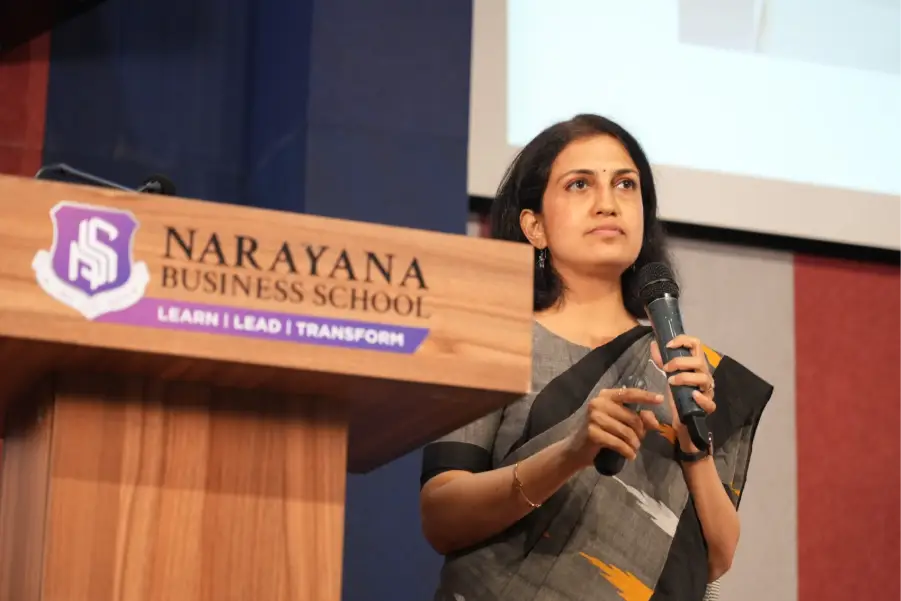





This op-ed was submitted by Asst. Prof. At Narayana Business School – Bindiya Dua
All of us are dreamers, every generation has them, but what actually separates the entrepreneurs from the rest is rarely talent or luck. It is always the one who begins. In India today, entrepreneurship is everywhere on television, in government speeches, in colleges. The ambition is real and this is the new India. But there’s a contradiction being observed from the inside. Contractions in the younger generation. It is like subscribing to gym membership on 1st January as a new year resolution but then quitting after one month.
This is the intention-action gap that social scientists have studied for decades. It is the gap between what people sincerely intend to do and what they actually do.
Bindiya Dua, Assistant. Prof. At Narayana Business School once asked her students if they wanted to become entrepreneurs. Below is her observation on the interaction:
In a classroom discussion, I asked my students how many of them wanted to become entrepreneurs. Almost every hand went up.
“Great,” I said. “When do you plan to start?”
The answers were familiar: “After working for a few years… after gaining experience.”
And if plans changed?
“We’ll decide later.” That “later” is where the real story lies.
India today is encouraging entrepreneurship like never before. Initiatives like Startup India and platforms such as Shark Tank India have made startups visible, respectable, and aspirational. Young people want to build something of their own.
Yet, many are not ready to begin.
In conversations with students, a pattern keeps emerging. Entrepreneurship is something they want but after stability. A job first, then maybe a venture. It sounds practical. But over time, this delay comes at a cost. The longer individuals wait to start, the harder it becomes to take that first step. Responsibilities increase; comfort deepens, and risk begins to feel heavier. What starts as a sensible plan to “wait” can slowly turn into a decision that is never acted upon.
This is where a deeper influence begins to show—upbringing. From an early age, many children are guided towards safety.
Take risks, but carefully.
Follow your passion, but have a backup.
These are caring messages. But they also shape how young people understand risk.
At the same time, failure is often something to avoid, not experience. Decisions are guided, not always explored. Over time, this limits the ability to act confidently in uncertain situations, the very situations where entrepreneurship begins.
A question I am often asked is whether too much change, new environments, new situations—makes it difficult for children to adjust.
It’s a valid concern. But it also assumes that stability is the only way to build confidence.
In reality, the ability to adapt can itself become a strength. When individuals learn to adjust, explore, and figure things out, uncertainty becomes less intimidating. It becomes something they can handle.
According to the Global Entrepreneurship Monitor (GEM) 2022/2023 Report, nearly 80% of Indian adults believe they have the skills and experience to start a business, and an almost identical proportion see good opportunities around them.
Yet only 20% expect to actually start a venture in the next three years. More striking still, over 60% of those who see good opportunities would not pursue them — for fear of failure.
Among 50 economies surveyed globally, India ranked third highest on this measure of fear-induced inaction, behind only China and Saudi Arabia.
Sometimes, in trying to make things easier, we make them too smooth. But confidence is not built on smooth roads. It is built like crossing a river—one step at a time, balancing on uncertain stones.
If we want more entrepreneurs, the answer may not lie only in policies or funding. It may lie in how we raise our children—how we allow them to make choices, face small failures, and deal with uncertainty early in life.
The new India is shifting and is one of the youngest nations in the world, with more than 65% of its population under the age of 35. This demographic structure presents both a challenge and an opportunity. Harnessing this youthful energy, intellect, and creativity can be the turning point in accelerating national development.
Read more: Role of youth in nation building
Because while the intention to become an entrepreneur is growing, the ability to act on it is shaped much earlier.
Connect with Asst. Prof. Bindiya Dua – https://www.linkedin.com/in/bindiya-dua-9ba903313/