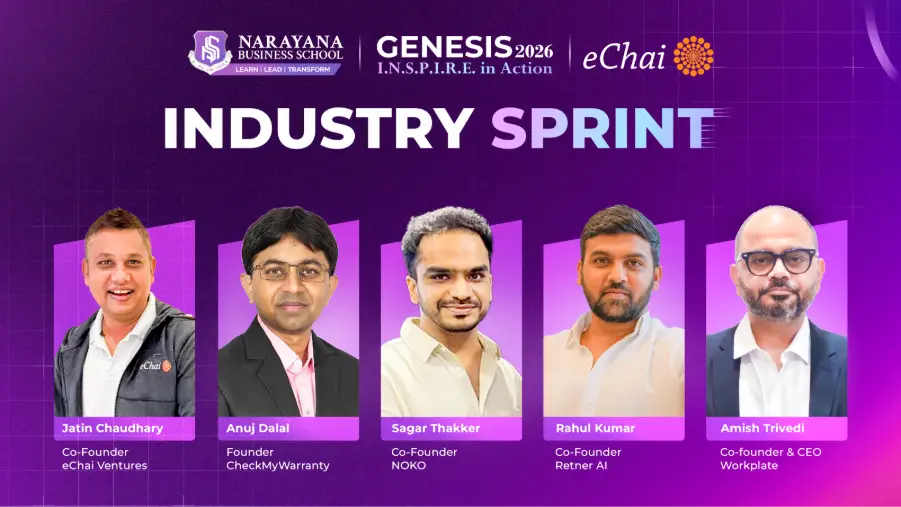
Solving Real Startups Problems Under 24 Hours: Genesis Sprint 2026

Before the sprint, each day of Genesis for the PGDM batch was dedicated to one value of the acronym I.N.S.P.I.R.E and we can conclude that each of those values were about raising awareness and gathering knowledge to set the tone for the journey ahead for the students.

But before the new students went back to their normal college time, we had something planned for them. Something on a execution level. 

Since the first two weeks were about raising awareness, Genesis Sprint 2026 was about putting that knowledge to actual test.

That was the premise behind the Genesis Industry Sprint 2026, the capstone experience of Genesis: I.N.S.P.I.R.E in Action.

For two days, the incoming PGDM Class of 2026–28 stepped away from presentations and theory to work on something far more uncertain.

Real business problems.

In collaboration with eChai Ventures, four startup founders walked into the NBS campus with challenges their companies are currently trying to solve. There were no case studies, no model answers, and no predefined framework.

Every team had just 24 hours.

Students had to understand the business, question assumptions, research the market, validate their ideas, use AI wherever required, and finally present their recommendations directly to the founders.

Every team was guided by a faculty mentor, but every solution belonged entirely to the students.

When the presentations concluded, each founder selected the solutions they believed had the greatest potential.

Challenge: How can Retner deliver an instant, high-touch WhatsApp support experience for thousands of D2C brands without proportionally increasing support headcount?

The founders selected two winning teams, each approaching the same problem from a different perspective.

Team Leader: Nalin Upadhyay

Team Members: Rudri Pandya, Nayan Jain, Sujata Patel, Kushal Tiwari, Tushar Parashar, Vedang Kothari, Sneha Singh and Shivam Goyal.

Faculty Mentor: Dr. Charmi Shah

The team proposed an Agentic AI-powered customer support system, demonstrating how intelligent automation can maintain personalised customer interactions while helping businesses scale efficiently.

Team Leader: Hardik Shivhare

Team Members: Nakul Pareek, Itisha Patel, Pranshu Vyas, Jayant Jain, Nisarg Bhensajaliya, Priyanshi Kotak and Prachi Doshi.

Faculty Mentor: Yashpalsinh Jadeja

Their solution focused on categorising customer queries based on urgency while introducing the Retner Community Club, creating a stronger customer engagement ecosystem alongside an efficient support structure.

Challenge: How can we make every household in India care about warranty management before something goes wrong?

Team Leader: Ruchi jain

Team Members: Tisha Parekh, Yagni Chovatiya, Kanika Gupta, Rahat Siddiqui, Sayyed Alfez Ali, Hardik Sharma and Gaurav Rathod.

Faculty Mentor: Dr.Hardik Brahmbhatt

The team presented a comprehensive strategy combining targeted digital marketing, personalised customer engagement, strategic partnerships, and an improved customer experience to strengthen both customer acquisition and long-term retention.

Challenge: How do we introduce the world’s first AI character for children in a way that children instantly love while parents instinctively trust?

Team Leader: Himanshi Singh

Team Members: Vishal Singhvi, Deeya Rathod, Asmita Tiwari, Bhakti Banwat, Sujal Allawadhi, Ridhima Jain, Aanya Shah, Sahil Bhavsar and Nimish Narang.

Faculty Mentor: Prof (Dr) Indra Meghrajani

The team’s recommendation was backed by customer research, surveys and a clear Segmentation, Targeting and Positioning (STP) strategy, helping balance two equally important goals, earning parents’ trust while creating excitement among children.

Challenge: Founder-led selling will get us part of the way. We now need a scalable sales playbook built from evidence, not intuition.

Team Leader: Vanshita Agrawal

Team Members: Divyansh Khandelwal, Ashutosh Sharma, Priyanshi Bairagi, Prachi Porwal, Rishika Shrivas, Sneha Dubey and Nupur Tiwari.

Faculty Mentor: Dr. Pragya Sharma

The team proposed bundled offerings, personalised sales journeys, customised product options and stronger compliance measures to help Workplate move beyond founder-led sales towards a scalable growth model.

We are proud of our incoming PGDM students for actively participating in the sprint and we congratulate all the winners. The Industry Sprint was never about finding the perfect solution. It was about learning how to approach a problem when the answer is unknown.

For many students, this was their first experience of working directly with startup founders, defending ideas, accepting criticism, changing direction, and presenting solutions under pressure.

Some teams won. Every team learnt. That is what made the Industry Sprint one of the most meaningful experiences of Genesis 2026. Because management is not learnt only by reading about businesses. Sometimes, it begins by helping build one.

Why Improving Communication Can Multiply All The Other Skills You Have: Genesis 2026

It is easy to think of communication as something that matters only during interviews, presentations, or public speaking. In reality, it influences almost every interaction we have. It shapes how we build relationships, work with teams, resolve disagreements, earn trust, and even how people remember us. Two people may have the same knowledge, but the one who communicates it more clearly often creates the greater impact.

This was the central message of Saumya Das, Chief Psychologist, NLP Global Trainer, and Founder of COUNSELLATION INDIA , during her session dedicated to communication at GENESIS 2026 at Narayana Business School. 

Genesis is a multi-day flagship orientation programme by Narayana Business School.

Follow the event here: https://www.linkedin.com/school/nbs-edu-in/

We were delighted to have her speak on the day of Genesis dedicated to skill development which was also one of the core values of I.N.S.P.I.R.E.

Rather than treating communication as a personality trait that some people naturally possess, she presented it as a skill that anyone can develop with awareness and practice. One of the first ideas she shared was surprisingly simple: before speaking, know why you are speaking.

Most conversations begin without much thought. We respond quickly, explain ourselves, or react emotionally without asking what we actually want to achieve. Saumya Das encouraged students to pause before important conversations and define their purpose. Are you sharing information? Are you making a request? Or are you trying to address a concern? When the purpose is clear, the conversation becomes clearer too.

This is one reason why misunderstandings happen so often. Many people focus on what they want to say instead of what they want the other person to understand.

As Saumya Das put it, “Communication is not just about expressing thoughts but also about creating understanding and removing misunderstandings.”

One of the most interesting parts of the session explored how our minds process information. Every second, our brain receives an enormous amount of information from the world around us, but only a very small part of it reaches our conscious attention. To make sense of everything, the brain filters information by deleting, distorting, and generalising what it experiences.

This explains why two people can witness the same situation and still walk away with completely different interpretations. Neither person is necessarily wrong. They are simply seeing the situation through different experiences, beliefs, and assumptions.

Understanding this makes communication more thoughtful. Instead of assuming that everyone thinks the way we do, we become more willing to ask questions, clarify our message, and listen without rushing to conclusions.

Another idea that stood out during the session was that “Communication is an exchange of energy.”

Long before people remember our exact words, they notice our tone, pace, confidence, and body language. They sense whether we are genuinely interested in the conversation or simply waiting for our turn to speak.

This is why building rapport matters. Saumya Das explained how simple things such as matching the other person’s pace, tone, communication style, or level of energy can make conversations feel more natural. It is not about copying someone or pretending to be someone else. It is about making the other person feel comfortable enough to engage openly.

Whether it is a classroom discussion, an interview, a networking event, or a workplace meeting, people connect more easily when they feel understood.

Perhaps the most unexpected lesson from the session was that good communication begins long before we start talking to someone else. The way we speak to ourselves influences the way we speak to the world. If our inner voice is constantly filled with doubt, fear, or self-criticism, it often shows in our confidence, body language, and interactions with others. On the other hand, when we develop a healthier internal dialogue, we naturally become calmer, clearer, and more confident in our communication.

This is why communication is not only an external skill. It is also an internal one.

As she said, “The quality of your communication determines the quality of your life.” While this may sound like a bold statement, it becomes easier to understand when we think about how many opportunities begin with a conversation. Friendships, internships, placements, mentorships, partnerships, and leadership opportunities all depend, in some way, on our ability to communicate with clarity and confidence.

Communication is often mistaken for talent. Some people appear to speak effortlessly, while others struggle to express themselves. But like every other skill, communication improves through observation and practice.

Every presentation, every group discussion, every difficult conversation, and every interview becomes an opportunity to improve. The goal is not to sound perfect. The goal is to become clearer, more thoughtful, and more aware of the people we are speaking to.

For students preparing to enter the professional world, technical knowledge will always matter. But knowledge creates value only when it can be understood, shared, and acted upon.

We extend our heartfelt thanks to Saumya Das for agreeing to do this with our students.

Leadership Lessons from ISRO: How High-Performance Teams Are Built

When people think of the Indian Space Research Organisation (ISRO), they usually think of rockets, satellites, and missions that make the country proud. What often goes unnoticed is the thousands of people working quietly behind every successful launch. Space missions are never the result of one brilliant individual. They are the outcome of teams that trust one another, follow disciplined processes, and stay committed to a common goal even when the odds are against them.

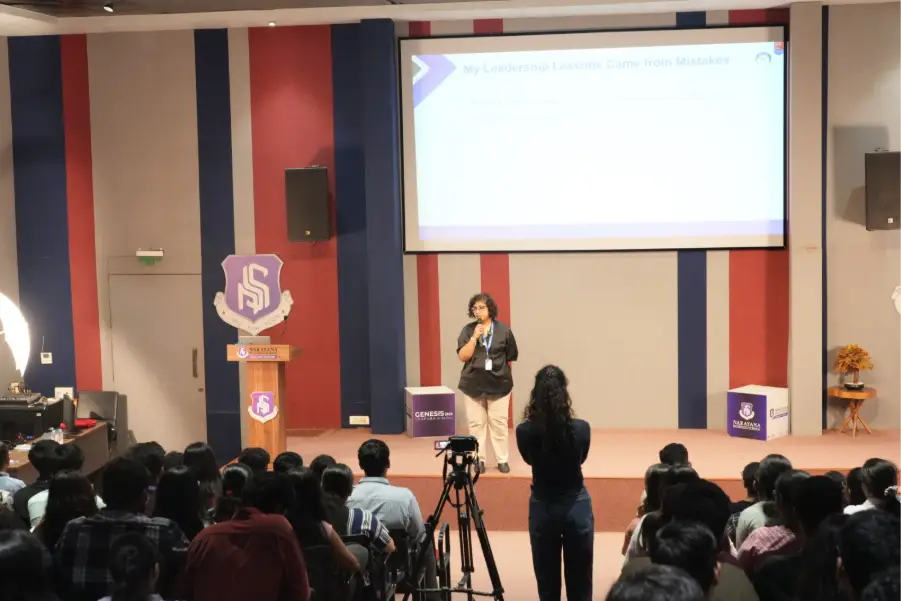
For the first time, Narayana Business School had the privilege of welcoming a scientist from ISRO to its campus as part of GENESIS 2026. Jyotsna Ladkani, who has spent over fifteen years designing advanced communication systems for India’s satellite missions, shared her experiences in a session titled “Leading High-Performance Teams: Lessons from ISRO’s Mission Success.” 

Today, she leads the development of next-generation RF ASIC technologies, including Digital Beamforming and Software Defined Radios, contributing to smarter and more efficient space communication systems. Her team’s recent work on an S-Band Trans-Receive Beamformer RF SoC has reduced the size, weight, and power consumption of earlier systems by nearly thirty percent.

While her work involves highly advanced technology, the lessons she shared had very little to do with engineering alone. They were lessons about people, leadership, and the culture that allows complex ideas to become successful missions.

One of the strongest messages from the session was that high-performing teams are built around a shared purpose. At ISRO, people are not simply working to complete another project or meet another deadline. Every mission contributes to something larger, whether it is improving communication, strengthening weather forecasting, supporting national security, or expanding scientific knowledge. When people understand why their work matters, they approach it differently. The mission becomes bigger than individual recognition, and that creates a stronger sense of ownership.

That sense of purpose also shapes the way challenges are approached. Space missions leave very little room for error, yet no organisation can completely avoid failure. What makes the difference is how failure is treated. Instead of becoming a reason to lose confidence, it becomes an opportunity to learn. Every setback is carefully reviewed, every mistake is understood, and every lesson is carried forward into the next mission.

As Jyotsna Ladkani said, “Failure should not be a setback; rather, it should be a stepping stone.” It is a simple thought, but one that applies just as much to students and professionals as it does to scientists. Progress rarely comes from getting everything right the first time. It comes from understanding what went wrong and making sure the same mistake is not repeated.

Another idea that stood out during the session was the importance of staying solution-oriented. In every organisation, people encounter problems, limited budgets, tight deadlines, and unexpected obstacles. Spending too much time discussing the problem rarely moves the work forward. High-performing teams develop the habit of asking a different question: What can we do with what we have?

This mindset was reflected in another piece of advice from Ladkani: “Manage things with available resources.” It is easy to believe that better results always require bigger budgets or better tools. ISRO’s journey has shown that thoughtful planning, disciplined execution, and smart use of available resources can achieve remarkable outcomes. Constraints often encourage innovation because they force teams to think differently instead of depending on ideal conditions.

Scientist at ISRO visits Narayana Business School

The discussion also highlighted something that is often overlooked in conversations about leadership. Great teams are not built by expecting one person to know everything. They are built by bringing together people with different strengths, giving them clear responsibilities, and helping them work towards a common objective. Engineers, scientists, project managers, quality experts, and many others contribute to every mission. Success comes from how well these different pieces fit together, not from individual brilliance alone.

This is why collaboration remains one of the most valuable leadership skills. High-performance teams communicate openly, review each other’s work, and solve problems together. Accountability exists, but it is not built on blame. It is built on trust, learning, and a shared commitment to achieving the mission.

Quality was another recurring theme throughout the session. In industries where the cost of failure is extremely high, there is no shortcut to excellence. Every process is reviewed, every system is tested, and every detail is examined before a mission moves forward. This focus on quality is not about perfection for its own sake. It is about reducing avoidable mistakes through preparation, discipline, and continuous improvement.

The same principle applies far beyond space research. Whether someone is building a business, managing a project, writing software, or working in finance, consistent quality comes from good systems rather than last-minute effort. Strong processes may not always be visible, but they are often the reason successful outcomes appear effortless.

Ladkani also spoke about the importance of balance. High performance is often misunderstood as working endlessly without rest. Sustainable performance is different. It requires people to manage their time well, continue learning, and take care of themselves so that they can perform consistently over the long term. Burnout may produce short bursts of productivity, but it rarely supports lasting excellence.

Perhaps the most memorable advice from the session was also the simplest: “Always have a never-giving-up attitude.” Behind every successful mission are years of preparation, testing, redesign, setbacks, and perseverance. The achievements the world celebrates are often the result of work that remained invisible for a very long time.

As students prepare for their own careers at Narayana Business School Ahmedabad, the principles that guide organisations like ISRO remain relevant everywhere. A clear purpose, disciplined execution, continuous learning, teamwork, resilience, and the ability to keep moving forward after failure are not qualities reserved for scientists. They are qualities that help people succeed in every profession.

Space missions may begin on a launch pad, but their success begins much earlier with people who believe in the mission, trust one another, and refuse to give up when the work becomes difficult.

That may be ISRO’s greatest lesson of all.

How To Think Like a Founder in 2026: Genesis 2026 At Narayana Business School

When people hear the word entrepreneurship, they often think about funding rounds, startup valuations, or building the next unicorn. But the truth is, entrepreneurship begins much earlier than that. It begins with the way a person observes the world around them.

Every successful business exists because someone noticed a problem that others had accepted as normal. They asked why things worked the way they did, questioned existing solutions, and believed there was a better way. That ability to notice problems before thinking about products is what separates a founder’s mindset from everyone else’s. 

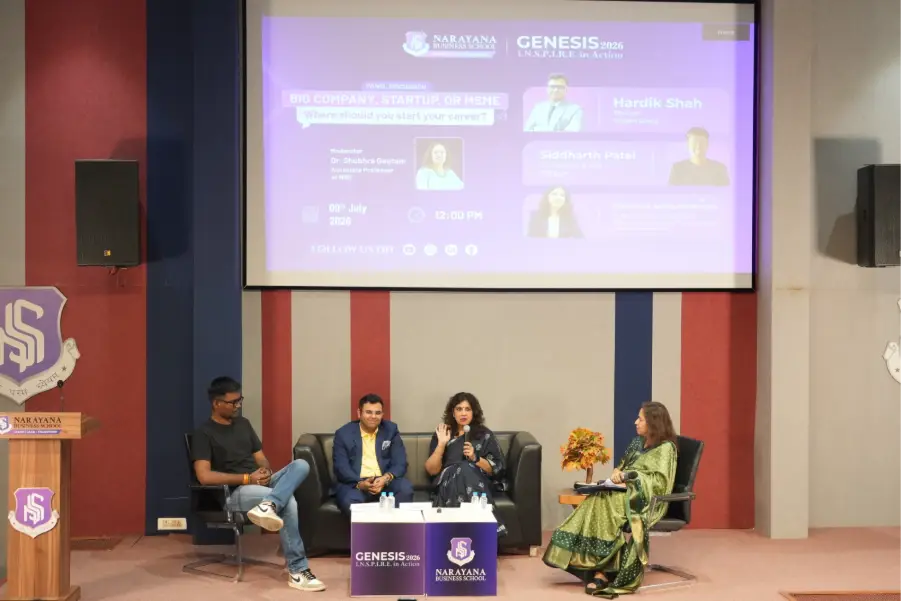
This idea formed the heart of the panel discussion, “Think Like A Founder: Cultivating An Entrepreneurial Mindset,” held in collaboration with eChai Ventures during GENESIS 2026 at Narayana Business School.

Bringing together entrepreneurs from different industries, the discussion featured Jatin Chaudhary of eChai Ventures, Sahil Shah from Petpooja, Umesh Uttamchandani of DevX, Syed Nadeem Jafri of HeartyMart, Khyati B. from Rocket, and Aditya Shah, Founder and CEO of Because. While each speaker had built a business in a different space, their journeys pointed towards the same lesson i.e., businesses succeed when they solve problems that people genuinely care about.

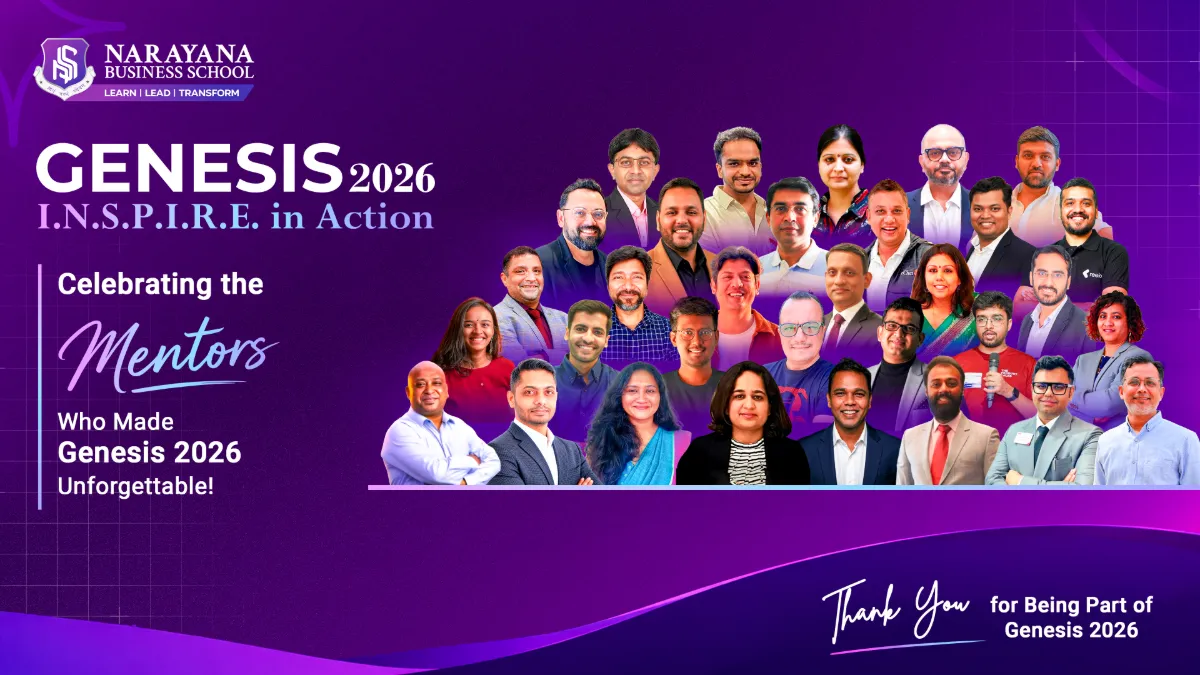
“One the inaugural day of Genesis 2026, we had Vatsal Shah, Founder of Pragmatic Consultancy speaking on what every MBA student must know before 2028 at Genesis”.

One of the biggest myths around entrepreneurship is that it starts with a great idea. The panel challenged this belief. An idea, by itself, has very little value if it doesn’t solve a real problem. Before building a product, investing money, or thinking about growth, founders must first understand the people they are trying to serve.

What are their challenges? What frustrates them? What are they willing to pay to solve? The answers to these questions matter far more than having an exciting business concept.

That is why validation came up repeatedly during the discussion. Many first-time entrepreneurs fall in love with their own ideas and spend months building products without knowing whether anyone actually needs them. The founders on the panel encouraged students to do the opposite. Start small, speak to customers, test your assumptions, gather feedback, and improve continuously. A simple pilot project or a basic version of a product often teaches more than months of planning. 

The discussion also reminded students that entrepreneurship is rarely about having unlimited resources. Most successful businesses begin with limitations. Instead of waiting until everything is perfect, founders learn to work with what they have.

They outsource where needed, focus on their core strengths, and grow only when they know the business is ready. Building slowly is often more sustainable than growing quickly without direction.

Every panellist, in one way or another, highlighted the importance of practical exposure. Internships, startup projects, networking events, competitions, and conversations with founders expose students to challenges that no textbook can fully explain. These experiences teach people how businesses operate, how customers think, and how decisions are made when there are no perfect answers.

The conversation naturally moved towards artificial intelligence, a topic that is shaping almost every industry today. While the panel agreed that AI will continue to improve efficiency and change the way businesses function, they also believed that it should be seen as a tool rather than a replacement for human capability.

Another interesting perspective came from the founders who spoke about growth. From the outside, entrepreneurship often looks like a race to expand as quickly as possible. The discussion offered a different view. Sustainable businesses are built on strong fundamentals. Healthy cash flow, profitability, customer trust, and disciplined decision-making matter far more than chasing growth for the sake of appearances. Markets may celebrate rapid expansion, but businesses survive because they create consistent value over time.

This is perhaps one of the most important lessons for young entrepreneurs today. Social media often celebrates success stories without showing the years of learning, mistakes, and persistence behind them. The founders spoke honestly about adapting their business models, listening to customers, and changing direction whenever required. Flexibility, they suggested, is not a weakness. It is one of the biggest strengths an entrepreneur can develop.

Although the discussion focused on entrepreneurship, its lessons apply far beyond starting a business.

Perhaps that is the biggest takeaway from the session. Thinking like a founder is not about deciding to start a company after graduation. It is about becoming the kind of person who notices opportunities where others see obstacles, who asks better questions instead of accepting easy answers, and who remains curious enough to keep learning.

Businesses will continue to evolve. Technology will continue to change. Industries that exist today may look completely different a decade from now.

That journey does not begin with raising capital or launching a startup. It begins with a mindset, and like every mindset, it can be developed long before someone calls themselves an entrepreneur.

We thank the entire panel for coming together and stitching the dots for our students to understand and learn on “how to think like a founder” at Genesis 2026 I.N.S.P.I.R.E in Action.

Follow the Event here: https://www.linkedin.com/school/nbs-edu-in/

What Every MBA Student Needs to Know Before 2028: Preparing For The Real World

By the time today’s students graduate in 2028, the world they step into will look very different from the one they imagined when they first entered college. Artificial intelligence is no longer a futuristic idea; it is already changing how businesses operate, how teams work, and how companies hire. Jobs are evolving, new roles are emerging, and routine tasks are becoming increasingly automated.

In the middle of all this change, one question becomes more important than ever: What will make someone valuable in the years ahead? 

This was the question that shaped Vatsal Shah’s session, “2028 Calling: Prepare for the Real World,” at GENESIS 2026 at Narayana Business School.

Follow The Entire Event Here: https://www.linkedin.com/school/nbs-edu-in/

A Business Catalyst, CEO Coach, and Founder of Pragmatic Consultancy, Shah has spent more than two decades working closely with businesses across IT, digital, eCommerce, and retail, coaching over 200 CEOs and training more than 16,000 professionals. Instead of asking students to worry about the future, he encouraged them to understand it and prepare for it with the right mindset.

Shah summed it up in a single line: “People who can think and solve are the ones who will have careers. For the rest, I have AI.”

While the statement may sound blunt, it reflects a reality that is already taking shape. AI is becoming exceptionally good at handling repetitive work, analysing information, writing content, generating code, and completing tasks that once required hours of human effort. What it cannot replace is human judgement, curiosity, and the ability to understand why a problem exists in the first place. Businesses will always need people who can ask better questions, make decisions with incomplete information, and find solutions that create real impact.

At the same time, Shah cautioned students against assuming that AI makes learning less important. In fact, he argued the opposite. Technology can make work faster, but it cannot replace strong fundamentals. Whether someone wants to build a career in finance, marketing, operations, analytics, or technology, understanding the basics remains essential. AI can provide answers, but without conceptual clarity, it becomes difficult to judge whether those answers are useful, accurate, or relevant. The better a person’s fundamentals are, the more effectively they can use AI as a tool rather than becoming dependent on it. 

As he put it, “You are at the age of exploration. Of 10 things you explore, 4 will fail, 3 will give moderate results, 2 will give good, but 1 will be your moonshot.”

There is an important lesson hidden in that thought. Failure is not the opposite of success; it is often the path that leads to it. Every internship, competition, project, conversation, or side hustle teaches something valuable, even when it doesn’t produce immediate results. The students who keep exploring are usually the ones who eventually find work that is meaningful because they have given themselves the chance to learn what they enjoy and where they can contribute the most. 

The session also challenged the way many young people think about careers. It is easy to choose a profession because it is popular or because it promises a high salary. Shah encouraged students to look beyond short-term rewards and think about where they can create long-term value. Industries will continue to change, technologies will evolve, and market demands will shift. Building a sustainable career, therefore, is less about chasing trends and more about developing skills that remain useful regardless of how the market changes. The ability to learn continuously, adapt to new situations, and solve meaningful business problems will always be in demand.

Mindset, according to Shah, plays an equally important role. Technical knowledge can open opportunities, but discipline, responsibility, and resilience determine whether a person can make the most of them. Careers are rarely shaped by one extraordinary achievement. They are shaped by everyday decisions—choosing to learn instead of procrastinating, taking ownership instead of making excuses, and staying consistent even when progress feels slow. 

This idea was reflected in another one of his observations: “You are the outcome of choices you made.”

Shah also reminded the incoming batch of PGDM students 2026-28 that growth is not about becoming satisfied with being good. “Good is not good when better is possible,” he said, encouraging them to keep improving even after they achieve their initial goals.

Perhaps the most thought-provoking line from the session was, “You are walking towards death, not birth. We seed today for fruits tomorrow.” It was not a pessimistic statement but a reminder that time never stands still.

As students prepare for 2028, the conversation can no longer be limited to placements, job titles, or salary packages. Those milestones matter, but they are outcomes, not the starting point. The real preparation begins much earlier by building strong fundamentals, embracing technology without becoming dependent on it, staying curious enough to keep learning, and developing the ability to solve problems that matter. The future will undoubtedly belong to AI in many ways.

But it will always have room for people who can think independently, understand people, take ownership, and create solutions that machines cannot. Preparing for that future does not begin after graduation. It begins with the choices students make today.

Ahmedabad Is India’s Best Career Bet Right Now in 2026

Most MBA students finishing their degree default to Bangalore, Mumbai, or Delhi. The logic is straightforward and does make sense i.e., that’s where the consulting firms, the BFSI roles, and the tech companies are. But career decisions aren’t just about where the jobs are today, they’re also about were leverage builds fastest. And on that measure, Ahmedabad is worth a much harder look than most people give it.

In a recent podcast episode, Yash Shah, who founded The Address, a managed office and coworking company now present across 14 Indian cities, and who built a ₹150 crore revenue business starting at age 21, said something that cuts to the heart of it: “If you can sell in Ahmedabad, you can sell anywhere in the world.” He was talking about how price-sensitive and demanding the market here is. But the flip side is equally true, which is a market that demands sharper professionals, faster. 

So, if you’re an MBA student deciding where to put your next five years, here’s what the data and the people building here actually say.

Population growth sounds like a boring statistic until you connect it to what it actually means on the ground. 

Ahmedabad’s population, which used to hover around 70 lakh, has now crossed 1.1 crore in the city proper. The metro area is already past 90 lakh and heading toward one crore by most estimates, growing at roughly 2.35% annually according to MacroTrends data, consistently, year after year. Gujarat as a state tells a similar story. As Yash Shah pointed out on the podcast, the state had about 4 crore people in 2011. By 2026, it’s approaching 8 crores. In 15 years, the state nearly doubled its population.

We are witnessing a pure migration of people and interest to Ahmedabad, terming it as just a population growth of a city might be an understatement. 

For a professional thinking about where to build a career, the direction of the migration curve matters as much as the absolute number. You don’t want to move to a city at its peak, competing for everything against decades of entrenched networks. You want to be in a city while it’s building those networks and while your early presence still counts for something.

The Ahmedabad Municipal Corporation boundary itself has expanded from 186 sq km in 2006 to nearly 466 sq. km today. The city is physically growing, new neighbourhoods are forming, and that means new demand for housing, for offices, for services, for skilled professionals who know how to operate in a growth environment. That’s a job market in the making, not one that’s already closed.

The BRTS has been operational for over a decade and is one of the few genuinely working bus rapid transit systems in India. The metro’s Violet Line now connects GNLU to GIFT City. The outer ring road and the new outer ring road have transformed how the city sprawls, making areas that were on the periphery five years ago now functionally central. Gandhinagar, which was a quiet government administrative town not long ago, is now being discussed in the same conversations as Southeast Asian smart cities.

GIFT City – Gujarat International Finance Tec-City sits between Ahmedabad and Gandhinagar on 880 acres, and it’s worth spending a moment on what it actually represents. It’s India’s first operational greenfield smart city, built with underground utility tunnels that eliminate the need for digging, a district cooling system, automated waste management, and 24/7 high-speed fibre connectivity. It holds India’s first Platinum rating under IGBC Green Cities. 

The commercial real estate numbers tell part of the story clearly. According to Knight Frank India’s report for the second half of 2024, Ahmedabad recorded 3 million square feet of office transactions in 2024, a 64% year-on-year growth, the highest volume ever recorded in the city in a single year. Total Grade A office stock now stands at 30.5 million sq ft, with nearly 9.7 million sq ft more projected by 2030. Rents for prime office space grew 25.5% according to CRE Matrix’s mid-2025 report. GIFT City alone accounted for 82% of Planned Business District transactions in the second half of 2024.

Yash Shah’s comparison is the right one: people questioned BKC for decades before it became what it is. Infrastructure stories don’t resolve in two years. They resolve in ten to fifteen. The question is whether you position yourself before the resolution or after.

Whenever people hear “Ahmedabad job market”, the few initial thoughts that pop up are textiles, chemicals, pharmaceuticals, real estate. Traditional industries, solid but not where MBA graduates typically imagine landing. But here’s again a ground reality which future MBA aspirates and young professionals should consider. 

The Ahmedabad–Gandhinagar–GIFT City belt ranked number one among 20 Tier-II cities for GCC ecosystem readiness, according to global consultancy Zinnov’s 2024 report. The region currently hosts over 35 Global Capability Centres and Global In-House Centres, more than 25 service providers, and 60+ startups, making it the largest GCC hub outside Tier-I cities. Companies like Infineon Technologies, Technip Energies, HSBC, Cognizant, and Hexaware have all entered or significantly expanded in the past two years.

For MBA graduates specifically, the GIFT City IFSC framework is particularly relevant. The zone is purpose-built for financial services i.e., banking, asset management, fintech, aircraft leasing, hedge funds, and alternative investment funds operating under a regulatory environment designed to be globally competitive. There are 177 fund management entities and over 270 funds registered in GIFT IFSC today, with Category-III AIF commitments nearly tripling within a year. The funds ecosystem within GIFT IFSC alone is projected to cross $100 billion by 2030. HSBC leased 0.18 million sq ft at Westpark in the Central Business District. The BFSI sector accounts for 56% of all Grade A office leasing activity in the city right now, followed by IT/ITES at 30%.

That last number deserves to be read twice. More than half the prime office space being leased in Ahmedabad is going to banking and financial services firms. This is not the job market of ten years ago. 

Yash Shah put the broader picture well: when you think of Pune, you think IT and automobiles. When you think of Hyderabad, you think IT and financial services. When you think of Chennai, you think automobile manufacturing. Ahmedabad is increasingly a city with all of these in some form, without being dominated by any single one.

Outside GIFT City, the Sanand GIDC corridor automotive, chemicals, heavy manufacturing, creates sustained demand for supply chain, operations, and general management professionals. Gujarat’s GCC Policy for 2025–30 is targeting 250 new GCCs, 50,000 new jobs, and ₹10,000 crore in fresh investment. Those are policy commitments backed by fiscal incentives: a 10-year income tax holiday under Section 80LA for IFSC units, EPF reimbursement under Gujarat’s IT/ITeS policy, lease rental subsidies, and power subsidies. 

Ahmedabad has IIM Ahmedabad, which ranked first in India under NIRF’s 2025 management category. There’s MICA Ahmedabad, one of India’s strongest communication schools. There’s Narayana Business School, consistently delivering 100% placements with over 670 recruiters visiting the campus including some of the prominent names like Deloitte, PwC, S&P Global, and L&T. NBS also offers India’s first PGDM in Quantitative Finance, a niche that feeds directly into GIFT City’s growing financial services demand. The National Institute of Design is headquartered here and like such many other great institutions are strategically positioned in Ahmedabad.

Ahmedabad’s cost of living is roughly 40% cheaper than Mumbai and about 11–16% cheaper than Bangalore, based on cost comparison data from 2025–26. Rent for a decent 1 BHK falls between ₹7,000 and ₹15,000 a month in most parts of the city. A single professional can live comfortably, rent, food, transport, and some lifestyle spending on ₹30,000–₹40,000 a month. 

Now do the maths on what that actually means for someone drawing an early-career salary of ₹12–18 LPA. In Mumbai or Bangalore, the majority of that salary disappears into rent, food costs, and commute expenses before any meaningful saving or investing happens. In Ahmedabad, you’re left with a real surplus, money that can go into upskilling, building a side project, or simply buying yourself the financial cushion to take career risks that a hand-to-mouth existence in a metro city doesn’t allow. 

The professional who can afford to walk away from a bad job, take a startup bet, or invest in a certification isn’t more talented than the one who can’t, they just have more room to manoeuvre. Ahmedabad creates that room in a way that Mumbai and Bangalore structurally don’t for early-career professionals.

The same logic applies at the entrepreneurial level. Yash Shah started The Address with ₹2 crore in capital. In Mumbai or Bangalore, that amount would have been absorbed by real estate costs before the product got off the ground. In Ahmedabad, it gave him enough runway to build, test, iterate, and reach profitability. He went on to build a ₹150 crore revenue business from that starting point. 

Yash Shah made a distinction worth sitting with: “Gujarat mein log company kholte hain. Bahar log organisation banate hain.” (In Gujarat, people open companies. Elsewhere, people build organisations.) His point wasn’t a criticism; it was an identification of a gap. And if you’re an MBA graduate who thinks in terms of systems and scale, that gap is an opportunity. India is expected to host more than 200,000 startups by 2030, and roughly half of today’s 115,000 registered startups sit outside the metros and with emerging cities like Ahmedabad increasingly emerging as their base, partly because operating costs run 25–30% below metro averages according to Mordor Intelligence’s 2026 report.

The startup ecosystem here is less crowded than Bangalore or Delhi. That’s a genuine first-mover advantage for someone willing to plant a flag early. The networks you build in an emerging ecosystem carry more weight than the ones you’d be one of thousands building in a saturated market.

Early relationships with the right people here, developers, manufacturers, GCC heads, government officers are relationships that will compound over the next decade as the city grows into its own.

And on pure capital efficiency Yash Shah built a ₹150 crore revenue business starting with ₹2 crore. That same ₹2 crore in Mumbai or Bangalore would largely disappear into real estate before the product found its footing. 

Nobody knows exactly how any city’s future plays out. But the inputs are visible, and they’re pointing clearly in one direction. Yash Shah’s view, stated plainly on the podcast, is that the next ten years belong to Ahmedabad. But not because of hype, he’s a person who operates across 14 cities and comes back to the same observation: the fundamentals here are harder to find elsewhere at this price point. The BKC comparison is the most honest framing for what’s happening at GIFT City. BKC was questioned for fifty years before it became India’s pre-eminent financial district. The people who dismissed it early on missed the window. The people who showed up before the window closed built things that now have real value.

Inquire for Narayana Business School: https://nbs.edu.in/quick-enquiry/ 

This blog draws on insights from the Masum Gandhi Podcast episode featuring Yash Shah, Founder of The Address and MD of True Value Nirman Pvt. Ltd., supplemented with publicly available data.

When India Stopped Sending Its Money Abroad: Enter GIFT City Gujarat

There’s a burning question that doesn’t get asked enough in business schools: why do so many Indian startups quietly move their headquarters to Singapore or abroad? 

It’s not because the founders stop believing in India. It’s because the system makes it expensive to stay.

This is the uncomfortable truth that ThinkSchool’s video on GIFT City puts on the table and it’s the kind of conversation that every MBA student should be having, because it sits right at the intersection of taxation, capital markets, startup policy, and global competitiveness. Four things you’re studying right now, playing out in real life, in a city being built from scratch in Gujarat.

This will help higher-ed students looking to move into Gujarat, professionals who are considering Gujarat and Ahmedabad as their work destination and families who want to forecast the potential of Gujarat give a clear idea of why GIFT city Gujarat is a gamechanger for India.

Let’s start with taxes. India’s average corporate tax rate is around 25%. Dubai’s is 0%. Singapore’s is 17%. On paper, that gap doesn’t sound catastrophic. But when you’re a startup making ₹100 crore in profit, that difference runs into tens of crores every single year. 

So, founders found a workaround. They’d set up a holding company in Singapore, transfer their intellectual property there, and then have their Indian entity pay royalties back to the Singapore parent. Suddenly, the taxable profit in India drops dramatically. The tax burden shifts to Singapore where the rate is lower. Net result — the company saves money, but India loses it.

This is called startup flipping, and it’s not illegal. It’s just rational. And that’s what makes it a policy problem rather than a moral one.

Then there’s the legal system. If you’re a tech company and someone steals your IP, you want the matter resolved fast because in technology, six months of delay can make a product irrelevant. In Delaware, USA, a corporate dispute can be resolved in three to eighteen months. In India, the same case can take four to six years. With over 40 million cases pending across our courts, corporate IP disputes sit in a queue alongside everything else. So, companies that can afford to register outside India.

And then there’s international banking. An Indian food chain wanting to expand to New York needs a dollar loan. American banks don’t know them, don’t trust them, and won’t lend easily. Indian banks that tried solving this by opening foreign branches found it prohibitively expensive and the jobs and tax revenue those branches generated stayed abroad anyway.

Four problems. Taxes. Legal speed. Overseas banking. Access to global capital markets. They seem unrelated until you realise they all point to the same root cause: India didn’t have a financial infrastructure that could compete internationally. Until now.

GIFT City — Gujarat International Finance Tec-City is India’s first International Financial Services Centre (IFSC). Located in Gandhinagar, it operates as a legally offshore zone within Indian borders. Think of it as India creating its own Singapore, on Indian soil, under Indian oversight.

The implications of that are significant.

A company setting up in GIFT City’s IFSC zone is treated as a foreign entity under Indian forex laws which means it gets access to a completely different regulatory environment. A 10-year tax holiday out of 15 years. No GST and no stamp duty. Single window clearance instead of running between departments. For a student who’s sat through even one session on regulatory compliance, you’ll immediately appreciate what single window means in practice.

On banking, Indian banks can now set up International Banking Units inside GIFT City itself, instead of expensive foreign branches. These units can lend in dollars, manage cross-border transactions, and support Indian businesses going global, all while the revenue, jobs, and taxes stay within India. It sounds like a small structural change. The economic impact is anything but.  

On capital markets, GIFT City now has its own international exchange. Indian investors can buy Apple or Tesla shares through a broker in Gandhinagar. Foreign investors can trade Indian stocks on the same exchange. The depository receipts that used to be traded in New York can now be traded right here — with Indian regulatory protection instead of having to depend on a foreign broker who, if things go wrong, Indian law cannot touch.

And on legal disputes, GIFT City has tied up with the Singapore International Arbitration Centre. Corporate disputes can now be resolved quickly, by specialists, without joining the 40-million-case queue.

The thing about studying business and management in 2026 is that the India you envisioned is not the same anymore. India has changed its trajectory and heading towards a better economy. The boundaries between domestic and international finance are blurring. The startup you join after campus, or the one you build three years later, will face decisions that GIFT City directly affects. This is what we train students for at Narayana Business School. 

Do you incorporate in India or flip to Singapore for better VC terms? Do you list domestically or raise from American markets? Where do you park your treasury if you’re running a fund? These aren’t hypothetical case study questions anymore. They’re real decisions, and GIFT City changes the calculus on all of them. 

There’s also a broader macro lens worth developing. India’s ambition is to be a $5 trillion economy. That doesn’t happen through manufacturing alone. It needs capital, global capital, flowing in and being deployed efficiently.

GIFT City Gujarat is the infrastructure layer that makes that possible. Understanding it isn’t just general awareness; it’s financial literacy for the world you’re about to enter.

GIFT City is not finished. Gandhinagar is not Dubai yet, and pretending otherwise would be dishonest. But the foundation is real. 

And 11 years later, here is what that vision looks like in numbers:

  • 1,150+ entities registered with IFSCA 
  • Banking sector at $106 billion 
  • Capital markets ecosystem at $80 billion  
  • 37 banks, 65 insurance entities, 35 aircraft leasing firms  
  • 20,000+ jobs created today, expected to cross 1,00,000 by 2030  
  • Global firms including HSBC, IBM, Oracle and Google operating here 

And the city has just 1 regulator, IFSCA, which handles everything from banking, markets and to insurance. Not just that, global universities including Deakin University, Coventry University and Queen’s University are entering India through GIFT City. 

And the world has noticed.  GIFT City is now ranked 1st globally in Reputational Advantage in the Global Financial Impact Centres Index and 5th among the world’s top emerging financial centres. For decades, India created wealth that got processed somewhere else.

MBA Admission Without CAT/XAT in India: Complete 2026 Guide for Students

Every year, lakhs of students prepare for CAT with the dream of getting admission into a top MBA college. The competition is intense, the pressure is high, and the preparation process can take months or even years. However, one important thing that students must understand is that CAT is not the only pathway toward a successful management career.

Today, many students are exploring MBA admission without CAT through alternative entrance exams, institute-level assessments, and direct admission processes. In fact, several reputed PGDM and MBA colleges in India now offer flexible admission pathways for students who want quality education without depending entirely on one national-level exam.

If you are looking for MBA admission without entrance exam or searching for MBA colleges without CAT, this guide will help you understand the complete process, available options, and why institutes like Narayana Business School are becoming a preferred choice among management aspirants. 

One of the most common questions students ask is: “Can I do MBA without CAT?” The answer is yes. CAT is one of the most recognized MBA entrance exams in India, but it is not compulsory for every MBA or PGDM college. Many private institutions and autonomous business schools offer admissions through:

  • Institute-level entrance exams like NBSAT from NBS Ahmedabad
  • Direct MBA admission processes
  • Profile-based selection
  • Other national exams like XAT, NMAT, CMAT, and MAT 

This means students today have multiple opportunities to pursue management education even if they do not appear for CAT. Over the last few years, MBA admissions in India have become more flexible and skill oriented. Colleges are now focusing on soft skills, analytical thinking, leadership ability, and overall student potential instead of depending only on a single exam score.

The demand for MBA without entrance exam in India is increasing rapidly. There are several reasons behind this shift.

Nearly 3 lakh students register for CAT every year, making it one of the most competitive entrance exams in the country. However, only a limited percentage of student’s secure seats in top MBA colleges in India.

Many capable students miss opportunities simply because they could not achieve a very high percentile in one examination. 

Many students do not want to spend another year preparing only for entrance exams. They prefer institutions where they can begin their management journey immediately through direct admission MBA colleges or institute-level assessments.

Modern management education is changing. Companies today look for communication ability, problem-solving skills, adaptability, leadership, and practical exposure.

As a result, many MBA colleges without CAT are focusing more on overall student profiles instead of only entrance exam performance.

Alternative admission pathways help fresh graduates, working professionals, entrepreneurs and students from diverse academic backgrounds. One of the major learning points of joining NBS Ahmedabad is that it hosts students from 25+ states and UTs.

This flexibility has also led to the increased interest in PGDM admission without entrance exam and direct MBA admission in India.

Students who are searching for MBA without XAT or MBA without CAT should know that several alternative pathways exist today.

Apart from CAT, students can appear for: 

  • NBSAT
  • XAT
  • NMAT
  • CMAT
  • MAT
  • SNAP 

These exams provide additional opportunities for students to secure MBA or PGDM admission in reputed institutions. However, many students now prefer colleges that conduct their own entrance assessments because these exams are often designed around practical aptitude and management potential. Several reputed business schools conduct their own admission assessments for students seeking MBA admission without CAT. These exams evaluate students on logical reasoning, communication skills, quantitative aptitude, leadership potential and career orientation.

If you have appeared for CAT MBA exam and wish to apply at NBS via CAT scores, the gateway is open. Follow the link.

As the MBA landscape evolves, students are now looking beyond traditional entrance exam pressure and focusing more on career outcomes, practical learning, and industry exposure.

This is where Narayana Business School has created a strong position. Narayana Business School offers admission opportunities through NBSAT, an entrance assessment designed to evaluate students beyond just memorization and percentile competition.

For students searching for MBA admission without CAT, PGDM without CAT, MBA without XAT, direct MBA admission India and MBA colleges without CAT, we have a solution.

The Narayana Business School Aptitude Test (NBSAT) is a digitally proctored entrance exam curated for aspiring management leaders of tomorrow. Unlike conventional aptitude tests, NBSAT goes beyond numbers and logic, it evaluates a candidate’s aptitude, leadership readiness, creativity, ethics, and decision-making abilities. Conducted online with AI-enabled proctoring, candidates can take the test from the comfort of their homes while ensuring a secure, transparent, and fair assessment experience.

Ahmedabad has rapidly emerged as one of India’s major education and business hubs. It is the dubbed as the financial capital of Western India and the business capital of Gujarat.  The city offers a strong ecosystem for management students because of its growing corporate environment, startup culture, and industrial presence.

As a result, many students are now searching for MBA colleges in Ahmedabad without CAT and PGDM colleges in Gujarat without entrance exam.

Among the institutions gaining attention in this space, Narayana Business School has built a strong reputation for industry-oriented management education.

NBS Ahmedabad has diverted it’s all its focus to providing the gold standard of education (ASSCB and BGA member) coupled with experiential learning where students go beyond academics and theory and practice the learned concepts in real life.

One such recent example is where we gave the students of NBS, a task to build an app from scratch. Students used AI for coding and built a weather app. But there was one important condition. The app had to understand the user’s language and respond accordingly. For example, if a user entered “Ahmedabad,” the weather forecast would be generated in Gujarati. If someone used a voice command and said “Calcutta,” the application would automatically respond in Bengali both in text and voice format. The results were amazing.

Choosing an MBA without CAT does not mean compromising on career growth. In many cases, students can access quality education and career opportunities through alternative admission routes.

Students can focus more on learning and career planning instead of spending excessive time preparing for one examination.

Direct admission pathways help students begin their MBA or PGDM journey earlier and enter the job market faster.

    Many talented students from smaller cities or diverse academic backgrounds get access to quality management education through institute-level exams and direct admissions.

    Several modern business schools are now emphasizing practical learning, industry projects, certifications, internships, and placement preparation instead of purely theoretical education.

    Institutions like Narayana Business School are aligning their programs with evolving industry expectations and business trends.

    Students should always evaluate a college carefully before applying for direct MBA admission India.

    Important factors include:

    Check whether the institution and program have proper approvals and recognition.

    A strong MBA or PGDM program should provide:

    • Corporate interaction
    • Live projects
    • Internships
    • Industry mentorship

    Career support and placement training play a major role in management education.

    Students should choose institutions that update their curriculum according to changing business trends and industry requirements.

    Modern MBA education should help students improve:

    • Communication
    • Leadership
    • Analytical thinking
    • Business decision-making
    • Problem-solving ability

    Narayana Business School has positioned itself around these industry-focused learning outcomes, making it a strong option for students looking beyond conventional MBA admission methods.

    Today, students are not only searching for degrees. They are searching for employability, exposure, and long-term career growth. Narayana Business School has built its admission and academic ecosystem around this changing mindset.

    Through NBSAT, the institution offers students an opportunity to pursue management education through a more practical, skill-oriented, and accessible process.

    For students searching online for:

    • MBA colleges without CAT 
    • MBA admission without entrance exam
    • PGDM without CAT score India
    • Direct MBA admission Ahmedabad
    • MBA without CAT low fees colleges

    Narayana Business School has emerged as a strong alternative for career-focused management education. Its emphasis on industry integration, career preparation, and student development continues to attract aspiring management professionals from across India.

    CAT is an important MBA entrance exam, but it is not the only route toward a successful management career. The Indian MBA ecosystem is evolving rapidly. Students today have access to multiple pathways through institute-level entrance exams, profile-based admissions, and direct MBA admission opportunities. What matters most is not only the entrance exam you take, but the quality of education, industry exposure, skill development, and career opportunities you receive during your MBA journey. For students looking for MBA admission without CAT/XAT in India, Narayana Business School and NBSAT offer a modern, flexible, and career-oriented pathway toward management education in 2026.

    The Intention–Action Gap in Entrepreneurship

    This op-ed was submitted by Asst. Prof. At Narayana Business School – Bindiya Dua

    All of us are dreamers, every generation has them, but what actually separates the entrepreneurs from the rest is rarely talent or luck. It is always the one who begins. In India today, entrepreneurship is everywhere on television, in government speeches, in colleges. The ambition is real and this is the new India. But there’s a contradiction being observed from the inside. Contractions in the younger generation. It is like subscribing to gym membership on 1st January as a new year resolution but then quitting after one month.

    This is the intention-action gap that social scientists have studied for decades. It is the gap between what people sincerely intend to do and what they actually do. 

    Bindiya Dua, Assistant. Prof. At Narayana Business School once asked her students if they wanted to become entrepreneurs. Below is her observation on the interaction:

    In a classroom discussion, I asked my students how many of them wanted to become entrepreneurs. Almost every hand went up.

    “Great,” I said. “When do you plan to start?”

    The answers were familiar: “After working for a few years… after gaining experience.” 

    And if plans changed?

    We’ll decide later.” That “later” is where the real story lies.

    India today is encouraging entrepreneurship like never before. Initiatives like Startup India and platforms such as Shark Tank India have made startups visible, respectable, and aspirational. Young people want to build something of their own.

    Yet, many are not ready to begin.

    In conversations with students, a pattern keeps emerging. Entrepreneurship is something they want but after stability. A job first, then maybe a venture. It sounds practical. But over time, this delay comes at a cost. The longer individuals wait to start, the harder it becomes to take that first step. Responsibilities increase; comfort deepens, and risk begins to feel heavier. What starts as a sensible plan to “wait” can slowly turn into a decision that is never acted upon.

    This is where a deeper influence begins to show—upbringing. From an early age, many children are guided towards safety.

    Take risks, but carefully. 
    Follow your passion, but have a backup. 

    These are caring messages. But they also shape how young people understand risk. 

    At the same time, failure is often something to avoid, not experience. Decisions are guided, not always explored. Over time, this limits the ability to act confidently in uncertain situations, the very situations where entrepreneurship begins.

    A question I am often asked is whether too much change, new environments, new situations—makes it difficult for children to adjust.

    It’s a valid concern. But it also assumes that stability is the only way to build confidence.

    In reality, the ability to adapt can itself become a strength. When individuals learn to adjust, explore, and figure things out, uncertainty becomes less intimidating. It becomes something they can handle.

    According to the Global Entrepreneurship Monitor (GEM) 2022/2023 Report, nearly 80% of Indian adults believe they have the skills and experience to start a business, and an almost identical proportion see good opportunities around them.

    Yet only 20% expect to actually start a venture in the next three years. More striking still, over 60% of those who see good opportunities would not pursue them — for fear of failure.

    Among 50 economies surveyed globally, India ranked third highest on this measure of fear-induced inaction, behind only China and Saudi Arabia.

    Sometimes, in trying to make things easier, we make them too smooth. But confidence is not built on smooth roads. It is built like crossing a river—one step at a time, balancing on uncertain stones.

    If we want more entrepreneurs, the answer may not lie only in policies or funding. It may lie in how we raise our children—how we allow them to make choices, face small failures, and deal with uncertainty early in life.

    The new India is shifting and is one of the youngest nations in the world, with more than 65% of its population under the age of 35. This demographic structure presents both a challenge and an opportunity. Harnessing this youthful energy, intellect, and creativity can be the turning point in accelerating national development.

    Read more: Role of youth in nation building

    Because while the intention to become an entrepreneur is growing, the ability to act on it is shaped much earlier.

    Connect with Asst. Prof. Bindiya Dua – https://www.linkedin.com/in/bindiya-dua-9ba903313/

    Preparing MBA Students For Placements in 2026: NBS Organises HR Connect 

    We believe that the real test of a business school whose focus is always implemented student centric approaches is not in the degree it shells out but rather how well prepared and ready its students. And gradually with the penetration of AI in workshop, the demands of the industry have changed as well. Industry demands human capital who understands business problems, knows how to operate with tech and can help execute operations. This is what being ready for entering the corporate world means.

    Recognising this, Narayana Business School has built a structured system that focuses on employability development from the very beginning of a student’s academic journey.

    A recent initiative HR Connect: From Campus to Corporate was an extension of this thought. 

    The event brought together HR leaders and talent acquisition professionals from a wide spectrum of organisations who visited the campus to conduct mock personal interviews with students. Designed as a pre-internship and pre-placement preparation exercise, HR Connect gave students an opportunity to experience the realities of corporate hiring before entering the formal recruitment cycle.

    During the sessions, industry experts interacted directly with MBA students, assessed their responses, and provided immediate feedback on communication, confidence, clarity of thought, and interview readiness. For many students, the experience helped them understand how recruiters evaluate candidates beyond academic performance.

    The initiative is closely aligned with the Narayana Employability Enhancement Program (NEEP), a structured framework developed by the institution to prepare students for professional careers step by step.

    The NEEP framework focuses on building employability skills progressively throughout the student journey. Rather than concentrating placement preparation at the end of the program, the framework develops professional readiness through multiple stages. The program begins with self-awareness, where students reflect on their interests, strengths, and career aspirations. This is followed by a core strength analysis, helping students identify the areas in which they can build expertise.

    Based on these insights, students are guided towards the right career domain, ensuring alignment between their abilities and the industry roles they pursue. The process then moves into practical preparation, beginning with customised CV building, where students learn how to present their achievements effectively.

    Students also develop professional portfolios, highlighting their projects, academic work, and achievements in a structured manner. Alongside this, they undergo group discussion preparation and aptitude training, two essential components of most corporate recruitment processes.

    One of the most critical stages of NEEP involves mock interviews, where students practice interview scenarios before meeting actual recruiters. Events like HR Connect are designed specifically for this stage, allowing students to interact with real HR professionals who simulate corporate interview environments The program also includes pre-placement workshops, grooming sessions, and training focused on personal branding, helping students understand how they present themselves professionally.

    The final stage prepares students to step confidently into the corporate world, equipped not only with academic knowledge but with the communication skills, professional awareness, and confidence required in modern workplaces.

    Supporting the NEEP framework is Narayana Business School’s three-layer mentorship system, which ensures that students receive guidance from multiple perspectives.

    The first layer is faculty mentorship, where academic mentors guide students in conceptual learning, projects, and analytical thinking.

    The second layer involves industry mentorship, where corporate leaders, HR professionals, and entrepreneurs share insights on industry expectations, workplace culture, and emerging career opportunities.

    The third layer is peer and alumni mentorship, where seniors and graduates guide students through real experiences of internships, placements, and corporate life. 

    Together, these three layers ensure that students benefit from academic guidance, industry exposure, and peer learning simultaneously.

    HR Connect also served as a learning opportunity for faculty members, who engaged with visiting HR leaders to understand evolving recruitment trends and industry expectations.

    This two-way exchange helps ensure that classroom teaching remains aligned with the skills and competencies demanded by employers.

    The event was successfully organised through the collaborative efforts of the placement team, faculty mentors, and the student placement committee, whose coordination enabled meaningful interactions between students and industry professionals.

    As the expectations from young professionals continue to evolve, our initiatives like HR Connect showcases how the role of B schools are changing, not simply as institutions that grant degrees, but as environments that prepare students to succeed in the corporate world from the very beginning of their journey.