



When people think of the Indian Space Research Organisation (ISRO), they usually think of rockets, satellites, and missions that make the country proud. What often goes unnoticed is the thousands of people working quietly behind every successful launch. Space missions are never the result of one brilliant individual. They are the outcome of teams that trust one another, follow disciplined processes, and stay committed to a common goal even when the odds are against them.
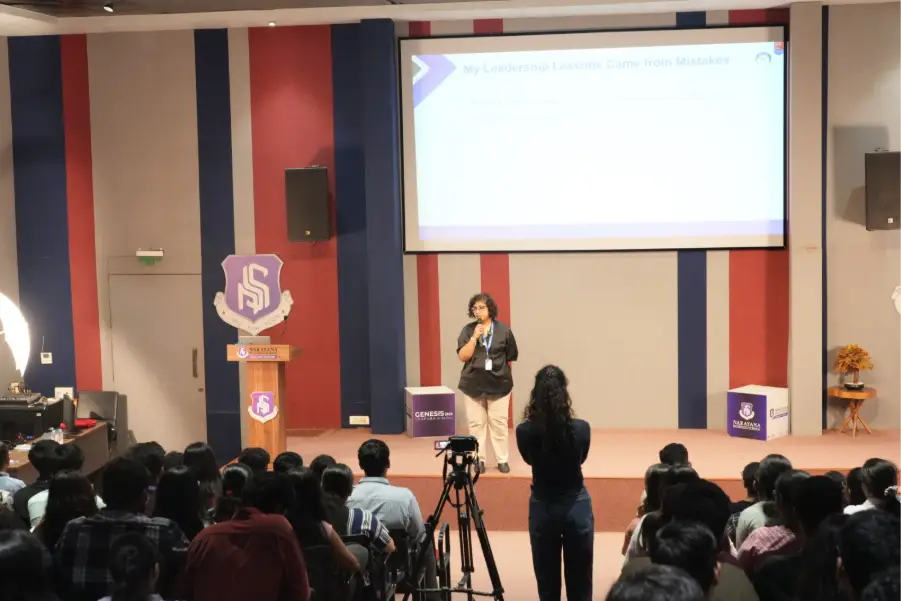
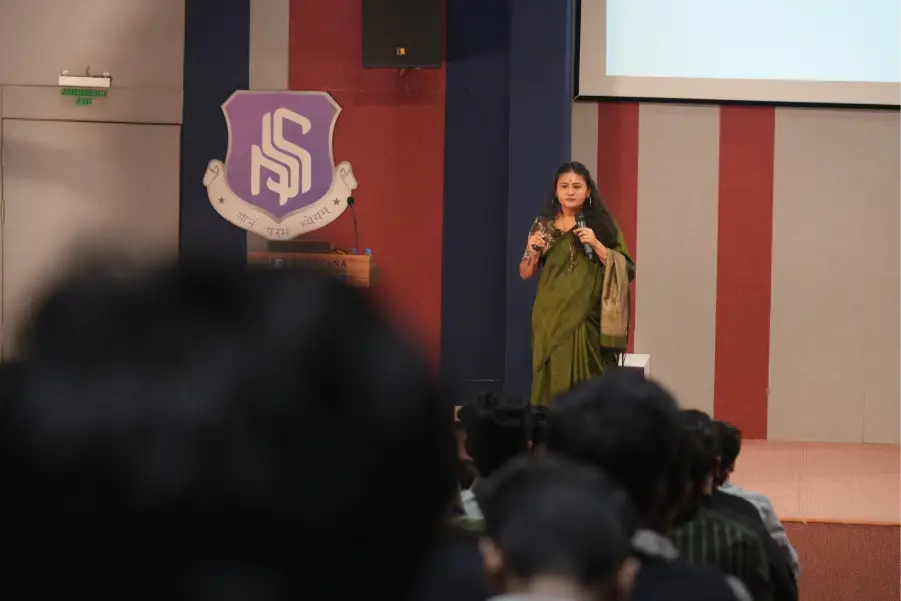
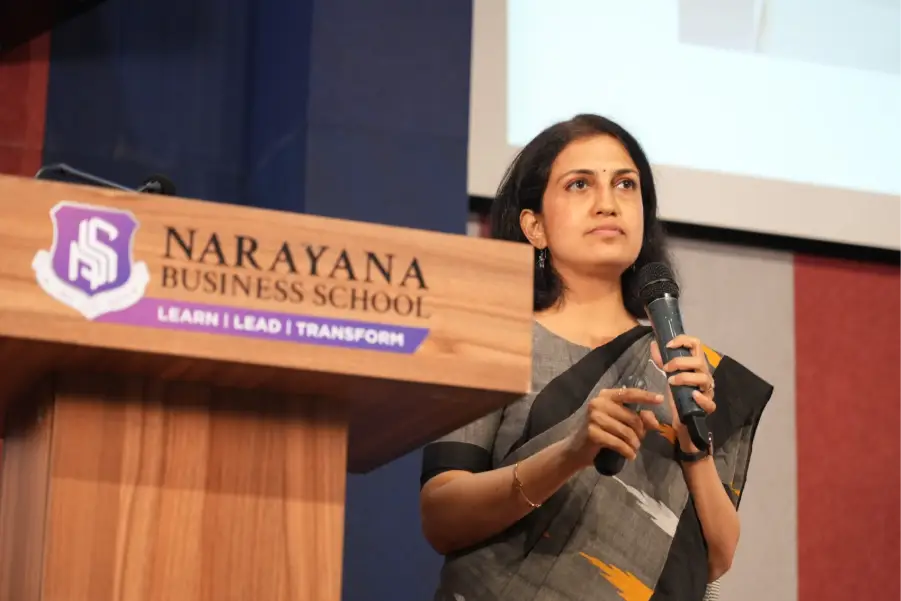
For the first time, Narayana Business School had the privilege of welcoming a scientist from ISRO to its campus as part of GENESIS 2026. Jyotsna Ladkani, who has spent over fifteen years designing advanced communication systems for India’s satellite missions, shared her experiences in a session titled “Leading High-Performance Teams: Lessons from ISRO’s Mission Success.”
Today, she leads the development of next-generation RF ASIC technologies, including Digital Beamforming and Software Defined Radios, contributing to smarter and more efficient space communication systems. Her team’s recent work on an S-Band Trans-Receive Beamformer RF SoC has reduced the size, weight, and power consumption of earlier systems by nearly thirty percent.
While her work involves highly advanced technology, the lessons she shared had very little to do with engineering alone. They were lessons about people, leadership, and the culture that allows complex ideas to become successful missions.
Lesson Number 1:
One of the strongest messages from the session was that high-performing teams are built around a shared purpose. At ISRO, people are not simply working to complete another project or meet another deadline. Every mission contributes to something larger, whether it is improving communication, strengthening weather forecasting, supporting national security, or expanding scientific knowledge. When people understand why their work matters, they approach it differently. The mission becomes bigger than individual recognition, and that creates a stronger sense of ownership.
That sense of purpose also shapes the way challenges are approached. Space missions leave very little room for error, yet no organisation can completely avoid failure. What makes the difference is how failure is treated. Instead of becoming a reason to lose confidence, it becomes an opportunity to learn. Every setback is carefully reviewed, every mistake is understood, and every lesson is carried forward into the next mission.
As Jyotsna Ladkani said, “Failure should not be a setback; rather, it should be a stepping stone.” It is a simple thought, but one that applies just as much to students and professionals as it does to scientists. Progress rarely comes from getting everything right the first time. It comes from understanding what went wrong and making sure the same mistake is not repeated.
Lesson Number 2:
Another idea that stood out during the session was the importance of staying solution-oriented. In every organisation, people encounter problems, limited budgets, tight deadlines, and unexpected obstacles. Spending too much time discussing the problem rarely moves the work forward. High-performing teams develop the habit of asking a different question: What can we do with what we have?
This mindset was reflected in another piece of advice from Ladkani: “Manage things with available resources.” It is easy to believe that better results always require bigger budgets or better tools. ISRO’s journey has shown that thoughtful planning, disciplined execution, and smart use of available resources can achieve remarkable outcomes. Constraints often encourage innovation because they force teams to think differently instead of depending on ideal conditions.
Lesson Number 3:
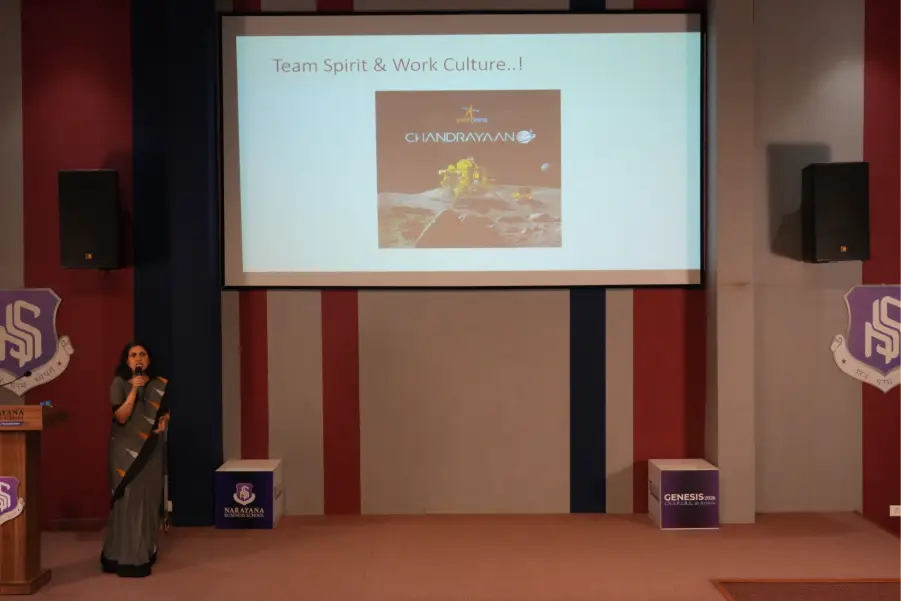
The discussion also highlighted something that is often overlooked in conversations about leadership. Great teams are not built by expecting one person to know everything. They are built by bringing together people with different strengths, giving them clear responsibilities, and helping them work towards a common objective. Engineers, scientists, project managers, quality experts, and many others contribute to every mission. Success comes from how well these different pieces fit together, not from individual brilliance alone.
This is why collaboration remains one of the most valuable leadership skills. High-performance teams communicate openly, review each other’s work, and solve problems together. Accountability exists, but it is not built on blame. It is built on trust, learning, and a shared commitment to achieving the mission.
Lesson Number 4:
Quality was another recurring theme throughout the session. In industries where the cost of failure is extremely high, there is no shortcut to excellence. Every process is reviewed, every system is tested, and every detail is examined before a mission moves forward. This focus on quality is not about perfection for its own sake. It is about reducing avoidable mistakes through preparation, discipline, and continuous improvement.
The same principle applies far beyond space research. Whether someone is building a business, managing a project, writing software, or working in finance, consistent quality comes from good systems rather than last-minute effort. Strong processes may not always be visible, but they are often the reason successful outcomes appear effortless.
Lesson Number 5:
Ladkani also spoke about the importance of balance. High performance is often misunderstood as working endlessly without rest. Sustainable performance is different. It requires people to manage their time well, continue learning, and take care of themselves so that they can perform consistently over the long term. Burnout may produce short bursts of productivity, but it rarely supports lasting excellence.
Perhaps the most memorable advice from the session was also the simplest: “Always have a never-giving-up attitude.” Behind every successful mission are years of preparation, testing, redesign, setbacks, and perseverance. The achievements the world celebrates are often the result of work that remained invisible for a very long time.
Parting thoughts: Scientist From ISRO visits NBS
As students prepare for their own careers at Narayana Business School Ahmedabad, the principles that guide organisations like ISRO remain relevant everywhere. A clear purpose, disciplined execution, continuous learning, teamwork, resilience, and the ability to keep moving forward after failure are not qualities reserved for scientists. They are qualities that help people succeed in every profession.
Space missions may begin on a launch pad, but their success begins much earlier with people who believe in the mission, trust one another, and refuse to give up when the work becomes difficult.
That may be ISRO’s greatest lesson of all.