




Top MBA colleges in India are increasingly giving preference to Profile Based MBA Admission process to conventional MBA exam score cut off based selection process. Top profile based MBA colleges in India offer a refreshing departure from the traditional selection process characterized by entrance examinations. Many of the top-tier business MBA colleges in India, such as IIMA, NBS Ahmedabad, ISB, SPJIMR, Great Lakes, and MICA, are now evaluating candidates on all aspects of their profiles.
A good percentile can open doors to reputed business schools, but it does not necessarily tell the complete story of a candidate.
Consider two applicants. One has performed well in academics and entrance examinations. The other has a similar academic record but has also led a student council, represented their state or country in sports, or taken responsibility for organising major initiatives during school or college.
Narayana Business School (NBS), Ahmedabad, has introduced a profile-based admission route for its MBA and PGDM programmes.
This transition has opened doors for candidates of different merit: athletes, artists, social leaders, entrepreneurs, and excellent representatives from the minority communities, to gain admission despite average test scores.
In this article, we have mentioned the top Profile-based MBA Colleges in India.
Profile Based Admission for Narayana Business School:
The profile-based admission for Narayana Business School focuses on three key areas. Each offers a different perspective on a candidate’s preparation, interests and ability to take on responsibility.
1. Academic Performance in Class 10 and Class 12
A student’s academic record offers an indication of their consistency, discipline and ability to work towards long-term goals.
NBS considers performance in both Class 10 and Class 12 as part of its profile-based evaluation. If the candidate has consistently scored 80% or more throughout 10th and 12th, the candidate is eligible to apply for profile based admission at Narayana Business School based on this criterion.
For management aspirants, this is relevant because postgraduate management programmes involve regular assessments, case studies, presentations, group assignments and independent learning. The ability to maintain academic discipline and engage with different subjects is an important part of preparing for this environment.
However, academic performance is only one part of the assessment. A candidate’s profile is not limited to marks obtained in school examinations.
2. Leadership Positions in School or Graduation
Leadership experience can begin well before someone enters a professional workplace.
Candidates who have held leadership positions during school or college can apply through this criterion. This includes roles such as Head Boy, Head Girl, student council representatives, college committee heads and other positions involving student leadership and responsibility.
For NBS, leadership positions held during school or college form the second criterion for profile-based admission.
The intention is to recognise students who have stepped forward to take responsibility during their academic journey.
3. Sports and Other Competitive Achievements
Candidates with achievements in sports at the national level or participation in other recognised competitive activities can present these as part of their profile. Relevant certificates and supporting documents should be submitted to establish their achievements.
Apply here before 27th November, 2026: https://applications.nbs.edu.in/
How To Apply For Profile Based MBA PGDM Admission at NBS?
The process is designed to evaluate the candidate’s profile before the entrance examination score becomes part of the admission documentation.
Here is how applicants move through the process:
Step 1: Submit The Application Form
Interested candidates for MBA or PGDM programmes at NBS must complete the application form and provide details of their academic performance, leadership positions and competitive achievements. Applicants should ensure that the information they submit is accurate and supported by relevant documents wherever required.
Step 2: Complete Psychometric Profiling
Applicants undergo psychometric profiling as part of the assessment. This helps the admission team understand aspects of their behavioural tendencies, preferences and approach to different situations.
Step 3: Attend The Personal Interview
Candidates who progress through the process are invited for a personal interview. The interview provides an opportunity to discuss their achievements, experiences, interests and aspirations in greater detail.
Step 4: Receive Provisional Admission
Based on the claims and achievements submitted by the candidate, along with the assessment and interview, selected applicants may receive provisional admission to the MBA or PGDM programme.
Step 5: Submit An Entrance Examination Score
An entrance examination score is still required as part of the admission process.
Candidates who have already appeared for CAT, XAT, CMAT or NMAT can submit their respective scores. The profile-based admission route does not require these candidates to meet a high entrance examination cut-off.
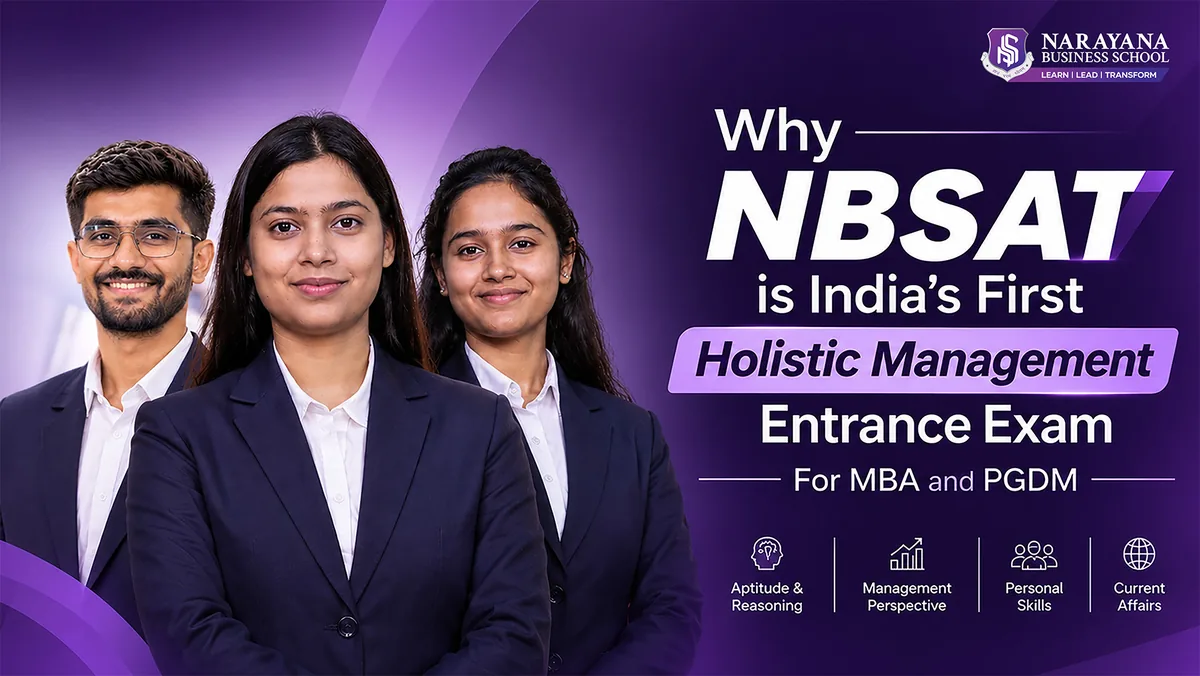
Candidates who have not appeared for any of these examinations will be required to take NBSAT, Narayana Business School’s own management entrance examination, to provide the required score.
This distinction is important. The profile-based route changes the basis of the initial evaluation, but it does not remove the entrance examination score requirement.
The last date to apply for NBS profile-based admission is 27 November 2026.
Other Top Profile Based MBA Colleges in India
NBS Ahmedabad is not the only business school in India that recognises a candidate’s achievements beyond entrance examination performance. Several established institutions consider academic consistency, leadership experience, extracurricular accomplishments, professional experience and other aspects of an applicant’s profile during their admission process.
However, the nature of profile-based selection differs across institutions. Some conduct dedicated profile-based shortlisting rounds, while others include profile parameters in their overall selection criteria.
Here are some prominent examples.
1. S.P. Jain Institute of Management and Research (SPJIMR), Mumbai
SPJIMR follows a two-route shortlisting process for its PGDM programme: Profile-Based and Profile-Cum-Score-Based.
The institute considers a candidate’s academic performance in Class 10, Class 12 and graduation, along with relevant work experience, versatility and achievements in different fields.
Applicants shortlisted through the profile-based route are still required to meet the institute’s qualifying entrance examination score requirements. CAT and GMAT scores are accepted for the programme.
This approach allows candidates with strong academic records and notable achievements to be considered through a profile-based route, while retaining an entrance examination requirement for selection.
2. Goa Institute of Management (GIM), Goa
GIM has an Achiever’s Round, a profile-based shortlisting process that considers achievements in academics, sports, co-curricular activities and professional experience.
The institute identifies candidates with notable achievements, including national-level sports participation, strong academic performance and workplace accomplishments.
An important feature of this process is that candidates can initially be shortlisted for the Achiever’s Round without their CAT, XAT or GMAT scores being considered. Entrance examination scores are factored in later in the selection process.
Selected candidates may receive spot admission offers, while other applicants can be considered alongside candidates in the regular admission round.
3. Institute of Management Technology (IMT), Ghaziabad
IMT considers exceptional profiles as part of its common admission process for postgraduate management programmes.
Its profile evaluation can include candidates from reputed undergraduate institutions, national-level sports representatives and individuals with significant achievements or recognised awards.
The institute also considers academic performance, entrance examination scores, work experience, academic diversity and performance in the selection process.
This provides an additional route for candidates whose achievements and capabilities extend beyond their entrance examination performance, subject to the institute’s eligibility and selection requirements.
4. Indian Institute of Management Ahmedabad (IIMA)
IIM Ahmedabad’s admission process places considerable importance on academic performance alongside entrance examination scores.
The institute evaluates candidates on the basis of CAT performance, academic records and performance in the Analytical Writing Test and Personal Interview.
Its shortlisting framework considers academic performance across school and graduation, with different academic backgrounds factored into the evaluation.
While IIMA does not offer a separate admission route that removes the CAT requirement for domestic applicants, its selection process demonstrates how a candidate’s academic profile and performance in other stages contribute to the final decision.
5. Indian Institute of Management Bangalore (IIMB)
IIM Bangalore follows a multi-parameter selection process for its flagship management programme.
The institute considers Class 10 and Class 12 performance, graduation marks, CAT scores and relevant work experience while preparing its shortlist. Candidates who progress to the next stage are evaluated through a Written Ability Test and Personal Interview.
During the interview, the panel also assesses the candidate’s academic background, quality of work experience and personal attributes.
The process recognises that a candidate’s suitability for management education cannot be determined through entrance examination performance alone. However, CAT remains an important eligibility and selection component.
6. XLRI – Xavier School of Management, Jamshedpur
XLRI encourages applications from candidates belonging to different academic and professional backgrounds.
For its flagship PGDM programmes in Business Management and Human Resource Management, the institute considers XAT performance alongside academic background, relevant work experience and extracurricular activities.
Performance in personal interviews and, where applicable, group discussions also contributes to the final selection.
Although XAT remains the principal entrance examination for Indian applicants to these programmes, XLRI’s selection process considers a wider range of factors when evaluating candidates.
7. Great Lakes Institute of Management
Great Lakes evaluates applicants through multiple parameters, including academic performance, entrance examination scores, work experience, diversity and personal interview performance.
Its admission process considers a candidate’s academic record across Class 10, Class 12 and graduation. It also looks at personal and professional initiatives, leadership potential, communication skills and extracurricular achievements.
The institute accepts CAT, XAT, GMAT and NMAT scores for its programmes, with the applicable requirements varying by programme.
This approach gives importance to a candidate’s overall record while assessing their readiness for management education.
Why Profile-Based MBA Admission Matters
A management classroom brings together students with different academic backgrounds, interests and experiences. Some may have developed strong analytical abilities, while others may have experience in leadership, sports, entrepreneurship, cultural activities or professional environments.
These experiences influence how students participate in discussions, approach problems and work with others.
An entrance examination remains a useful way to assess aptitude and preparedness. But it is only one indicator of a candidate’s capabilities. A student’s academic journey, responsibilities and achievements can provide additional information about their potential.
Profile-based admission creates room for these aspects to be considered during the selection process. It gives students an opportunity to present a more complete picture of themselves and allows business schools to look at the experiences and abilities they may bring to their classrooms.
At Narayana Business School, the profile-based admission route is an opportunity for students to have their academic record, leadership experience and competitive achievements considered before their entrance examination score becomes part of the process.
For candidates who have worked hard outside the classroom, taken up responsibilities or achieved recognition in their chosen fields, this offers another way to pursue management education.
Seize this opportunity. Apply for MBA or PGDM. The application deadline is 27 November 2026.
Candidates interested in the profile-based admission process can apply through the Narayana Business School Application Portal.