Crafting A Winning SoP For NBSAT: A Concise Guide To Help You Secure Admission At Narayana Business School 

A Statement of Purpose or SoP is a personal essay that outlines your academic background, professional experiences, and future goals to support your application for a specific academic program or institution. 

Narayana Business School is now officially accepting applications for Batch Of 2025 via NBSAT entrance exam.  

The Statement of Purpose is a crucial component of your NBSAT application for Narayana Business School. This concise guide will help you craft a winning Statement of Purpose for the NBSAT entrance exam, showcasing your potential and aligning with the expectations of Narayana Business School. 

Your SoP is your chance to shine. It’s not a box to check, but a platform to showcase your unique potential to NBS. This document should concisely present your academic background, professional experiences, and future goals, demonstrating why you’re an ideal candidate for the B school. 

  • Showcases Your Fit With The Programmes

Narayana Business School is known for offering unique and specialized MBA and PGDM programs. Your SoP should demonstrate that you understand these offerings and explain why a specific program aligns with your career goals. Show how your background and aspirations make you an ideal candidate for the chosen program. 

  • Highlights Your Unique Qualities And Experiences

Use your SoP to present experiences, skills, or achievements that set you apart from other applicants. This could include relevant work projects, leadership roles, or personal challenges you’ve overcome. Explain how these experiences have shaped you, nurtured you and how you are ready to experience the vibrant life at NBS. 

  • Demonstrates Your Communication Skills

The SoP is a chance to showcase your ability to articulate ideas clearly and persuasively. Strong writing in your SoP indicates that you can communicate effectively in the business world.  

Use this opportunity to present your thoughts in a well-structured, coherent manner. 

  • Provides Context To Your Background

Your SoP should explain your academic and professional journey, giving meaning to the facts listed in your resume. Use it to clarify any unusual aspects of your background, such as career changes or gaps in your education. This context helps the admissions committee understand your path and motivation. 

  • Expresses How NBS Aligns With Your Career Aspirations

Clearly state your career goals and explain how the programmes offered at the B school will help you achieve them. Mention specific aspects of NBS, such as particular courses, faculty expertise, or networking opportunities, that are crucial for your professional development.  

This shows that you’ve researched the school and have a clear plan for your future. 

Start by deeply understanding the B school: 

  • Study the curriculum and faculty 
  • Identify unique programs or courses 
  • Understand the B school’s values and culture 

Clearly articulate how Narayana Business School fits into your career plan: 

  • State your career objectives 
  • Explain how NBS will help achieve these goals 
  • Mention specific aspects of the program that attract you 

Tell your story compellingly: 

  • Begin with an engaging introduction 
  • Discuss your academic and professional journey 
  • Highlight relevant experiences and achievements 
  • Address any gaps or inconsistencies in your record 
Testimonial

Adhere to the word limit (600-800 words) 

Provide specific examples of your experiences and how they relate to your goals and the courses offered by NBS. 

Follow all instructions provided by the college for the SoP. This shows attention to detail. 

Use industry-specific terms judiciously. Ensure your SoP is accessible to a general audience. 

Thoroughly review your SoP multiple times. Consider having others proofread it as well. 

Tailor your SoP specifically for NBS. Avoid a one-size-fits-all approach. 

Hook the reader with a compelling opening that summarizes your motivation for pursuing an MBA or PGDM program at NBS. 

Briefly discuss your educational qualifications, highlighting achievements relevant to business studies. 

Outline your work history, emphasizing skills and experiences that prepare you for a postgraduate degree. 

Explain why you’ve chosen Narayana Business School, referencing specific programs or aspects that align with your goals. 

Clearly state your short-term and long-term career objectives, showing how the programmes from NBS fits into this plan. 

Highlight personal attributes or experiences that make you a strong candidate for the college. 

Summarize why you’re an excellent fit for the B school and reaffirm your commitment to the program. 

Remember, your SoP is your chance to make a lasting impression. Be honest, be specific, and let your passion for business education shine through.  

With careful preparation and thoughtful writing, your SoP can significantly boost your chances of securing admission to Narayana Business School through the NBSAT entrance exam

Gender Diversity And Inclusion Conclave 2024: NBS & CII IWN On Building An Inclusive India  

Indeed, making an organization inclusive is not essentially about increasing the number of women; rather, it involves creating policies and a culture that foster equal opportunities for growth. Future leaders must not only navigate these changes but also actively contribute to creating inclusive environments and gender diversity in the workplace.  

The Result? A newborn child in lieu of collaboration between Narayana Business School and CII Indian Women Network. A conclave born out of the emergence and calling in today’s time.  

The Gender Diversity and Inclusion Conclave 2024 or DE&I conclave held on 21st September 2024, served as a pivotal platform for addressing these critical issues, bringing together visionaries, industry leaders, and aspiring change-makers. The conclave highlighted the necessity of safe, dignified, and inclusive workplaces. For students entering the workforce and professionals seeking career advancement, understanding and engaging in this transformation is essential. 

Gender diversity is not merely a moral obligation; it represents a significant economic opportunity. At the NBS Conclave, experts underscored that advancing women’s equality could add up to $770 billion to India’s GDP by 2025.  

Despite this potential, disparities persist.  

According to the World Economic Forum’s Global Gender Gap Report 2024, India has slipped two places in the global rankings to 129th in 2024 from 127th in 2023 out of 146 countries for women’s economic participation and opportunity.  

Moreover, a 2020 Deloitte survey revealed that 60% of Indian organizations have fewer than 10% of women in senior management roles. The conclave urged participants to take on leadership roles in fostering inclusive work environments, emphasizing the urgent need to change this narrative. 

The NBS Conclave featured discussions on the remarkable progress Indian women have made, particularly in education. Women now outnumber men in higher education enrollment, Gender Parity Index (GPI), the ratio of female GER to male GER is 1.01 in 2021-22.  

GPI has continued to be above 1 since 2017-18 i.e., female GER continues to be more than male GER for fifth consecutive year according to the All India Survey on Higher Education (AISHE) 2021-2022. However, this educational achievement hasn’t translated into equal workforce participation.  

The conclave explored the reasons behind this disconnect, revealing that India’s female labor force participation rate has plummeted from 30.27% in 1990 to just 20.8% in 2019.  

Key social, cultural, and economic factors, including societal expectations and workplace biases, continue to hinder women’s progress. 

Mr. Vinod Agrawal, Co-Chairman of the CII-WR Sub Committee on International Trade and Managing Director of Arunaya Organics Ltd, delivered an insightful special address that explored the intersection of international trade and gender diversity. Drawing from his extensive experience, Mr. Agrawal highlighted how gender inclusion can significantly enhance both domestic markets and international business operations.  

In a compelling session, Ms. Yogita B. Ahuja, Chairperson of CII IWN-Gujarat and Director of Storycircle Edusaarthi India Pvt Ltd, emphasized the critical role of the PoSH Act 2013 in creating safer workplaces. She outlined the importance of effective implementation of this legislation in promoting gender diversity within organizations.  

A highlight of the event was the panel discussion moderated by Dr. Shivangi Shukla, Associate Professor at Narayana Business School. This engaging discussion featured esteemed academic and industry leaders, including Dr. Noopur Surti, Ms. Radhika Bhandari, and Dr. Miti Randeri. Together, they explored various facets of gender diversity in the workplace, sharing valuable real-world insights from both academia and industry. 

Key topics included: 

  • Barriers to Inclusion: Identifying obstacles that hinder gender diversity. 
  • Strategies for Overcoming Biases: Practical methods to counteract ingrained biases in organizational cultures. 
  • The Role of Male Allies: Discussing how male leaders can actively support and advocate for gender diversity initiatives. 

The panelists provided actionable solutions and inspired attendees to rethink their approaches to fostering inclusive environments in their workplaces. 

At our B School, we are committed to equipping students with the skills and knowledge necessary for success in their academic and professional journeys. 

All in all, one of the major takeaways from the NBS Gender Diversity & Inclusion Conclave was the importance of gender diversity in shaping the future of leadership. 

Participants discussed how true inclusion goes beyond simply hiring more women—it requires building a culture and policies that promote equal opportunities for everyone. Future leaders must be equipped with the empathy and knowledge needed to thrive in increasingly diverse workplaces. 

During the NBS Gender Diversity & Inclusion Conclave, updated studies from 2024 were presented, highlighting the progress made in implementing PoSH policies.  

The reports showed that organizations adhering to PoSH guidelines experienced improvements in workplace morale, employee retention, and overall organizational trust. However, speakers noted that challenges remain, particularly in sectors where awareness of PoSH laws is still low. 

Another major focus of the Narayana Business School Conclave was the Sexual Harassment of Women at Workplace (Prevention, Prohibition, and Redressal) Act (PoSH) of 2013.  

This law, designed to safeguard employees, particularly women, from workplace harassment, was a key topic in a session led by experts who stressed its importance in creating safer and more dignified workplaces. 

The PoSH Act mandates that all organizations with 10 or more employees must establish an Internal Complaints Committee (ICC) to handle sexual harassment complaints. At the NBS Conclave, industry leaders discussed the need for stricter implementation of the PoSH guidelines, particularly in smaller companies and rural areas, where compliance is often lagging. 

Proposed amendments in 2024 suggest extending the time limit for filing complaints from three months to one year, which could provide victims with more time to process their experiences and seek justice.  

Additionally, removing the conciliation process could help prevent any undue pressure on victims to settle matters informally, thereby promoting thorough investigations.  

Recent Supreme Court rulings emphasize the importance of correctly constituting Internal Committees and enhancing accessibility to complaint mechanisms. 

The PoSH Act has fostered greater awareness about sexual harassment in workplaces. It mandates the formation of Internal Committees (ICs) in organizations with ten or more employees, making it easier for victims to report incidents. This has led to more women feeling empowered to come forward with their complaints 

Since its enactment, the PoSH Act has significantly influenced workplace culture, a point reiterated during the Gender Diversity Conclave. Companies that have fully embraced the law report higher employee satisfaction and trust. The conclave highlighted how such policies not only protect employees but also contribute to a positive, inclusive environment that fosters professional growth. 

The Narayana Business School Gender Diversity in the workplace Conclave is just one example of how the institution is taking a leadership role in promoting gender diversity and inclusion. By hosting events like this and collaborating with organizations such as CII IWN Gujarat, Narayana Business School is helping to shape the next generation of leaders who will create more inclusive and equitable workplaces. 

The NBS Conclave featured special addresses from thought leaders, including a deep dive into the PoSH Act, as well as panel discussions on gender diversity and real-world examples of overcoming workplace biases. The school’s commitment extends beyond hosting events—it actively engages students through mentorship programs, internships, and research presentations that aim to create a pipeline of diverse talent ready to lead. 

Narayana Business School with its conclave on 21st September has made it clear: the future of work is diverse, inclusive, and equitable. As the event concluded, participants left with not only greater awareness but also a commitment to act. Whether through small changes in their own workplaces or larger advocacy efforts, the next generation of leaders will be responsible for creating work environments where everyone, regardless of gender, can thrive. 

Ask yourself: Are we ready to unlock the full potential of gender diversity in the workplace? The lessons from the NBS Gender Diversity Conclave urge us to act now.  

Together, we can build safer, more inclusive workplaces that benefit all. 

How To Write Statement Of Purpose – Step-by-Step Guide, Common Mistakes To Avoid, Importance Of Tailoring

In the competitive world of graduate school admissions, your Statement of Purpose (SOP) can be the deciding factor between acceptance and rejection. It’s your chance to step out from behind the curtain of GPAs and test scores and show the admissions committee who you really are. But how do you craft an SOP that not only tells your story but also convinces the committee that you’re the perfect fit for their program? 

Let’s dive into the art and science of writing a compelling Statement of Purpose that will help you stand out from the crowd and unlock the doors to your dream program. 

Before we delve into the nitty-gritty of crafting your SOP document, let’s take a moment to understand what it really is and why it matters so much. 

A Statement of Purpose is more than just another essay in your application package. It’s your personal pitch to the admissions committee.  

Think of it as your chance to sit down with each member of the committee and tell them, face-to-face, why you’re passionate about your field, what you’ve accomplished so far, and how their program fits into your grand plan for the future. 

Your SOP for university is where you get to connect the dots between your past experiences, your current ambitions, and your future goals. It’s where you demonstrate not just your academic prowess, but your ability to think critically about your own path and articulate your vision for the future. 

In short, your SOP is your golden ticket. It’s your chance to show the admissions committee that you’re not just a collection of grades and scores, but a thoughtful, passionate individual who will bring unique value to their program. 

NBSAT Registrations Are Now Open – Full Details Here 

Now that we understand the importance of the SOP, let’s break down the process of creating a stellar one into 7 manageable steps. Below is the statement of purpose sample and SOP contents:

Your journey to SOP for college and its success begins long before you write your first word. The first step is to don your detective hat and dive deep into researching the program you’re applying to. 

This isn’t just about skimming the program’s website. It’s about really getting to know the program inside and out. What’s the program’s philosophy? What kind of research are the faculty members engaged in? What unique opportunities does the program offer? 

For instance, in case of Narayana Business School, the B school offers 4 unique programs namely: 

As you research, keep an eye out for aspects of the program that align with your interests and goals. Maybe there’s a professor whose research fascinates you, or a particular course that seems tailor-made for your career aspirations. Make note of these things – they’ll come in handy when you’re writing your SOP. 

Remember, the goal here is to understand not just what the program offers, but why it’s the perfect fit for you – and why you’re the perfect fit for it. 

With your research done, it’s time to turn the spotlight on yourself. This step is all about reflection and introspection. 

Start by asking yourself some big questions: 

  • What sparked your interest in this field? 
  • What experiences have shaped your academic and professional journey? 
  • What are your long-term goals, and how does this program fit into those plans? 

As you reflect, try to identify key moments or experiences that have been particularly influential. Maybe it was a class that opened your eyes to new possibilities, an internship that confirmed your passion for your field, or a challenge that taught you an important lesson. 

Don’t just focus on your successes, either. Consider the obstacles you’ve faced and how you’ve overcome them. Admissions committees aren’t looking for perfect candidates – they’re looking for resilient, determined individuals who can learn and grow. 

The goal of this brainstorming session is to gather the raw material for your SOP. You’re creating a pool of experiences, insights, and aspirations that you can draw from as you craft your narrative. 

Now that you have your raw material, it’s time to start shaping it into a compelling narrative. 

Think of your SOP as a story – your story. Like any good story, it should have a clear beginning, middle, and end. Here’s a basic structure you can follow: 

  1. Introduction: Start with a hook – a compelling anecdote, a thought-provoking question, or a powerful statement that captures the essence of your journey. 
  1. Your Academic Journey: Discuss your relevant academic background. Highlight courses, projects, or research experiences that have prepared you for graduate study. 
  1. Professional Experience: If you have relevant work or internship experience, discuss how it has informed your academic interests and career goals. 
  1. Research Interests and Future Goals: Clearly articulate what you want to study in graduate school and why. Connect your interests to the program you’re applying to. 
  1. Why This Program: Explain why this specific program is the ideal place for you to pursue your goals. Reference your earlier research here. 
  1. Conclusion: Wrap up by reiterating your enthusiasm for the program and your readiness to contribute to the academic community. 

Remember, this is just a guideline. Feel free to adjust the structure to best tell your unique story. 

With your structure in place, it’s time to start writing. In this first draft, focus on getting your ideas down on paper. Don’t worry too much about perfection at this stage – that comes later. 

As you write, keep these tips in mind: 

  • Be authentic. Let your genuine passion and enthusiasm shine through. 
  • Use concrete examples to illustrate your points. Don’t just tell the committee you’re passionate about research – show them by discussing a project you’ve worked on. 
  • Be specific about your goals and how the program fits into them. 
  • Avoid clichés and generic statements. Instead of saying you’ve “always been fascinated by science,” explain what specifically fascinates you and why. 

Remember, your goal is to write an SOP that only you could write. Let your unique voice and experiences come through in your writing. 

Once you have your first draft, it’s time to refine and polish. Step away from your SOP for a day or two, then come back to it with fresh eyes. 

As you revise, consider: 

  • Does your narrative flow logically? 
  • Have you clearly connected your past experiences to your future goals? 
  • Is your language clear and concise? 
  • Have you effectively demonstrated why you’re a great fit for the program? 

This is also the time to tighten up your language. Look for places where you can be more concise or where you can replace general statements with specific examples. 

No writer is an island, and that includes SOP writers. Once you’ve polished your SOP to the best of your ability, it’s time to seek feedback. 

Pro tip: Prepare multiple statement of purpose samples (if needed) to get better clarity for the outer picture.  

Share your SOP with mentors, professors, peers, or anyone else whose opinion you trust. Ask them to be honest – you want constructive criticism, not just praise. 

As you receive feedback, be open-minded. Sometimes an outside perspective can spot weaknesses or opportunities that you’ve missed. At the same time, remember that this is your statement. While you should consider all feedback carefully, you don’t have to implement every suggestion. 

With feedback in hand, it’s time for the final polish. Revise your SOP based on the feedback you’ve received, making sure each change aligns with your overall narrative and goals. 

Once you’re happy with the content, it’s time for the final proofread. Check for any grammatical errors, typos, or formatting issues. Make sure you’ve adhered to any guidelines provided by the program, such as word count limits. 

Remember, every word in your SOP should serve a purpose. If you’re over the word limit, look for places where you can be more concise without losing important content. 

A typical SOP word limit is 1000-1500 words  

Even as you follow these steps, there are some common pitfalls you’ll want to avoid. Here are five mistakes that can sink even the most promising SOP: 

Avoid general statements that could apply to anyone. Be specific about your experiences, interests, and goals. 

Each program has its own requirements for the SOP. Make sure you follow them to the letter. 

While it’s important to demonstrate your knowledge, avoid using so much technical language that your SOP becomes hard to read. 

Typos and grammatical errors can make even the most brilliant candidate look careless. Proofread, proofread, and then proofread again. 

Resist the temptation to use the same SOP for multiple applications. Each SOP should be tailored to the specific program you’re applying to. 

SOP full form in education is always a statement of purpose. When you’re applying to multiple programs, visa or anything, it can be tempting to use a single, generic SOP for all your applications.  

Even SOP full form in visa is statement of purpose.  

After all, your experiences and goals remain the same, right? 

Wrong. While your core story might stay consistent, how you tell that story should change depending on your audience. 

Think of it this way: if you were applying for two different jobs, you wouldn’t send the exact same cover letter to both employers. You’d emphasize different skills and experiences based on what each employer was looking for. The same principle applies to your objective of SOP. 

Here’s how to effectively tailor your SOP for each program, a good statement of purpose example would be:  

  1. Reference Specific Program Features: Mention courses, research opportunities, or faculty members that attract you to the program. This shows you’ve done your homework and have a genuine interest in what the program offers. 
  1. Align Your Goals with the Program’s Strengths: Frame your research interests and career goals in a way that aligns with the program’s areas of expertise. 
  1. Reflect the Program’s Values: If the program emphasizes interdisciplinary research, collaborative work, or any other values, discuss how these align with your own approach to your field. 
  1. Make Connections: If you’ve had any contact with faculty members or current students, or if you’ve attended any information sessions about the program, mention these. It shows you’ve taken initiative to learn about the program. 

Remember, the goal is not to completely rewrite your SOP for each application, but to fine-tune it to show why you’re an excellent fit for each specific program. 

We’ve spent most of this guide discussing the Statement of Purpose, but let’s recap its key characteristics: 

  • Focus: Academic and professional 
  • Content: Your academic background, research interests, career goals, and reasons for choosing the specific program 
  • Tone: Professional and focused, with a clear emphasis on your academic journey and future plans 
  • Purpose: To demonstrate your readiness for graduate study and your fit with the program 
  • Word Limit: 1000-1500 words 

A Personal Statement, on the other hand, has a somewhat different focus: 

  • Focus: Personal background and experiences 
  • Content: Significant life experiences, challenges overcome, personal growth, and how these have shaped your decision to pursue graduate study 
  • Tone: More personal and narrative, often telling a story about your journey 
  • Purpose: To give the admissions committee insight into your character, resilience, and motivations 
  • Word Limit: 800-1000 words 
  • Academic VS Personal Focus: An SOP is primarily about your academic and professional journey and goals, while a Personal Statement is more into your personal background and experiences. 
  • Future VS Past Orientation: An SOP is largely future-oriented, discussing your goals and how the program fits into them. A Personal Statement often looks more to the past, explaining how your experiences have led you to this point. 
  • Tone and Style: An SOP maintains a more professional tone, while a Personal Statement may be more narrative and emotional in style. 
  • Content Detail: An SOP typically includes more detail about your academic achievements and research interests, while a Personal Statement might focus more on personal challenges and growth. 

Some applications may require both an SOP and a Personal Statement. In this case: 

  • Avoid repetition. Use each document to showcase different aspects of yourself. 
  • In your SOP, focus on your academic journey, research interests, and professional goals. 
  • In your Personal Statement, delve into the experiences that have shaped your character and led you to pursue this path. 
  • Ensure that both documents, while distinct, present a coherent narrative about who you are and why you’re an excellent candidate for the program. 

Remember, whether you’re writing an SOP, a Personal Statement, or both, the goal remains the same: to convince the admissions committee that you are a great fit for their program and that you have the potential to succeed in graduate study and beyond. 

Crafting a compelling Statement of Purpose is no small feat. It requires deep reflection, careful planning, and multiple rounds of writing and revision. But the effort you put into your SOP is an investment in your future. 

It’s a chance to show the admissions committee not just what you’ve done, but who you are and who you hope to become. 

As you refine your SOP, consider how your goals align with the opportunities at Narayana Business School: 

  • Innovative curriculum blending theory and practice 
  • Diverse, international student body 
  • Hands-on learning through industry projects 
  • Strong alumni network 
  • State-of-the-art facilities 

At Narayana Business School Ahmedabad, we’re committed to nurturing future business leaders. Our programs in finance, marketing, entrepreneurship, and more are designed to turn your aspirations into reality. 

Remember: Your SOP is your story. Make it authentic. Make it specific. Make it powerful. 

Your perfect program is out there, and a well-crafted SOP is your key to unlocking it. So, take a deep breath, flex those writing muscles, and start crafting your ticket to grad school success. Your future self will thank you. 

Our Socials:  

Good luck, and happy writing! 

Narayana Business School Announces Commencement of NBSAT Phase 1 Registrations: Apply Now At India’s Top B School 

Narayana Business School is now officially accepting registrations for NBSAT entrance exam phase 1 for the 2025-2027 batch. The race to join one of top B schools in India has officially begun! If you’re aiming to pursue a prestigious MBA or PGDM degree, this entrance exam is your opportunity to secure admission to Narayana’s top-tier programs, including the MBA+PGPCE and 3 specialized PGDM programs 

Narayana Business School is consistently ranked among India’s best, known for its cutting-edge curriculum, industry connections, and a focus on experiential learning. With the right preparation, this exam can catapult you into one of the most sought-after post graduate programs in the country, putting you in the company of future leaders, innovators, and top executives. 

Let’s walk you over on the MBA entrance exam, Aptitude Test, Assessment Parameters, Key Dates, Exam Highlights, Syllabus Overview, Eligibility Criteria, Selection Process. 

Apply Now 

 The NBSAT (Narayana Business School Aptitude Test) is an online proctored exam conducted by Narayana Business School to evaluate the aptitude and analytical abilities of candidates seeking admission into their MBA and PGDM programs. This exam plays a crucial role in determining admission into these competitive programs. 

With a rigorous focus on Quantitative Techniques, Data Interpretation, Vocabulary, Analytical Reasoning, and Reading Comprehension, the NBSAT ensures that only the best candidates secure a spot in their MBA+PGPCE (Post Graduate Program in Corporate Excellence) and PGDM courses. 

The NBSAT is an online proctored exam, meaning you can take it from the comfort of your home while ensuring a secure testing environment. It consists of multiple sections, each designed to evaluate your proficiency in different areas critical to business management. 

  • Quantitative Techniques: This section assesses your mathematical skills and understanding of numbers. 
  • Data Interpretation: Here, your ability to interpret data and use it for decision-making is tested. 
  • Vocabulary: This section measures your command of the English language, which is essential for effective communication in business. 
  • Analytical Reasoning: A critical part of the test, this measures your logical thinking and problem-solving skills. 
  • Reading Comprehension: It evaluates your ability to comprehend and interpret written material, a vital skill in the business world. 
  • MBA + PGPCE: This program equips you with a strong foundation in management and corporate excellence. 

Narayana Business School’s Quantitative Finance Program, paired with the prestigious EY CAFTA certification, is designed to help you stand out in a competitive job market. Curious about how our Integrated EY CAFTA Program can benefit you? Learn more  

  • The registration process for NBSAT started on September 2, 2024. Students interested in applying should register as soon as possible to avoid missing the deadlines. 
  • The exam will be conducted in two phases, giving candidates ample opportunities to participate and secure a spot 

The eligibility extends to students from all academic disciplines, making it accessible for both fresh graduates and working professionals who wish to pursue management education. Additionally, candidates in the final year of their undergraduate program can also apply, provided they meet the minimum eligibility criteria by the time they are called for admission. 

  • Candidates should hold a bachelor’s degree from a recognized university. 
  • A minimum of 60% marks in graduation is required for general category students and reserved categories

The registration process for NBSAT 2025 is straightforward and fully online. Here’s a step-by-step guide:  

  • Visit the Official NBSAT Website:

Navigate to the official Narayana Business School website and find the NBSAT 2025 registration link

  • Create an Account:  

Enter your personal information, including your name, email, phone number, and date of birth to create your account. 

  • Complete the Application Form:  

Fill in academic details, including your undergraduate degree and marks. Select your preferred program—either MBA+PGPCE or PGDM programmes. 

  • Upload Documents:  

Upload scanned copies of required documents such as your photograph, signature, and academic transcripts. 

  • Pay the Application Fee:  

Use the available payment options to complete the application fee process. 

  • Submit and Confirmation:  

Once the payment is made, review your application and submit it. You will receive a confirmation email with further instructions. 

The NBSAT exam pattern has been carefully designed to assess your managerial potential through multiple sections. The test consists of 100 multiple-choice questions (MCQs), with each correct answer awarding 1 mark. The exam has no negative marking, so it’s advantageous to attempt all questions. The MBA entrance exam is divided into four key areas: 

  1. Quantitative Techniques (30 questions): Focuses on mathematical problem-solving, arithmetic, algebra, and geometry. 
  1. Data Interpretation & Logical Reasoning (30 questions): Tests your ability to interpret data and solve problems logically. 
  1. Vocabulary & Reading Comprehension (20 questions): Measures your English language skills, including reading comprehension and vocabulary knowledge. 
  1. Analytical Reasoning (20 questions): Assesses your ability to think logically and solve complex problems under pressure. 

Below are key dates for NBSAT 2025-27 admissions

  • Registration Start Date: September 2, 2024   

  • Phase 1 Exam Date: December 15, 2024    

  • Phase 2 Exam Date: January 20, 2025  

  • Admit Card Release: One week before the exam date   

  • Result Announcement: Two weeks after the exam    

  • Admission Process Begins: February 2025    

It is advisable to complete your registration well before the deadline to avoid last-minute technical issues. 

When deciding between entrance exams like CAT, XAT, GMAT, and NBSAT, it’s essential to consider your strengths and career goals. In India, popular options include the CAT (Common Admission Test), XAT (Xavier Aptitude Test), GMAT (Graduate Management Admission Test), and NBSAT (Narayana Business School Admission Test). Each exam caters to different candidate profiles and career aspirations, making it essential to understand their unique features. 

NBSAT is specifically designed for candidates aiming for admission to the MBA+PGPCE and PGDM programs at Narayana Business School, one of India’s top business schools. Unlike the more widely recognized exams such as CMAT, CAT and XAT, which are accepted by numerous institutions across the country, NBSAT is tailored for those who have a clear focus on Narayana Business School’s offerings. 

The exam assesses quantitative, analytical, and language skills, providing a comprehensive evaluation of a candidate’s readiness for management studies. The format aligns closely with the curriculum and expectations of Narayana Business School, ensuring that candidates are well-prepared for their MBA journey. 

Comprises three sections: Verbal Ability and Reading Comprehension, Data Interpretation and Logical Reasoning, and Quantitative Ability. It is known for its high difficulty level and unpredictable question patterns, making it a challenging option for many aspirants. 

Similar to CAT but includes a Decision Making section, which tests candidates’ ability to analyze complex scenarios. XAT is often regarded as tougher than CAT due to its rigorous nature and diverse question types. 

Primarily used for international MBA programs, the GMAT evaluates analytical writing, quantitative reasoning, verbal reasoning, and reading comprehension. It is widely recognized by business schools worldwide, making it a versatile option for candidates considering global opportunities. 

To perform well in NBSAT 2024, it’s important to develop a robust study plan. Here are a few tips to get you started: 

  1. Focus on Quantitative Techniques:  

Practice problem-solving exercises from topics like algebra, arithmetic, and geometry. Mock tests are a great way to improve speed and accuracy. 

  1. Improve Data Interpretation:  

Enhance your ability to analyze charts, graphs, and tables. Time yourself while solving data interpretation sets to simulate real exam conditions. 

  1. Build Your Vocabulary:  

Regularly read books, newspapers, and business journals. Use flashcards to remember new words, and practice comprehension exercises. 

  1. Work on Analytical Reasoning:  

Solve puzzles, brain teasers, and logical reasoning questions from online resources or books specifically designed for MBA entrance exams. 

  1. Take Mock Exams:  

Simulate the real exam experience by taking full-length mock tests under timed conditions. 

  1. Revise Regularly:  

Make a study schedule that includes time for revision of key concepts to ensure they’re fresh in your memory on exam day. 

The school’s strong industry connections and robust placement program help students secure internships and full-time positions with leading companies in India and abroad. 

  • The registration fee for NBSAT is INR 2000, payable online during the application process. 
  • No, NBSAT does not have negative marking. This allows you to attempt all questions without the fear of penalty. 
  • Yes, students in the final year of their undergraduate studies are eligible to apply, provided they meet the minimum marks requirement by the time of admission. 
  • Practice solving graphs, charts, and tables from online resources and focus on improving your speed and accuracy. 
  • The results are usually announced two weeks after the exam
  • Graduates can pursue careers in Finance, Marketing, HR, Business Analytics, and Consulting, with many securing positions in top global firms. 

2024 Faculty Additions – NBS Strengthens And Expands Its Academic Community With New Esteemed Members

As a post graduate management institution, Narayana Business School has had a big share in creating the most specialized educational diaspora across the country. Known for its unique experiential learning teaching pedagogy, comprehensive curricula, and top tier management education, NBS has ranked among the top private B school in India.

Central to this success is the B school’s faculty – a group of highly qualified, experienced, and dedicated academicians who lead with excellence in their respective fields. 

We invited applications, received, and recruited the best of the best. And today, we want you to meet them.

Here are the profiles of the newly joined esteemed faculty members of Narayana Business School, highlighting their contributions, expertise, and the unique value they will bring to the institution.

Dr.Lucky Mishra

Title: Associate Professor  
Key Expertise: Microeconomics, Macroeconomics, Managerial Economics, International Economics 
Academic Credentials: 

  • MA in Economics 
  • PhD in Economics 
  • MBA in Finance and Marketing (Dual Specialization) 
  • UGC-NET Qualified 
    Experience: 16+ years in teaching Business Management and Law 

Shaping Future Economists 
Dr. Mishra’s in-depth understanding of economics will empower students to analyze and interpret complex economic scenarios. Her practical approach to teaching will equip students with the skills necessary to apply economic theories in real-world situations, preparing them to become insightful economists and decision-makers. 

Dr.Charmi Shah

Title: Associate Professor  
Key Expertise: Corporate Finance, Wealth Management, Financial Markets, Portfolio Management 
Academic Credentials: 

  • PhD in Finance 
  • MBA 
  • Certified Financial Planner (CFP) 
    Experience: 17+ years in teaching, training, and research 

Building Financial Experts 
Dr. Shah’s extensive experience in finance will guide students to master the intricacies of financial markets and corporate finance. Her focus on practical financial management will prepare students to excel in high-stakes financial environments, making them well-rounded financial experts ready for the global market. 

Dr.Yashpal Jadeja

Title: Assistant Professor  
Key Expertise: Production Management, Quality Management, Supply Chain and Logistics, Operations Research 
Academic Credentials: 

  • Engineering Degree in Mechanical 
  • MBA in Operations Management and Tourism Management 
  • Six Sigma Green Belt Professional 
  • UGC-NET Qualified 
    Experience: 18+ years in academia and industry 

Driving Operational Excellence 
Dr. Jadeja’s expertise in operations management will instill in students the importance of efficiency and quality in business processes. His teachings will enable students to optimize operations and implement effective management strategies, ensuring they become leaders in production and operations management.

Dr.Kedar Bhatt

Title: Associate Professor  
Key Expertise: Services Marketing, Digital Marketing, Data Analysis, Consumer Behavior 
Academic Credentials: 

  • PhD Guide at Gujarat Technological University 
  • Expert in Advanced Data Analysis Techniques 
    Experience: 15+ years in marketing and research 

Crafting Marketing Innovators 
Dr. Bhatt’s focus on marketing analytics and consumer behavior will provide students with the tools to create data-driven marketing strategies. His emphasis on digital marketing will ensure that students are at the forefront of marketing innovation, ready to lead in a rapidly changing digital landscape. 

Dr.Archana Singh

Title: Assistant Professor  
Key Expertise: HR Management, Soft Skills Development, Educational Psychology 
Academic Credentials: 

  • PhD Candidate in Training & Development 
  • PG Diploma in Marketing & Sales Management 
  • Dual Master’s in HR Management and Educational Psychology 
    Experience: 18+ years in HR and soft skills training 

Empowering Future HR Leaders 
Prof. Singh’s expertise in HR and soft skills will help students develop the interpersonal and professional skills essential for success in human resources. Her innovative teaching methods will prepare students to navigate complex HR challenges and excel as HR leaders in diverse organizational settings. 

Prof. Vachika

Title: Assistant Professor  
Key Expertise: Office Administration, Team Building, Interpersonal Skills 
Academic Credentials: 

  • MBA 
    Experience: 14+ years in UG and PG teaching 

Enhancing Administrative Excellence 
Prof. Vachika’s dedication to team-building and interpersonal skills will prepare students to excel in office administration and management roles. Her focus on practical skills and collaborative learning will empower students to become effective administrators who can manage teams and processes efficiently.

Prof. Bindiya Dua

Title: Assistant Professor  
Key Expertise: Human Psychology, Administration, Behavioral Studies 
Academic Credentials: 

  • Gold Medalist in MBA(IB) awarded by late president Shri Pranab Mukherjee 
    Experience: Diverse experience in academia and administration 

Fostering Psychological Insight 
Prof. Dua’s unique perspective on human psychology and behavior will provide students with a deeper understanding of the psychological factors that influence business and management. Her integrated approach to education will enable students to develop strong leadership skills and a profound understanding of human dynamics in the workplace. 

Prof. Pratima Talreja

Title: Assistant Professor  
Key Expertise: Digital Analytics, Social Media Trends, Business Analytics 
Academic Credentials: 

  • MBA in Business Analytics 
    Experience: 4+ years in digital and social analytics 

Navigating the Digital Landscape 
Prof. Talreja’s expertise in digital analytics will guide students in mastering the tools and techniques needed to analyze and interpret social media and online trends. Her teachings will prepare students to make data-driven decisions in digital marketing and business analytics, positioning them as leaders in the digital economy. 

Prof. Neha Uphadyay

Title: Assistant Professor  
Key Expertise: Integrated Marketing Communication, Green Marketing, Sustainable Fashion 
Academic Credentials: 

  • UGC NET Qualified 
  • Cambridge Certified English Trainer 
    Experience: 9+ years in teaching marketing and research 

Championing Sustainable Marketing 
Prof. Upadhyay’s focus on sustainable marketing practices will instill in students a keen sense of ethical responsibility in business. Her expertise in green marketing and consumer behavior will prepare students to create marketing strategies that are not only effective but also socially and environmentally responsible. 

Prof. Kritika Pancholi

Title: Assistant Professor  
Key Expertise: Behavioral Finance, Financial Decision-Making, Psychological Influences 
Academic Credentials: 

  • Extensive Corporate Background in Banking, Finance, and Telecom 
    Experience: Rich experience in management, finance, and sustainable development.

Influencing Financial Decision-Makers 
Prof. Pancholi’s insights into behavioral finance will equip students with the knowledge to understand and predict financial behavior. Her teachings will prepare students to make informed financial decisions, considering both economic and psychological factors, thus shaping them into insightful financial professionals. 

Congratulating Dr. Shivangi Shukla Bhavsar on receiving the “Ananya – Unique Teachers’ Felicitation Award 2023” by ISTD – See Here 

Dr. Shivangi Shukla Bhavsar receiving the Ananya – Unique Teachers’ Felicitation Award 2023 from ISTD.

About ISTD 

EdTech

Click Here To Know More | Book Link 

At Narayana Business School, faculty excellence is a standard that permeates every aspect of the educational experience. What we mean is that, as we boast the most specialized PG programs in country, it becomes imperative to have the most sought after and the best faculty for management education.  

Subscribe To Our Dedicated Faculty Series –  

1. Driving Innovation In Curriculum And Teaching:  

Excellence in faculty translates into innovation in teaching methodologies and curriculum development. At NBS, the faculty is constantly evolving and adapting the curriculum to meet the changing demands of the business world. Whether it is incorporating the latest trends in digital marketing or exploring new frontiers in financial analytics, NBS faculty running on the ideology of experiential learning, they ensure that the education students receive is both relevant and innovative. 

2. Enhancing Academic Reputation:    

A B school’s reputation is often built on the strength of its faculty. The research, publications, and thought leadership of NBS faculty members contribute to the institution’s academic prestige. Their involvement in industry collaborations, conferences, and research projects not only enhances their own professional profiles but also elevates the standing of NBS in the global academic community

3. Providing Personalized Mentorship And Support:  

Faculty members are mentors who take a personal interest in their students’ academic and professional growth. This personalized approach ensures that students receive the guidance and support they need to excel, making their educational journey at NBS both enriching and transformative. 

Know More About The 3 Layer Mentorship Program 

At Narayana Business School, we are committed to providing our students with the best resources, mentorship, and opportunities to excel in the dynamic world of management. Our newly recruited faculty members are poised to drive innovation, inspire excellence, and contribute to the holistic development of our students. We invite you to be a part of this transformative journey. 

With this dynamic mix of talent, NBS will continue to uphold its tradition of academic rigor while embracing the latest ideas and methodologies that prepare our students for the evolving global marketplace. 

Explore our programs, engage with our faculty, and take the first step toward a successful career in management.  

Links: 

Our portal: https://www.nbs.edu.in/  

LinkedIn: https://www.linkedin.com/school/nbs-edu-in/  

Follow Us on Instagram: https://www.instagram.com/nbs.edu.in/?hl=en   

Like Our Facebook Page: https://www.facebook.com/nbs.edu.in  

Quora: https://www.quora.com/profile/Narayana-Business-School-NBS  

Registrations for NBSAT, our entrance exam, commences on 2nd September 2024. This is your opportunity to join one of the top-ranked B-schools in India, where excellence in education meets real-world business insights.

For more details on the application process and exam dates, visit our official NBSAT Portal 

Genesis 2024 At Narayana Business School – The Best Orientation Program That Welcomed 500+ PGDM & MBA+PGPCE Students   

Ahmedabad, India – Narayana Business School has successfully concluded its highly anticipated Genesis 2024 induction program, running from July 15 to August 3, 2024. This exceptional program is designed to redefine the student orientation experience, ensuring a smooth transition into the challenging B-School environment.

Tailored to facilitate a smooth transition into the demanding B School environment, Genesis 2024 combined mentorship, networking, and personal development to ensure every student feels supported and inspired from day one.

Dr. Amit Gupta, in his inspiring address, shared, “We need to accept who we are today to become who we aspire to be tomorrow.” He further added “By embracing our current selves, our strengths, weaknesses, and unique qualities, we lay the foundation for a future filled with possibilities. It reminds us that acknowledging our present is essential to unlocking the potential and driving us towards our dreams”.

Visual detailing key features or achievements of NBS, aimed at prospective students.

Understanding that one size doesn’t fit all in education, Genesis 2024 offered multifaceted days tailored to diverse interests and career goals. The B School recognizes that every student has unique aspirations, and therefore, it provides a variety of specialized learning opportunities.

Participants engaged in hands-on activities, Q&A with industry experts and case studies, gaining practical insights and skills that are directly applicable to their future careers.

Narayana Business School collaborated with CII – Indian Women Network (IWN), Idea Roast and EChai Ventures to bring together sessions that resonate with the most pressing needs of today’s dynamic landscape.

In another session, “Women in Entrepreneurship: The Change Maker,” prominent leaders from Storycircle Edusaarthi, She & WE Institute, Respire Experiential Learning, and Tresna Foundation where NBS celebrated the real women change makers of the society, who shared their inspiring journeys, highlighting the power of collaborative leadership.

These collaborations, combined with sessions featuring experts from the Bombay Stock Exchange, PwC, Zomato, and Deloitte, where students learned smart work techniques to maximize productivity without burning out, are essential skills for both personal and professional success.

The kind of exposure Genesis delivered for the batch of 2024-26 was beyond everything. It has impacted the academic landscape in a great way, setting a new benchmark for educational programs. Its impact is evident in the way it prepares students for the future, ensuring they are equipped with the skills needed to navigate the constantly evolving job market.

For full details on the sessions of the Genesis Program– Click Here

The Genesis 2024 program began with a session that wasn’t just an introduction—it was a call to greatness. Dr. Amit Gupta, the visionary Founder and Director of Narayana Business School, set the stage with the “NBS Odyssey.”

Dr. Gupta’s message was clear and powerful: to shape the leaders of tomorrow, we must first understand who we are today. He urged students to embrace their unique strengths and recognize their potential, for it is only by acknowledging our present selves that we can unlock the door to our future aspirations. 

He challenged students to see this induction not merely as an entry into a business school, but as the first step in a lifelong journey of learning, leading, and transforming. Under his guidance, the Genesis 2024 program became more than an orientation, a self introduction for students.  

Dr. Diksha Sisodia, Assistant Professor at Narayana Business School, introduced students to the innovative concept of the “Cloud Campus.” This session explored how digital platforms and cloud technology are revolutionizing education, making learning more accessible and flexible. Dr. Sisodia’s presentation emphasized the benefits of cloud-based learning environments in fostering collaboration and ensuring continuity in education, aligning with NBS’s mission to provide a cutting-edge educational experience. 

On July 18th, 2024, the Genesis 2024 program commenced with a profound session led by Mr. Mahesh Pandya, a Senior Executive at the Bombay Stock Exchange (BSE). His workshop on Capital Markets offered students a deep dive into the intricacies of the financial markets, covering essential concepts like stock exchanges, trading mechanisms, and investment strategies. This session was instrumental in equipping students with the knowledge to navigate the complexities of capital markets, setting a solid foundation for their future financial endeavors. 

On July 19th, 2024, Kshatriya Sundeep Singh, Head of People & Culture at Renee Cosmetics, led an engaging session on “The Role of HR in Modern Organizations.” Mr. Singh highlighted the evolving responsibilities of HR in today’s dynamic business environment, emphasizing the importance of cultivating a positive workplace culture, managing talent, and driving organizational change. This session was particularly valuable for students pursuing careers in human resources and organizational management. 

One of the highlights of Genesis 2024 was the panel discussion on “Leveraging AI for Business Specialization” on July 23rd, 2024. Moderated by Saumya Shah, Founder of ServoLabs, the panel featured industry leaders including Abhishek Gupta (Co-founder and Promoter at Travse Media), Aditya Goel (Founder at Claw Enterprises), and Siddharth Patel (Co-Founder & Chief Executive Officer at Digipple). The discussion centered around the transformative role of Artificial Intelligence in business, from enhancing operational efficiency to creating new market opportunities. The insights shared during this session provided students with a forward-looking perspective on how AI can be a game-changer in various business domains.

On July 24th, 2024, Rasa Parayan Prabhu Ji led a session on “Spiritual Leadership & Management,” offering a unique perspective on leadership rooted in spiritual principles. This session underscored the importance of integrating ethical values and mindfulness into management practices. Prabhu Ji’s teachings resonated deeply with students, encouraging them to pursue leadership roles with integrity and compassion, which are crucial traits in the ever-evolving corporate world. 

On July 31st, 2024, Dr. Indra Meghrajani, Associate Professor at Narayana Business School, introduced students to the Case-Based Learning method, a hallmark of NBS’s pedagogy. Dr. Meghrajani explained how this interactive and practical approach to learning helps students develop critical thinking and problem-solving skills by analyzing real-world business scenarios. The session was pivotal in preparing students to tackle complex business challenges, making them more adept at decision-making in their future careers. 

Closing the impactful series of sessions, Priyank Patel, Director at Deloitte India, led a session titled “Do Less for More!” on July 29th, 2024. Mr. Patel shared strategies for maximizing productivity and achieving more by focusing on essential tasks and eliminating unnecessary activities. His insights on time management and efficiency struck a chord with the students, providing them with practical tools to enhance their personal and professional productivity. 

“They say, with great power comes great responsibility, the reverse holds true as well. We at Narayana, aspire that our students take maximum responsibilities and leadership roles, say, becoming council members, actively participating in clubs as so on, said – Vishal Tiwari – VP Growth & Strategy at NBS”. “He further added, the students should learn to be in power, and power here is knowledge. Once students start taking responsibilities, accountability comes hand in hand which is crucial for students at PG level to succeed’.  

At Narayana Business School, the ethos revolves around nurturing a student’s core competencies and aligning them with industry demands. This philosophy was vividly embodied in the Genesis 2024 induction program to help students identify and hone their unique skills and interests, ensuring they maximize their potential during their tenure at NBS and beyond. 

Continuing this notion, programmes like PGDM Dual Specialization offered by the B School, was designed for students who possess skills in one area but have a keen interest in another.

For instance, a student with a strong foundation in Human Resources but a growing interest in Marketing can pursue both specializations. This dual approach ensures that students are not forced to choose between their passions but can instead develop a robust skill set in both areas. This unique structure further allows students to follow multiple passions and acts as a pivotal turning point in their careers. By broadening their knowledge base, they are equipped with a diverse skill set that significantly enhances their employability. 

Additionally, there were sessions on spirituality, where students explored the intersection of personal growth and professional development, guided by esteemed spiritual leaders. For those interested in sales and IT, Genesis 2024 orientation program provided targeted workshops that covered the latest trends and technologies, sales strategies, and customer relationship management. Personal branding sessions helped students craft their unique professional identities, teaching them how to effectively communicate their value and stand out in a competitive job market. 

Nothing is more inspiring than hearing success stories from those who were once in your shoes. The orientation program in college featured 30+ alumnus like Rishita De – HR Associate at Social Pilot LLP, Ali Akbar Bohra – Senior Analyst at PwC, who share their journeys beyond mere success stories. Students receive practical advice and motivation, seeing firsthand that success is a journey, not a destination. 

“A book too close cannot be read”, Mentorship and faith go hand in hand, it is important for students to have faith in process and let the outcome reveal itself”.

Genesis 2024 was designed with the student experience at its core. Transitioning to a new academic environment can be stressful, but this program ensures students never feel alone. Mentorship sessions offer personalized guidance, while networking opportunities connect students with industry leaders and peers, fostering a robust support system. 

Each thematic day was planned to cater to specific interests, ensuring that every student could find their niche and passion. This personalized approach to education helped students maximize their learning experience, making the most of their time at NBS. It transformed their educational journey into a tailor-made adventure, equipping them with the knowledge, skills, and connections they needed to thrive in their chosen fields.

For more details on each thematic day – CLICK HERE

The orientation programme welcomed over 500 students who eagerly engaged in a multitude of activities designed to inspire and educate. The event featured insights from 40+ industry experts, sharing their invaluable knowledge and experience with the next generation of leaders. Additionally, over 30 alumni returned to engage with the current cohort, offering guidance and mentorship. 

Spanning 20 action-packed days, Genesis 2024 included 7 dynamic panel discussions that delved into current industry trends and future opportunities. Participants also enjoyed 4 hands-on workshops and management games, fostering practical skills and teamwork. The 2 heritage walks offered a unique blend of learning and cultural appreciation, allowing students to connect with the rich history around them. 

Genesis 2024 was an unforgettable event brimming with excitement and educational opportunities. The vibrant atmosphere was a perfect blend of fun and learning, creating a unique experience for everyone involved. Attendees were treated to a diverse array of activities, from insightful workshops and engaging seminars to lively music and dance performances. Poetry readings added a touch of artistic flair. This year’s Genesis truly encapsulated the spirit of unity and growth, leaving a lasting impression on all who attended. 

As all of us look forward, with one unified mission to LEARN, LEAD & TRANSFORM, Narayana Business School aims to bridge the gap between industry and academia and give students the opportunities that they deserve. 

For more information, contact at www.nbs.edu.in, know more about the MBA+ PGPCE and PGDM programs at https://nbs.edu.in/academic-programs/ 

Narayana Business School Fuels Startup Growth: What We Learned At Genesis 2023 and Idea Roast, Top Tips For Indian Startups

Narayana Business School is on a mission to nurture the next generation of startup entrepreneurs through its innovative and impactful events. Recently, NBS hosted two significant and highly anticipated events in discussion with some of the top startups in India: Genesis 2023 and Idea Roast event, both designed to provide practical insights, constructive feedback, and essential guidance to burgeoning startups. These events brought together industry leaders, seasoned entrepreneurs, and ambitious new startups in India, creating a dynamic platform for growth, learning, and networking.

India’s startup ecosystem is experiencing a significant positive momentum, marked by robust growth and substantial investments. As of 2023, India ranks as the third largest startup ecosystem globally, boasting over 99,000 startups and 107 unicorns valued at $30 billion. This impressive growth is driven by several factors, including supportive government policies, increased ease of doing business, and a thriving network of incubators and accelerators.

In the first quarter of 2023, Indian startups attracted over $2 billion in venture capital investments across 183 deals, highlighting a strong investor confidence despite global economic uncertainties

NBS Genesis

Genesis 2023, an annual hallmark event at NBS, provided an inspirational platform for budding entrepreneurs. This year’s theme was “Insights and Journeys from Startup Founders.” The event featured entrepreneurs Jitendra Lakhwani, Nikita Mahesh, and Faraz, who shared their unique experiences and lessons learned from their entrepreneurial journeys.

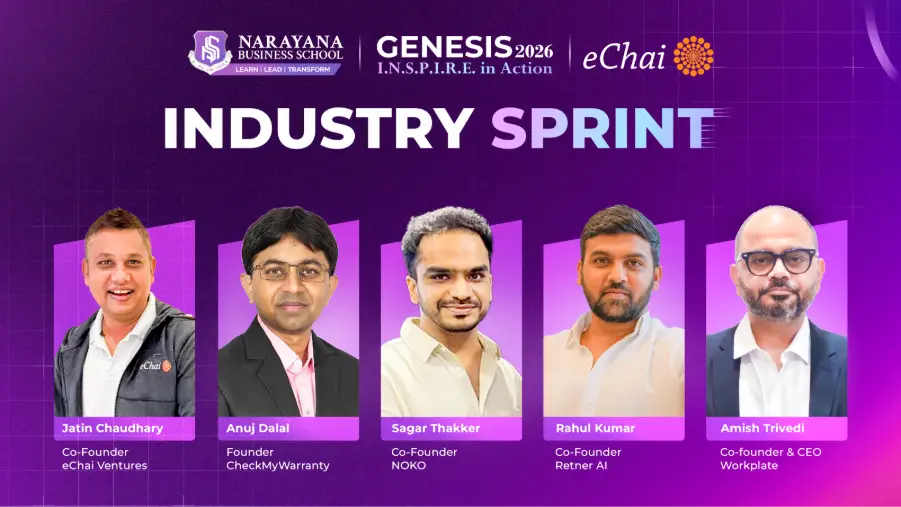
Jatin Chaudhary, the co-founder of eChai Ventures, has significantly influenced the global startup community through his visionary leadership and strategic initiatives. Founded in Ahmedabad, eChai Ventures has grown remarkably, establishing active chapters in over 25 cities across 10 countries.

Jatin’s vision for eChai Ventures focuses on fostering a collaborative environment where startups can thrive through engaging growth meetups and cross-border collaborations. Under his leadership, eChai Ventures hosts regular events that bring together entrepreneurs, investors, and industry experts, creating a dynamic platform for sharing knowledge and building meaningful connections.

Jitendra Lakhwani: Jitendra Lakhwani, an engineer turned MBA graduate, began his career with IBM. Despite early setbacks, his sincere dedication and hard work paved the way for his success. He now heads a leading IT company, underscoring the importance of leveraging early experiences for significant growth. Jitendra highlighted how sincerity and perseverance are crucial in the entrepreneurial journey. He emphasized the value of a solid foundation and the need for continuous learning and adaptability.

Nikita Mahesh: Nikita Mahesh, a law graduate who transitioned into logistics, shared her remarkable journey from a legal professional to a successful entrepreneur. She founded a niche company specializing in ceramic tiles and sanitary ware, leveraging the geographic advantage of Morbi, a major tile-producing hub in India. Nikita’s company, which operates in 13 cities and is completely bootstrapped, stands as a testament to her strategic vision and determination. She emphasized the importance of understanding market needs and adapting to changes to achieve success.

Faraz: Faraz, with a background in BBA and MBA, stressed the significance of building genuine, long-term relationships over transactional ones. His company, which operates in multiple countries including India, the US, UK, Canada, and Australia, showcases the value of meaningful networks and continuous learning. Faraz encouraged aspiring entrepreneurs to focus on cultivating relationships that are based on trust and mutual respect, as these are instrumental in long-term success. 

Narayana Business School partnered with Idea Roast to host a landmark event focused on “Navigating GTM (Go-To-Market) Metrics. The format of the event was designed to enable brimming startups to come 1v1 with industry pioneers where entrepreneurs, investors, or industry experts provide constructive feedback and criticism on startup pitch decks, ideas, or products.

Illustration of startup strategies

The event, modelled after the popular Shark Tank format, the idea was to conduct an event which helps in providing startups an opportunity to present their innovative business ideas to a panel of esteemed jury members. The jury included:

  • Nachiket Patel – Co-Founder And VP – Operations At Digicorp, Board member at GESIA IT
  • Mithilesh Chudgar – Virtual CEO, Performance Coach – Business Growth Specialist
  • Chirag Barot – Consultant at IT services/products
  • Dr Shivangi Shukla – Associate Professor – Narayana Business School

The entire event was moderated by Mr. Vishal Tiwari – VP growth and Strategy – Narayana Business School. Adding to the event’s prestige, special guest Ananya Maloo, the founder of Nuutjob, brought her unique perspective and experience in the startup ecosystem in the firechat session.

The event kicked off with an introduction of the jury members and the special guest. Each startup pitcher was given 20 minutes to present their innovative ideas and products. The Q&A session that followed involved questions from the jury members, providing the startups with valuable feedback and insights.

After the Q&A session, the event took a break for networking, allowing the startups to connect with the jury members and other attendees. The panel discussion that followed focused on the theme of “Unveiling the Myths and Facts behind GTM Metrics.” The discussion was led by the jury members and the special guest, providing attendees with a deeper understanding of the importance of Go-to-Market (GTM) metrics in the startup world.

The discussion concluded with the jury providing final feedback on the startups, highlighting key strengths and areas for improvement. An open floor Q&A session allowed all participants to engage with the jury and speakers, ask questions, and go in-depth into the discussed topics.

“We are thrilled to have collaborated with Idea Roast on this event,” said Vishal Tiwari, VP Growth and Strategy at Narayana Business School. “Our goal is to provide our students with the best possible learning experience, and events like this help us achieve that. We are grateful to Idea Roast for their support and look forward to future collaborations.”

Narayana Business School has a long history of collaborating with industries and organizations to provide its students with real-world learning experiences. The institution was the first postgraduate college in West India to collaborate with EY for its quantitative finance program, further solidifying its commitment to providing its students with the best possible education.

Genuine Relationships:

  • Build meaningful and long-term relationships rather than focusing on short-term gains.
  • Genuine connections can lead to unexpected opportunities and collaborations.

Continuous Learning:

  • Stay adaptable and keep learning to stay ahead in the dynamic startup environment.
  • Embrace new technologies and methodologies to improve business operations.

Leveraging Geographic Advantages:

  • Utilize local advantages to create a niche in the market.
  • Understanding the local industry and customer behavior can provide a competitive edge.

Family Influence:

  • Family backgrounds and early experiences can significantly shape entrepreneurial thinking.
  • Encourage family discussions about business and market trends to nurture future entrepreneurs.

Resilience and Adaptability:

  • Be prepared to face and overcome challenges.
  • Adaptability and resilience are key to sustaining and growing a business.

Narayana Business School’s Genesis 2023 and Idea Roast was a deliberate and successful effort to call all great startup founders under one roof and take lessons from startups that scaled up. By providing a platform for practical insights, constructive feedback, and essential guidance, these events have empowered aspiring entrepreneurs to navigate the complexities of the startup landscape effectively. The collaboration between industry leaders, seasoned entrepreneurs, and ambitious startups has fostered a vibrant ecosystem of innovation and growth.

As the Indian startup ecosystem thrives amid supportive government policies and strong economic growth, platforms like Genesis 2023 and Idea Roast are crucial in shaping the future of entrepreneurship in India. With a focus on continuous learning, meaningful relationships, and strategic adaptability, Indian startups are well-positioned to achieve sustained success and drive economic progress.

Quantitative Finance Program Know It All: The Integrated EY CAFTA Program At NBS vs. Regular EY CAFTA

We see that there’s always a buzz about quantitative finance course in India where students and professionals want to know it all when it comes to learning via masters in finance as a career upgrade, becoming a quant analyst or a better management decision maker. We are living in the times where people are curious about how the world of finance works, how to analyze risk, investments, and make high end finance related decisions. Why is that? 

The potential of general curiosity among people is on a rise, every student or professional is in search for a better alternative to stand out from the crowd. Now, you don’t stand out from the crowd by doing the ordinary, let alone get a simple degree in finance. This is why there’s an upsurge for the demand for learning quantitative finance as a major. Learning quantitative finance is essential in today’s data-driven world, where financial markets are increasingly complex and interconnected. As a quantitative finance expert, you’ll lead financial innovation by creating algorithms for high-frequency trading, optimizing portfolios, and predicting market trends with precision.  

Considering the immense value and career potential of quant finance, we have partnered with industry leaders to develop a customized EY CAFTA program integrated with our Quantitative Finance curriculum. This exclusive combination provides you with the advanced skills and real-world insights needed to excel in high-frequency trading, portfolio optimization, and market prediction.  

By enrolling in this tailored pgdm finance course, you’ll gain a significant edge in the competitive job market, positioning yourself as a top candidate for lucrative roles in investment banks, hedge funds, asset management firms, and fintech companies. Our team of finance experts wants you to learn quantitative finance the best way possible.  

Illustration explaining EY CAFTA program

The EY CAFTA (Certificate in Applied Finance, Treasury, and Analytics) program is a highly regarded certification designed by EY to equip finance professionals with advanced skills in finance, treasury, and analytics. This program covers critical areas such as cash management, investment management, and financial risk management. It’s a better alternative to a diploma in treasury investment and risk management. Professionals engage in rigorous academic training complemented by practical applications through live workshops, real-world case studies, and simulations.  

The EY CAFTA program distinguishes itself from other finance courses through its comprehensive and practical approach to education. Unlike typical finance courses that may focus solely on theoretical concepts, the EY CAFTA program integrates theoretical knowledge with practical applications.  

This integration is achieved through live workshops and real-world case studies, providing participants with hands-on experience and practical insights. Furthermore, the program is continuously updated to reflect the latest industry trends and technological advancements, ensuring that the curriculum remains relevant and up-to-date. The involvement of industry experts and leaders in delivering the program content further enhances its value, providing participants with firsthand insights from those at the forefront of the finance industry. 

Students can even take part in the CAFTA case championship held every year. The EY CAFTA Case Championship is a dynamic competition tailored for ambitious students eager to showcase their skills in finance, treasury, and analytics. Participants work in teams to tackle real-world financial problems, honing their analytical and strategic thinking abilities. Winning teams gain significant recognition and potential career opportunities with EY, making it an invaluable experience for finance enthus.  

Ernst & Young also offers ey financial modelling course which is a top-tier e-learning program designed to teach you the essentials of financial modeling, including data analysis and business valuation techniques. This course is perfect for finance enthusiasts aiming to enhance their career prospects. 

To truly excel in financial modeling, consider the integrated Quantitative Finance program at NBS. This program goes beyond basics, combining rigorous quantitative analysis with advanced financial modeling.

Students from NBS engaging in the EY-CAFTA program, capturing the learning environment.

In the age of everyone trying to find a competitive edge, 90% of the masses end up finding none. The reason being all of us take a similar route thinking that we are the price. Turns out, a lot of people took the same route and now stand at the same position in an effort to find a higher edge. It’s like going to an off-beat place because a travel influencer said so, and now fifty thousand of you are in that off-beat location. Guess what? It’s not offbeat anymore.  

At Narayana Business School, we offer hyper focused post graduate programs that give you a real competitive edge over your competitions. With the same energy, our historic collaboration with EY for its CAFTA program, made us the first and top B school in India (west) to do so giving India one of the best finance courses.  

Criteria  EY CAFTA With QF Program Regular EY CAFTA 
Mode Of study Full Time – Offline Hybrid E-Learning 
Duration 24 Months 90 Hours 
Industry Collaborations Collaborations with top financial institutions Standard industry connections 
Faculty Taught by industry leaders and top academics Delivered by experienced professionals 
Curriculum Trimester Quantitative Finance Curriculum with focus on finance, treasury and analytics Focus on Finance, Treasury, and Analytics 
Program FlexibilityTailored electives to match career goals Fixed curriculum 
Hands-On Experience Extensive Hands-on projects and simulations Limited practical applications 
Capstone Projects Real-world capstone projects with industry mentors Basic capstone projects 
Certifications 14 Certificates after completing each module 1 certificate after completion 
Workshops Exclusive workshops on high-frequency trading, risk management and portfolio optimization Workshops on finance 
Scholarships/FundingAvailability Of merit-based scholarships, education loan and financial aid Limited scholarship opportunities 
Reward Full Time Degree with 14 EY module certifications 1 EY CAFTA certificate 
Alumnus Status Both NBS Alumnus and EY Alumnus Status EY Alumnus Status 
Illustration of EY CAFTA program details

About a few years ago, before integrating EY’s CAFTA program in treasury, analytics and applied finance, our board of studies (BoS) discussed the unrealized and prospective opportunities for best masters in finance courses in India.  

We observed it first hand. The gap between learning online vs offline, learning just applied finance vs learning in depth quantitative finance, professionals looking for a career switch in finance but settling for one certification program, graduate students confused on which finance course to take for higher studies.

Narayana Business School was founded by two great academicians, Dr Amit Gupta and Dr. Purvi Gupta, India gold medalist in the field of finance and certified chartered accountants. We had to deliver the finance education in India, it is our core, our DNA, our identity and most sought after program. We introduced the opportunity of completing international CFA with us along with the quantitative finance program but we wanted to up a notch. Like we said, in an attempt to provide better targeted education, we wanted to provide the best. We want you to have a REAL competitive edge in 2024 and the decades to come.  

Following which, NBS, having a recruiter network and industry connections of 670+, we dug and found EY to be the best for what we already deliver in finance. Tied up with EY to provide one complete quantitative finance course that opens all possibilities for you as a finance expert. The REAL edge.  

The integration of the Quantitative Finance curriculum with the EY CAFTA program at NBS ensures a well-rounded education. This unique combination of finance, analytics, and quantitative methods makes graduates more versatile and highly competitive in the job market.  

Graph showing rise in salaries of quantitative analysts

Our approach towards holistic education and providing the best experiential learning possible, students at NBS benefit from extensive hands-on projects, real-world simulations, and practical workshops. These experiences provide valuable practical knowledge, essential for thriving in the finance industry. 

The program’s strong partnerships with top financial institutions offer students unparalleled networking opportunities, internships, and job placements.  

The program is taught by a mix of leading academics and industry professionals. This ensures that students receive a balance of theoretical knowledge and practical insights, learning from the best in the field. Learn from the pioneers and innovators in finance. 

With a dedicated placement cell and a high placement rate, students are well-supported in securing lucrative roles in the finance sector post-graduation. The program’s comprehensive career development services are designed to help you achieve your professional goals. Step into your dream job with confidence and support. 

International study tours and exchange programs provide students with a global perspective on finance. This exposure enhances their learning experience and significantly boosts their career prospects. See the world, learn from the best, and broaden your horizons. 

These criteria collectively illustrate why the NBS EY CAFTA program, integrated with Quantitative Finance, offers a superior education and better career opportunities compared to the regular EY CAFTA program. Stand out in the crowded finance job market with a truly unique qualification. 

For graduate students and professionals looking for a career change, this program is an exceptional choice. It not only equips you with advanced skills but also provides the practical experience and industry connections needed to excel. With expert faculty, dedicated career support, and global exposure, the NBS EY CAFTA program positions you at the forefront of the finance industry, ready to tackle complex financial challenges and lead with confidence. Transform your future—embrace the path to excellence. 

Become a master in finance, quant finance, better professional after graduation, career advancement after CA or CFA.  

We crafted something which is suitable for every student and professional whether you are seeking for pg diploma in banking and finance, financial risk management course, quantitative trading course or ms in finance. This surpasses bits pilani mba, jbims msc finance, coursera quantitative finance and many others

The Quantitative Finance program at NBS Ahmedabad provides a comprehensive education in finance, blending theoretical knowledge with practical applications. The curriculum includes: 

  • Managerial Accounting: Fundamentals and their applications in decision-making. 
  • Corporate Finance: Advanced financial strategies and analysis. 
  • Financial Mathematics: Quantitative techniques in finance. 
  • Machine Learning using Python: Modern data analysis and predictive modeling. 
  • Financial Econometrics: Statistical methods in finance. 
  • Derivatives Pricing: Valuation of financial derivatives. 
  • Risk Management: Techniques to identify and mitigate financial risks. 
  • Quantitative Asset Management: Advanced portfolio management strategies. 
  • Financial Engineering: Development of new financial instruments and strategies. 

The EY CAFTA (Certificate in Applied Finance, Treasury, and Analytics) program further enhances the curriculum with specialized modules, including: 

  • Understanding Risk: Basics of risk assessment and management. 
  • Financial Markets: Comprehensive understanding of financial markets. 
  • Investment Management: Advanced techniques in investment management. 
  • Financial Risk Management: Strategies for managing financial risks. 
  • Corporate Finance: In-depth corporate finance strategies. 
  • Data Analytics: Introduction to Power BI and data analytics. 

Imagine the advantage of having access to both a comprehensive Quantitative Finance curriculum and the esteemed EY CAFTA program in one seamless educational experience at NBS. This unique integration means you are not only learning advanced financial theories and quantitative methods but also gaining practical insights from industry leaders. With subjects ranging from Managerial Accounting and Corporate Finance to Financial Risk Management and Data Analytics, the curriculum is meticulously designed to prepare you for every facet of the finance industry.  

Here’s your opportunity to learn finance via data. Know the top 10 data science tools to use in 2024 

At NBS, we’ve customized the EY CAFTA program to perfectly align with our rigorous Quantitative Finance curriculum, ensuring that you receive a holistic education tailored to current industry demands.  

The program is delivered and taught by our experienced faculty who follows the unique teaching pedagogy of experiential learning, subject matter experts with vast experience in various sectors, including banks, NBFCs, and corporates.  

The fusion of these programs means you benefit from hands-on projects, real-world simulations, and invaluable networking opportunities with top financial institutions.  

Picture yourself not just learning, but applying complex financial strategies and analytics, preparing you to excel in roles that require both depth and breadth of knowledge. This integrated approach guarantees that you are well-equipped to tackle complex financial challenges and lead with confidence in your career. 

The integrated EY CAFTA Program at NBS stands out as a pioneering educational path for those aiming to excel in the competitive field of finance. This program, blending the rigorous Quantitative Finance curriculum with the prestigious EY CAFTA certification, offers a holistic and advanced learning experience.  

Students not only gain deep theoretical knowledge but also benefit from practical applications through hands-on projects, real-world simulations, and industry workshops. This comprehensive approach ensures that graduates are well-prepared to tackle the complexities of modern finance and secure lucrative roles in top financial institutions. 

Don’t settle for ordinary. Embrace the extraordinary with the NBS x EY integrated program. Take the leap towards a future where your skills are not just relevant but revolutionary. The world of finance is evolving rapidly, and with it, the demand for highly skilled quantitative finance professionals.  

Enroll now to secure your place among the elite, to transform your career, and to become a leader in the finance industry. With the NBS x EY program, you’re not just learning finance; you’re mastering it 

NBS Ahmedabad Is A Truly Digital Community | From Cloud Based Learnings To Operations | 100% DIGITAL FIRST APPROACH At Narayana

Whilst multiple MBA colleges and top universities in India are adapting to the practices of digitization and digitalization, we are excited to announce that we are taking one step further, as the top B School in India, Narayana Business School has embraced the future by adopting 100% digital transformation in its operations and management, making it a truly digital community with its digital first approach. 

Cloud based systems have been set up for all the students of MBA and PGDM batches are Narayana making them well equipped with the latest tech used for operations and communication. 

Further, with the idea of providing the best experiential learning in the country, students of NBS Ahmedabad are proficiently armed with widely used technology for seamless communication and operational excellence, mirroring the sophisticated technological frameworks adopted by the global corporate sector. 

“We are developing an habit on being organized and transparent with our students and management”

All related student activities and faculty operations will now be taken via cloud systems and cloud based applications like microsoft cloud campus, trello, google suite and other softwares. Through such systems and our dedicated internships provided by our placement cell, students of Narayana are always hire ready and 10x more employable with our specialized PGDM programs and MBA specializations

This Everest shift was not a fortnight’s work doing, but a journey of 25 years of observing, analyzing, A/B testing and always keeping Narayana School updated for industry and academia. 

Narayana has ventured beyond the digital horizon, completely remastering the educational landscape within the ethereal realms of cloud technology becoming one of the best MBA colleges in cloud computing and cloud integration in its operations. NARAYANA BUSINESS SCHOOL IS 100% CLOUD CAMPUS AND SUPPORTS CLOUD BASED LEARNINGS AND DIGITAL EDUCATION

WE ARE THE BEST NEW AGE B SCHOOL FOR PG COURSES IN INDIA, AND WE ARE EXCITED ABOUT THE FUTURE WE ARE CREATING. THIS IS MORE THAN AN ADVANCEMENT IN TECHNOLOGY. 

Our primary thought was to build a data centric habit among the entire family of Narayana Business School i.e., all students, staff and directors should have transparent systems, full control of the process, and real time checks. In fact, this is the foundation of our dedicated masters in data science and business analytics program where we build a data driven habit, teach the hows and whys of big data tools and more. 

The adoption of cloud technology and AI in education with higher education has surged, with over 80% of institutions now leveraging cloud solutions to enhance operational efficiency and educational delivery. This paradigm shift has enabled Narayana Business School to offer unparalleled flexibility and scalability in its offerings, ensuring that students and faculty have access to resources and collaboration tools anytime, anywhere.

Integration of Cloud-based classrooms, omni channel communication along with our dedicated offline teaching facility, facilitates a dynamic and interactive learning environment that transcends geographical boundaries. At Narayana Business School, we’ve observed a notable 42% surge in student engagement alongside a 27% enhancement in academic performance, underscoring the profound impact of digital technologies on education.

Our embrace of Customer Relationship Management (CRM) tools has revolutionized our approach, offering a 55% quicker turnaround in addressing inquiries. This pivotal shift has not only boosted prospective student satisfaction but has also propelled our enrollment figures upward by 25%.

Our venture into automating the placement procedure has refined our approach to bridging the gap between our students and prospective employers, bolstering career preparedness. This calculated initiative has been rewarded with a 65% uptick in successful job placements within 2 years full time post graduation, highlighting the value of digital advancements in career services.

Acknowledging the financial hurdles faced by numerous students, we’ve integrated cutting-edge financial aid management solutions. These systems bring to the forefront transparent and adaptable financing options, broadening the horizons of quality education. Consequently, we’ve witnessed a 32% increase in the uptake of financial aid, mirroring our dedication to cultivating an inclusive academic atmosphere.

Cloud Operations

While many universities and colleges claim to be digitally equipped with systems, which is true, they lack the digital transformations in their operations. Having digital equipment to support operations is one thing, but conducting entire operations of a cloud based system is the other. Later, what is known is digital transformations. 

Lately, many new age E learning universities and colleges have adapted the concept of digital transformations like Plaksha University, Master Union while other top colleges like IIM shillong, NIFT Patna, BITS Pilani still lack behind. 

10 Best Reasons To Pursue an MBA Degree

“We, at Narayana Business School, one of the best MBA college in Gujarat, mirror the footsteps of global trends and we constantly update our systems with well demanded curriculum, training and real world knowledge. Thus, WE ARE THE NEW AGE B SCHOOL”

The gateway to our institution (NBSAT),  the admissions process, has been reimagined with a dynamic CRM system, streamlining the journey for prospective students with a touch of personalization and efficiency that mirrors the school’s commitment to excellence from the first interaction. Financial aid, a critical component of accessibility to education, is managed through innovative platforms, simplifying the process for students and families, and ensuring that financial barriers are minimized in the pursuit of academic excellence.

The bridge between academic preparation and professional success is fortified with an automated placement system, enhancing the efficiency of matching our graduates with meaningful career opportunities, reflecting the school’s dedication to student success beyond the classroom. 

Alumni relations are nurtured through a dedicated engagement platform, ensuring that the bonds formed during the educational journey continue to grow, fostering a lifelong community of support and collaboration.

Even the daily nuances of campus life, such as the digital canteen on the MealPe app, are transformed through smart management solutions, elevating the quality of life on campus while optimizing operational efficiency. Communication, the lifeblood of any vibrant community, flows effortlessly through advanced platforms, ensuring that every member of the Narayana Business School community is connected, informed, and engaged.

Through these subtle yet profound enhancements, Narayana Business School has not only streamlined its operational processes but has also enriched the educational experience, ensuring that every aspect of college life is touched by the ease and innovation of digital transformation. This holistic approach to integrating cutting-edge technology across all facets of the institution exemplifies our commitment to preparing students for a future where adaptability, innovation, and connectivity are paramount.

Our academic backbone is strengthened by an advanced ERP system, seamlessly integrating the myriad facets of educational administration, from curriculum planning to student success monitoring, thereby crafting a cohesive and responsive academic ecosystem.

It signifies that our doorway to the institution, marked by the NBSAT and the entire admissions framework, has been redefined through a dynamic CRM system. This transformation has refined the path for prospective scholars, infusing it with a level of personalization and efficacy that echoes our commitment to excellence from the very first encounter. 

Financial aid, a crucial aspect of educational accessibility, is now managed via forward-thinking platforms. These innovations streamline the process for students and their families, ensuring that financial constraints do not hinder the pursuit of academic distinction.

Furthermore, our automated placement system acts as a robust conduit between academic preparation and professional achievement, optimizing the effectiveness of connecting our graduates with significant career opportunities. This reflects our unwavering dedication to the success of our students beyond the academic sphere.

MAKING DIGITAL INDIA

In embracing the vastness of the cloud, Narayana has sculpted a sanctuary of knowledge where the future of education is being written in the code of innovation and the spirit of limitless possibility. We took this step to make our students the best in the industry, and become the HIGHEST EARNERS IN THE ROOM. 

Standing at par with the “Digital India” initiative, this journey transcends the conventional, marking Narayana school not as a mere participant in the digital age but as a luminous constellation guiding the way to a new era of enlightenment ahead of other colleges and universities of India, where education is boundless, accessible, and intertwined with the very fabric of progress. 

Are you prepared to join the best B school which has the most engaging community of post graduates? This is the moment to decide whether to watch from the sidelines or to immerse yourself in the journey towards creating a legacy of innovation and leadership. Will you step forward

Top 10 Data Science Tools To Use In 2024: How Much Do Data Analysts Make?

Undoubtedly deemed as the “hottest career of 2024” data science continues to be a critical field in the modern digital landscape, shaping industries from healthcare to finance with its ability to extract actionable insights from raw data. Data is important in any organization to make better decisions and stay ahead of the competitors.

The application of DS is expanding and impacting numerous aspects of our lives. It is used in every industry, including technology, finance, e-commerce, healthcare, etc. which makes it more significant. According to research by LinkedIn, data science is the most in-demand profession, with a 37% increase in hiring over the previous three years.

For students eyeing a future in this vibrant field, understanding the tools of the trade and potential earning outcomes is essential. Our team of subject experts have analyzed the market and finalized the most in demand data tools in 2024.

Narayana Business School offers masters in data science which by many students has been deemed as the best data science course in the industry. Let’s explore the top 10 data science tools poised for prominence in 2024 and provide a detailed look at salary expectations for data analysts, aiming to guide your academic and career choices effectively. 

Data science enables organizations to identify and refine their target audiences by merging existing data with additional data points to develop valuable insights. The growing importance of data science is rooted in the increasing value of data. 

In the education sector, data science provides centralized control over all student data, enabling educators to evaluate student performance and make informed decisions.

Here are the nuances of each tool, exploring their new features, use cases, and the impact they’re poised to make in the data driven landscape of 2024. Your guide to masters in big data:

ToolOverviewKey FeaturesImpact
PythonCornerstone of data science due to its simplicity, readability, and vast array of libraries.Libraries like TensorFlow, Pandas, and Matplotlib. Improved integration with data platforms and performance optimizations.Simplifies complex data analysis tasks, community-driven support. Indispensable for data scientists.
RKnown for its statistical prowess and graphical capabilities.Packages like tidyverse for data manipulation and ggplot2 for plotting.Beneficial in academia and research for detailed statistical methods.
SQLStandard for managing relational databases.Sophisticated query capabilities, integration with NoSQL databases.Handles large volumes of data efficiently, key in industries with significant database management.
Apache SparkIdeal for large-scale data processing.Enhanced machine learning libraries, better cloud integration.Versatile in processing vast amounts of data quickly, invaluable for real-time applications.
TensorFlowLeading framework for deep learning.Focus on ease of use with more pre-built models, simplified APIs.Drives AI innovations with extensive use in AI research and real-world applications.
TableauStands out for intuitive visual interface for complex visualizations.Better mobile support, enhanced integrative capabilities with real-time data sources.Democratizes data visualization, favored among non-technical users in corporate settings.
Jupyter NotebooksSupports interactive data science and scientific computing via a web interface.Better collaboration tools, increased language support.Ideal for educational and collaborative features in academic and research environments.
GitHubCrucial for version control and code sharing as a repository hosting service.Improved data version control, integration with continuous integration tools.Essential for collaborative projects, efficiently managing changes and maintaining work history.
SASPowerful software suite for data analytics used primarily in corporate settings.Robust analytics and enhanced machine learning capabilities.Useful in sectors like healthcare and finance for data security and precise analytics.
Microsoft ExcelWidely used spreadsheet management despite more advanced tools.Integrates AI features for automation and predictive analysis insights.Continues to fundamental tool for data handling in the business world due to its ease of ubiquity.

Python is a programming language that is easy to learn and use, which is why it’s incredibly popular among data scientists and developers. It has libraries (like toolkits) such as TensorFlow for creating complex machine learning models.

Learn Python Enabled Pandas Tool

Learn Python Enabled Pandas Tool

Pandas for organizing and manipulating data, and Matplotlib for making charts and graphs. Python is great for automating tasks, analyzing data, and building applications. Its community-driven nature means many people contribute to its development, constantly improving its functionality. Recent studies show that big data analytics tools like Python’s simplicity and flexibility are driving its adoption in diverse fields from web development to artificial intelligence.

R is particularly favored in academic and research settings due to its strong statistical analysis capabilities. With tools like tidyverse and ggplot2, it’s perfect for analyzing complex datasets and visualizing the results in detailed graphs. R is often used in biology, economics, and psychology for statistical tests, modeling, and visualization. The comprehensive nature of its packages allows for detailed exploratory data analysis, which is essential in research to uncover patterns or test hypotheses.

SQL (Structured Query Language) is the standard tool for managing relational databases. It helps in efficiently managing structured data, like that in a customer database. Its ability to perform sophisticated queries makes it indispensable in sectors like banking, healthcare, and retail, where managing vast amounts of data is crucial. Recent enhancements allow better integration with modern database technologies, such as NoSQL, which are designed to handle a wide variety of data formats.

Apache Spark is a powerful platform for handling large-scale data processing. It can process data across many machines, which makes it faster than traditional single-server platforms. Spark is ideal for real-time analytics and has applications in industries like finance where immediate data processing is critical, such as for fraud detection systems. The recent updates have focused on improving its machine learning capabilities and making it easier to use in cloud environments.

TensorFlow is a leading tool for deep learning, a type of artificial intelligence that mimics the way human brains operate. TensorFlow is widely used in creating systems that can recognize speech, improve search engine results, and even diagnose diseases from images. Its ease of use and flexibility, thanks to recent updates, make it accessible to both beginners and experts. Recent studies using TensorFlow have shown significant advancements in automated driving systems and healthcare diagnostics.

Tableau excels in making data visualization intuitive and accessible. It allows users to create detailed graphs and interactive reports without needing extensive technical skills. This makes it popular in business environments where quick, clear insights into data are necessary for decision-making. Its latest updates have improved how it works on mobile devices and how it integrates with real-time data sources, enhancing its versatility.

Jupyter Notebooks provide an interactive computing environment where you can combine code execution, rich text, and visualizations in a single document. This tool is particularly useful in educational settings, allowing for a hands-on approach to learning programming and data science. It facilitates collaboration and is used extensively in research to document experiments and share findings.

GitHub is a platform for code hosting and version control, allowing multiple people to work together on software projects. Its recent updates have focused on data version control, which is crucial for teams working on data-intensive projects, ensuring that changes can be tracked and managed effectively. It is essential for developers in maintaining the history of their work and collaborating on projects across the globe.

SAS (Statistical Analysis System) is a suite of software tools specifically designed for data analytics. It’s widely used in professional environments where robust data analysis capabilities are needed, such as in healthcare for analyzing patient data or in finance for risk assessment. Its powerful analytics and machine learning capabilities make it a preferred choice for complex data environments where accuracy and security are paramount.

Despite the presence of more sophisticated analytical tools, Microsoft Excel remains a staple in many business settings. It is primarily used for spreadsheet management, budgeting, and financial analysis. Excel’s recent integration of AI features to automate tasks and provide predictive analysis has kept it relevant in the modern data-driven world. Excel is often the first tool many people learn for data management, making it universally valuable in both personal and professional contexts.

Learn Python Enabled Pandas Tool

Learn Data Science With No Coding Background Required

The role of data science is becoming increasingly pivotal across various sectors. This field, which seamlessly blends statistical analysis, algorithmic development, and technology, is not just enhancing operational efficiencies but is also driving innovation and strategic decision-making. For those considering a career in this dynamic field, pursuing a Masters in Data Science or a PG in Data Science could be highly beneficial. Various institutions offer specialized programs such as Data Science and Business Analytics courses and PGDM in Data Science, tailored to meet the industry’s demands.

In 2024, data science in healthcare is revolutionizing patient care through predictive analytics and personalized medicine. Data Science courses, focusing on healthcare applications, teach how to manage and analyze vast datasets—from patient genetics to lifestyle choices—enabling the development of tailored treatment plans that significantly improve patient outcomes. Additionally, Data Science certifications are equipping professionals to use machine learning models to predict epidemic outbreaks and devise response strategies, critical in preempting and managing public health crises.

Financial institutions are leveraging data science to enhance customer experiences and optimize risk management. Business Analytics and Data Science courses are crucial for professionals aiming to develop algorithms that detect fraudulent activities in real-time and automate trading strategies. Moreover, Data Science courses near me can provide localized training, integrating AI with traditional banking processes to facilitate personalized banking services.

The retail landscape is undergoing significant transformation thanks to data science. Courses on Big Data and Data Science help professionals optimize supply chain logistics and personalize shopping experiences through predictive analytics. These programs enable retailers to forecast demand more accurately, manage inventory efficiently, and enhance customer satisfaction through personalized recommendations.

The transportation sector benefits from a data-driven approach, improving everything from traffic management to fuel efficiency. Professionals trained in Data Science course eligibility that include geospatial data analysis are optimizing routes, reducing traffic congestion, and advancing autonomous driving technologies.

Data Science courses play a crucial role in combating climate change by analyzing environmental data. These courses prepare scientists to predict weather patterns and assess the impact of human activities on the environment. The knowledge gained is crucial for developing effective environmental policies and technologies aimed at reducing carbon footprints and promoting sustainability.

Data Analysts

Becoming a data analyst can be a lucrative career choice. Here’s what influences their salary:

A degree in masters in data science or related fields like quantitative finance often leads to higher starting salaries.

Even as a fresher you shall earn well if studied from the best b school.

Salaries vary widely depending on geographical location like Ahmedabad is the emerging hub of data and quant experts.

Industries with higher stakes in data, like finance and technology, typically offer higher pay.

Industries with higher stakes in data, like finance and technology

In the U.S., the average salary for a data analyst ranges from $60,000 to $90,000 annually, with variations depending on the above factors.

Globally, salaries vary but follow similar patterns influenced by the local economic landscape and industry demands.

For graduate students eyeing a future in data science, business analytics, looking for MBA in data science and analytics is essential. The ability to analyze and derive meaningful insights from data is defining the new era of financial professionals. By embracing data science, aspiring financiers equip themselves with the necessary tools to innovate and excel in this evolving field.

As the reliance on data continues to shape financial strategies, the demand for skilled practitioners in data science will only increase, promising a rewarding career at the intersection of finance and technology.

Consider enrolling in a data science course, data science programs, or pursuing a PGDM in data science to start your journey in this lucrative field.

Industries with higher stakes in data, like finance and technology

NBS On Quora