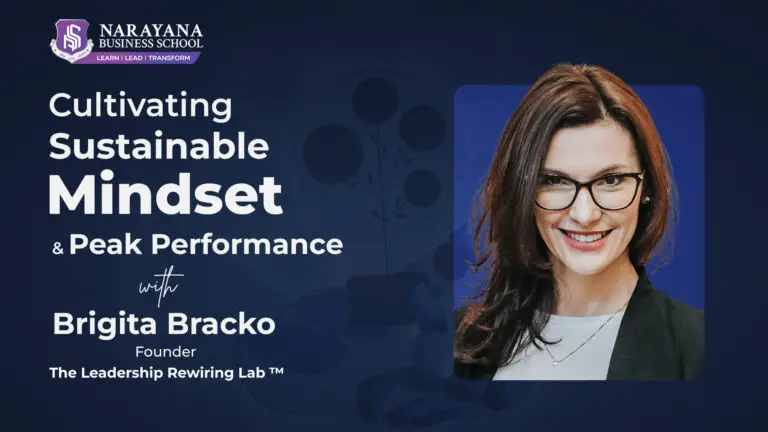
Cultivating Sustainable Mindset & Peak Performance With CBH Expert Brigita Bracko 

31st May, 2025 – “Sustainable mindset” a topic which resonates deeply with our ethos at Narayana Business school. We have carried NBS sustainably for over 24 years and as India’s fastest growing B school founded by academicians we continue take active initiatives to remain committed to our ethos and roots and nurture the young leaders of rising Bharat. 

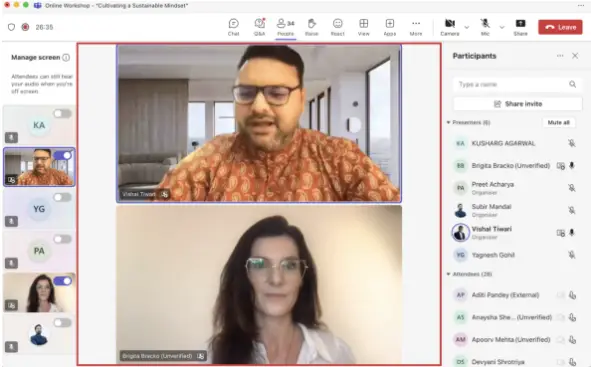
Continuing the momentum, we invited Brigita Bracko, Founder of The Leadership Rewiring Lab™, a certified Cognitive Behavioural Hypnotherapist from Bali, Indonesia and a licensed Rapid Transformational Therapy (RTT) practitioner. Through neuroscience-based tools, Cognitive Behavioural Therapy, Hypnotherapy, and Organizational Psychology, she creates powerful mindset shifts that drive sustainable transformation.

The workshop was hosted by Mr. Vishal Tiwari – VP Growth & Strategy At NBS, and was joined by NBSians, educators, and entrepreneurs.

Unlike typical workshops that focus on what to think, this session taught participants how to think. The approach emphasized on understanding the root causes of mental patterns, developing strategies and creating sustainable change through awareness rather than willpower.  

Workshop on Sustainable mindset

Sustainability is about making sure there’s enough left over for tomorrow and the next day, and for everyone else too.  

A sustainable mindset takes a big idea and brings it home to you. It means learning to think ahead, to balance your needs today with what you’ll need in the future. If you’ve ever stayed up late working on a project, only to feel exhausted and unproductive the next day, you’ve seen what happens when you ignore sustainability in your own life.  

A sustainability mindset asks you to notice when you’re stretching yourself too thin whether that’s staying glued to your phone, overcommitting at work, or squeezing too many social plans into a weekend and to give yourself permission to slow down before you burn out.  

Brigita Bracko began with a warm smile. “But what if I told you that the most important thing to sustain is actually your own mind and well-being? That’s what a sustainable mindset is really about learning to think and live in ways that don’t burn you out or drain the people around you.” 

Sustainability is about fundamentally creating systems of thinking and being that can endure, regenerate, and thrive across time without depleting the resources, whether mental, emotional, social, or environmental, that sustain them.

The workshop addressed critical areas that often hold people back from reaching their full potential:  

The workshop revealed how to rewire the brain to perform well in high-pressure environments. Unlike traditional motivational approaches that focus on temporary inspiration, this session taught participants how to create lasting mental patterns that support consistent excellence. 

Bracko explained that most performance goals are undermined not by lack of talent, but by unconscious mental habits that work against success. Participants learned specific techniques to identify and modify these patterns, creating a foundation for sustainable achievement.

A breakthrough moment came when participants learned about the true nature of fear and emotions. “We experience more than 80 different emotions, yet fear dominates our decision-making,” Bracko noted. “Understanding that fear is simply our brain’s way of trying to protect us changes everything.” 

The session explored how fear often becomes counterproductive in modern life, causing people to avoid opportunities, freeze in important moments, or make decisions based on outdated survival instincts. Participants discovered practical methods to acknowledge fear without being controlled by it.

  • Fear is not the enemy – it’s trying to protect you 
  • You can observe your thoughts without being trapped by them 
  • Emotions provide valuable information when properly understood 
  • The mind can be trained like any other skill 

Perhaps the most eye-opening revelation was learning that most people operate with awareness of only 5% of their mental processes. This means 95% of thoughts, reactions, and behaviours happen automatically, often working against stated goals and values. 

Bracko guided participants through exercises to expand their conscious awareness, teaching them to: 

  • Recognize unconscious thought patterns 
  • Identify triggers that lead to unwanted reactions 
  • Develop the ability to pause and choose responses 
  • Build stronger connections between intention and action 

“Self-awareness is the first step to sustainable change,” explained Bracko. “When you can observe your mind in action, you gain the power to direct it consciously.” 

Brigita introduced several groundbreaking concepts that challenged traditional self-help approaches: 

Participants learned a simple but powerful language shift that can transform thinking patterns. Instead of using “but” (which dismisses previous thoughts), using “and” allows for more complete, balanced thinking. This small change helps break the cycle of all-or-nothing thinking that often leads to mental paralysis. 

Rather than trying to eliminate negative emotions, the workshop taught participants how to work with them constructively. “Negative emotions actually make us feel more alive and provide important information,” Bracko explained. “The goal isn’t to be positive all the time – it’s to be aware and responsive.” 

A fascinating segment explored how our brains, designed for prehistoric survival, often work against us in modern environments. Participants learned why the mind tends toward negativity (it kept our ancestors alive) and how to retrain these ancient patterns for contemporary success. 

“High performance goals are often held back by our actions, not our intentions,” noted Bracko during the session. “When we recognize our thought patterns and understand that we can really change our beliefs, transformation becomes possible.”   

Throughout the workshop, Bracko shared profound insights that resonated deeply with participants:   

We start to build our subconscious from where we are born. Most of what drives our behaviour comes from patterns established early in life. But here’s the exciting part, when we become aware of these patterns, we gain the power to consciously reshape them. 

In relationships, the sustainable mindset is asking ‘What is this person battling through right now?’ instead of taking their behaviour personally. Understanding that everyone is fighting their own internal battles changes how we respond to conflict.  

The goal isn’t to become someone else, it’s to become more consciously yourself. When you understand how your mind works, you can direct it toward what truly matters to you.

Fear doesn’t act upon you – it becomes anxiety when you think about the future or regret when you dwell on the past. In the present moment, fear is just information about what needs attention.

There was one “aha” moment in the workshop where Brigita asked all of us to look around and remember all the “blue” coloured objects around us. For a minute we did and came back. Then she said, “Now tell me a “red” coloured object around you without looking, and there was a pause, a cinematic pause, nobody knew the answer signifying that our focus is always rooted to where we look. 

We live in times, where anything and everything is and can be glorified. To some extent and all of us being guilty, glorified the “overwork hustle” culture too. Always quoting a few exceptions that work we built a narrative that hustle brings purpose, that forget health and work, that sacrifice sleep and work, that forget relationships and work.  

Have you ever noticed that you might have 100s of problems in your life, but the moment you fall ill, there’s only 1 problem in life? To get back up? Doesn’t it signal something? That there’s nothing without health? 

While being ambitious is fruitful, and all successful things in the world once started with an obsession, it is important to keep a check on yourself, to sustain your body and mind. A small habit for lasting impacts.  

It is imperative that we adopt a sustainability mindset moving forward in our lives, not just for us but for the people around us too.  

“This workshop represents our commitment to holistic education,” said Vishal Tiwari.  

“We believe that academic excellence must be paired with emotional intelligence and mental resilience. Our students and community members deserve tools that will serve them throughout their lives, not just in their immediate academic or professional challenges.” 

NBS Ahmedabad continues to offer cutting-edge workshops and programs designed to prepare students and professionals for success in today’s demanding world.  

Keep an eye on our events page to be a part of such transformative experiences: https://nbs.edu.in/events/  

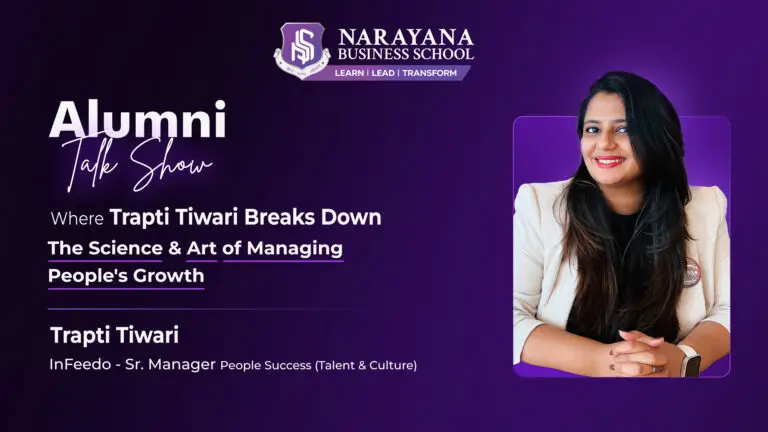
Alumni Talk Show EP 2: NBS Alumna Trapti Tiwari Breaks Down The Art And Science Of Managing People’s Growth

22nd May, 2025 – Alumni talk show is the signature initiative by the Alumni Association of Narayana (AAN) with the motive to create an inclusive environment between the students and alumnus of NBS. With over 9,400 alumni, this talk show was also born from the idea of exploring whether what we teach and preach truly holds up in the real world, once our students enter the corporate world or advance in their careers. 

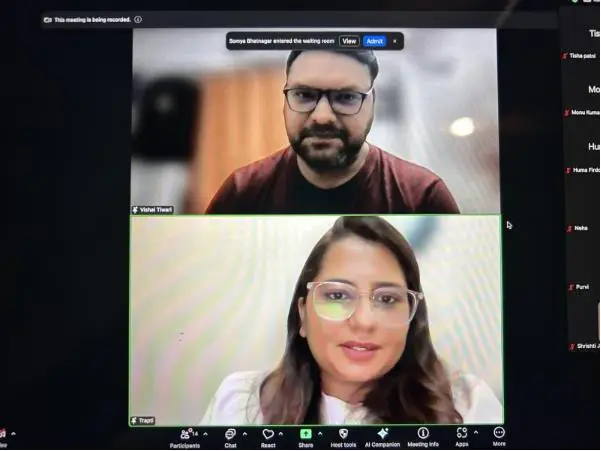
This talk show acts as a direct proof of the ethos of Narayana Business School, the ethos required to build, to succeed and most important of all, to build and succeed sustainably. On that note, we invited Trapti Tiwari – Sr. Manager People Success (Talent & Culture) at Infeedo AI for the second episode of Alumni talk show to talk on the topic of “The science and Art Of Managing People’s Growth” hosted by Vishal Tiwari – VP – Growth & Strategy at NBS Ahmedabad. 

Trapti opened the session with a reflective account of her early days, navigating through different cities like Mandsaur, Ahmedabad, and Gurgaon. She candidly spoke about the anxiety she experienced at the age of 18 and how those challenging years shaped her resilience. “Too much anxiety at that age, but no one teaches you how to manage it,” she said. “Sometimes you just have to keep moving as life itself becomes the teacher.” 

While having lived in different cities throughout her career, each city had its own diversity and made Trapti understand a lot about people and their background they are coming from. Like what we discussed in our recent webinar on Rise of Bharat, Trapti has been through the two Indias, one in the metro and the other in the towns. Her geographical, professional and interpersonal experience is what compelled us to speak to her as she knows the true art and science of managing people’s growth.

All of this has helped Trapti become a compassionate human and better HR professional. Today she works at Infeedo AI, Asia’s leading employee experience platform that helps engage employees, predict attrition & answer FAQs with conversational AI that people love. 

As an HR, the art and science of managing people’s growth is a very crucial task especially in today’s time as it is very easy to be swayed by bogus narratives pushed forward by social media. The agenda of the webinar was to showcase NBSians and other fellow attendees what skill sets you require to manage people as an HR and the kind of candidate every HR should look for their organization. 

She emphasized that students should not measure every task against their ego. Instead, she encouraged them to benchmark themselves internally and use every experience as a stepping stone, even if it’s outside their comfort zone. Referring to her own early days, taking every given task as the ultimate challenge and the hunger to do it in the best of best way is what works in real life. While attaching a few ups and downs in a professional environment to your ego can be fatal, focusing on the efficiency of tasks, interpersonal skills, transparent communication is what can take individuals higher and farther in their careers.

Quoting loosely from Maslow’s hierarchy, she urged students to find purpose beyond self-validation. “Don’t tag everything to your ego. Try to benchmark the task, not your pride,” she said. 

“Even if you don’t enjoy something,” she advised, “ask yourself what you can learn. That mindset completes the journey faster than any shortcut.” 

While touching upon the art of people management, Trapti ideal traits she looks for while hiring a candidate and what every HR should learn and observe to do as well.  

Ownership, Curiosity and the Courage to Disagree 
Central to the “art” of people management, Trapti suggested, are three non‐negotiables: 

  1. Ownership. Leaders look for candidates who treat challenges as personal missions. 
  1. Curiosity. Asking why and how sparks innovation and fuels continuous improvement. 
  1. Constructive Dissent. “I don’t want yes-men,” she quipped. “When you disagree respectfully, you push the team forward.” 

She illustrated these traits with examples from her hiring experience at Infeedo AI, where candidates who took initiative rather than waiting for direction, earned callbacks and offers. She reminded us that people management remains, at its core, a deeply human endeavour. 

Tripti’s message to students was clear: while tools, certifications, and technical know-how are essential, what truly propels careers and organizations forward are mindset traits that cannot be automated or templated. 

To build a culture that cultivates these attributes, she offered three tips: 

  • Hire for traits, train for skills: Prioritize potential and mindset over a perfect CV. 
  • Reward initiative: Publicly recognize those who step up, question, and contribute beyond their roles.
  • Model dissent at the top: Leaders must welcome disagreement to make it safe for others to do the same.  

Trapti tiwari along with Vishal Tiwari on the webinar


According to Forbes, AI-powered chatbots and virtual assistants now handle up to 70% of routine HR inquiries, everything from leave requests to benefits questions. Eventually freeing HR teams to focus on high-value activities such as coaching and culture building  

Likewise, The Guardian reports that an AI-enabled payroll platform reduced one HR team’s monthly processing time from two days to under an hour, enabling them to spend more time on employee relations and onboarding.  

“There’s a lot of noise about AI replacing jobs. But the reality is AI is removing the repetitive parts so you can focus on being more productive and creative,” she said.  

By offloading repetitive and rule-based duties, AI frees HR professionals from the “busy work” that once filled their days. The result is twofold: 

  1. Productivity Gains: HR teams can process larger volumes of tasks with higher accuracy and far fewer delays or errors. 
  1. Creative & Strategic Bandwidth: Freed from administrative bottlenecks, HR practitioners can devote time to higher-value activities such as designing innovative engagement programs, coaching managers on leadership best practices, or analyzing workforce trends to inform talent strategy. 

UPCOMING WEBINAR ON AI: CLICK HERE  

One of the crucial things which was touched upon in the webinar by Trapti Tiwari for students was to work, work like it was your ultimate challenge and strive to make the task a benchmark for others. That’s how you grow in your initial years. Don’t tag everything to your ego, communicate as much as you can and stay CURIOUS.  

Another thing noted by Mr. Vishal Tiwari after being asked a question “sir what if we don’t like our jobs?”, he said, if you don’t like anything but it is important for your overall survival, find ways to through that phase of life as quickly as possible instead of being complaining about it.  

And that is what we desire from the students of NBS Ahmedabad, to have a solution-oriented mindset, which is farther life helps organization and the individuals personally too. It’s easy to blame-shift, whether on a person, the situation or God, but what matters is how quickly you take responsibility, fix the hiccup and move on the bigger fish. That’s what being a good HR is about, that’s what is the art and science of managing people’s growth.  

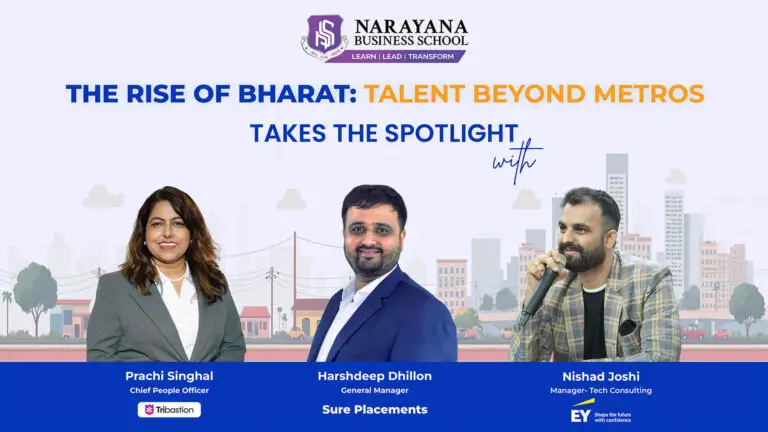
The Rise Of Bharat: Talent Beyond Metros Takes The Spotlight, NBS Ahmedabad Sparks Dialogue 

Ahmedabad, 21st May, 2025 – As India’s fastest growing B school, we are compelled to stir up the conversations often ignored by mainstream narrative. We feel compelled to nurture our students and faculty to stay in touch with ground narrative. And we are compelled to act and build in extension of our ethos and truly contribute to the rise of Bharat in 2025.  

We are not just a new age B school based out of Ahmedabad, we are the pioneers of this knowledge driven world, providing the best opportunities and exposure to individuals beyond the metros. 

To stir up the dialogue, we conducted a webinar on “The Rise Of Bharat: Talent Beyond Metros” and invited thought leaders across industry. They were: 

  1. Prachi Singhal – Chief People Officer | Tribastion Technologies 
  1. Nishad Joshi – Tech Manager | EY 
  2. Harshdeep Dhillon – General Manager | Sure Placements  

In the opening remarks, Nishad Joshi, an HR professional and implementation expert, asked a perfectly timed question to the entire audience, “There’s a very famous monologue of Vir Das saying, ‘I come from two Indias’, so which India to you come from?”, and that set the tone for the entire webinar.  

The webinar titled “Rise of Bharat: Talent beyond metros” saw panellists sharing anecdotes from their journeys and experiences in education and employment. 

Prachi, an HR leader, shared her transition from Dehradun to western India, emphasizing that “intent matters more than just knowledge.” She underlined how students today are more aware, more driven, and have access to tools and exposure that were once limited to urban elites. 

As per a report published by datareportal in February 2025, India counted 806 million internet users, with penetration at 55.3% of its 1.46 billion population. Crucially, 62.9% of Indians still live in rural areas, and internet growth in these regions is outpacing urban centres two-to-one.  

Harshdeep, who has been in and around industry-academia placements highlighted how connectivity has become the great equalizer post-COVID, opening doors for rural and semi-urban talent like never before. “There is fierce competition, but those from smaller towns often come with a deeper passion to change the legacy of their families”

What he meant is that individuals coming from towns have a deeper sense of purpose, probably an added obligation to become something, support their loved ones and earn a reputation in their careers. All of this in turn becomes added fuel, builds a problem-solving mindset to pursue, perform and stay curious in their professional front making them better managers for any organizations.  

Also, he noted that individuals coming from towns showcased a higher sense of loyalty and affinity towards their work and the company as well. They stick to one organization longer than those hailing from the metros. This is also one of the reasons why many companies prefer individuals who came stay with them longer as it is beneficial in multiple areas both for the individual and for the company.  

Now, this dialogue does not undermine any individual’s potential basis their geographical affinity, instead it brings a fresh perspective of the rising India and where the current recruiters are eyeing their next managers.  

In recent years, there has been a notable shift in recruitment strategies among Indian companies. Organizations are increasingly looking beyond metropolitan areas to tap into the rich talent pools of smaller towns and rural regions. This trend is driven by a combination of factors, including the desire for a more diverse workforce, cost efficiencies, and the recognition of the unique qualities that candidates from these areas bring to the table. 

The discussion also examined the role of educational institutions. “B-Schools today play a crucial part not just in education but in building confidence and bridging students to corporate ecosystems,” said Prachi. The focus, according to the panel, should be on developing a problem-solving mindset, learning effective communication, and tapping into the consumer awareness of today’s students. 

NBS Ahmedabad recognized this emerging shift towards smaller towns nearly two decades ago. Founded by an academician duo, we have engaged at the grassroots level and ascended to the top, witnessing the two Indias firsthand. We have always believed in the potential and loyalty of Bharat’s talent emerging from towns. Understanding the responsibility of cultivating the mindset in a knowledge driven world, we take proactive steps and initiatives to support our ethos and help students make the most out of their 2 years spent with us, beyond textbooks.  

While textbook knowledge is important, we are observing a significant and adamant shift in the demands of recruiters to employ only practically exposed students and not just number toppers. Through our various portals like Alumni association of Narayana (AAN), Narayana centre for research and innovation (NCRI) and industry partners with NISM, EY, JITO JIIF, CII and many more, we are home to a 100% digital campus and ensure maximum exposure to students hailing from towns of India, often struggling to secure the right admission and the right B school. Our evaluation patterns go beyond just numbers and rather focus on the entire personality of the student.

The narratives shared by panellists emphasized a pivotal shift in India’s socio-economic fabric. Small towns and rural regions are no longer just passive participants but active drivers of change. Their stories serve as a clarion call for policymakers, educators, and businesses to recognize and nurture the immense potential that lies beyond the metros. 

Individuals from towns often have an added hunger to work. They have resilience, loyalty, and drive,” emphasized Vishal Tiwari, closing the session on an inspiring note. 

We at NBS Ahmedabad emphasize on building an entrepreneurial mindset among these students, teaching them how to start a startup, providing initial support and the knowledge required. We do this in the hopes and beliefs that students coming from towns, after getting the best knowledge and exposure will go back to their towns and build there. This is turn will fuel the growth of tier 2 and tier 3 cities, eventually contributing to the rise of Bharat by the talent beyond metros.  

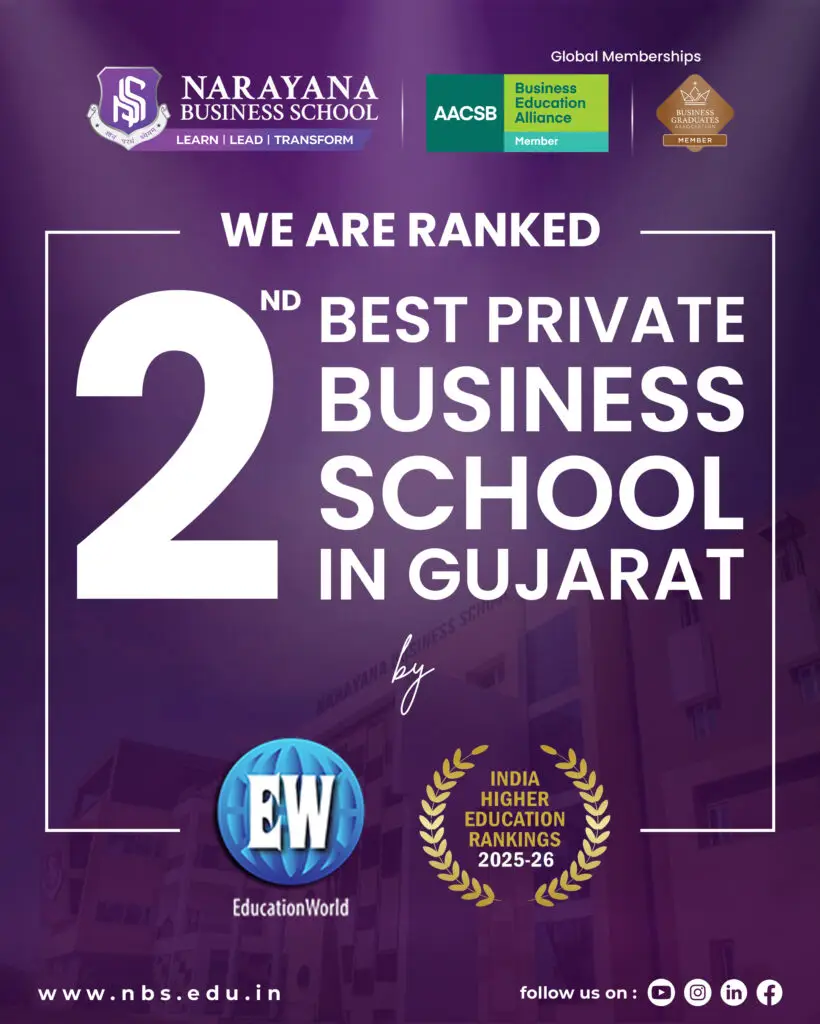
List Of Best Private B School In Gujarat: NBS Ahmedabad Ranked 2nd Best Private B School In Gujarat By EducationWorld (EW) India 2025-26 

In 2025, Gujarat stands tall as one of India’s most exciting places to study. What started as a handful of colleges decades ago has grown into a vibrant ecosystem of education. 

Today, the state is home to more than 60 universities—2 central, 30 state-run, and many nationally recognized top-rated private B schools. You’ve probably heard of names like Narayana Business School, Nirma University, Ahmedabad University, and Parul University. 

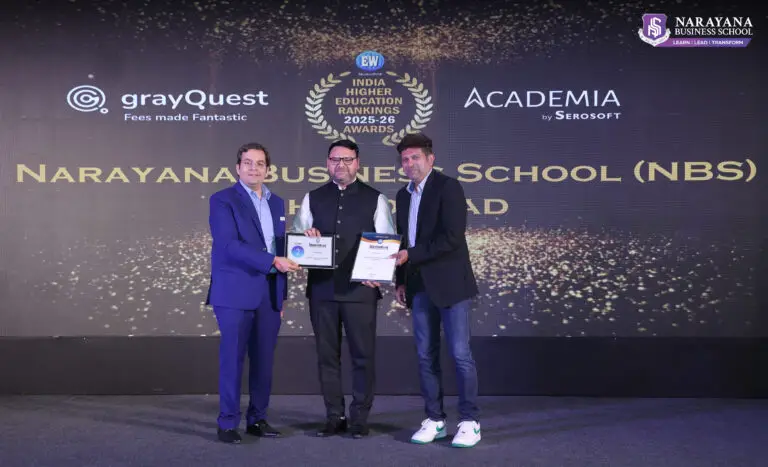
As Gujarat continues to emerge as the most preferred hub for multidisciplinary education and research in India, we are proud to represent Ahmedabad, Gujarat on a national level and announce that Narayana Business School has been ranked 2nd best private B school in Gujarat by EducationWorld (EW) India Higher Education Rankings 2025-26. This announcement was made at the EW India Higher Education Grand Jury Awards held at The Grand, New Delhi, Vasant Kunj, on April 25, 2025, where top academic institutions from across the country were honored. 

Mr. Vishal Tiwari, Vice President – Growth & Strategy at NBS, represented the institution at the ceremony. He stated, “Proud to receive this recognition on behalf of NBS and to represent the growing spirit of Gujarat on a national level, we at NBS continue to enhance the learning experience and contribute highly to the rising India growth story”

Continue reading to find the list of the best private B school in Gujarat ranked by EducationWorld (EW) 2025.

EducationWorld ranked business schools based on academic excellence, faculty quality, placement performance, infrastructure, industry interface, and global exposure. Here are the top-ranked private B-Schools in Gujarat as per EW India 2025-26: 

  1. Narayana Business School Ahmedabad (NBS): 2nd Best Private B School

  2. Nirma University Ahmedabad: 1st Best Private B School

  3. ICFAI Business School (IBS), Ahmedabad: 3rd Best private B School

  4. Laxmi Institute of Management, Sarigam: 4th Best Private B School

The full-day conference and awards event, organized by EducationWorld in association with GrayQuest and Academia by Serosoft, was held on April 25, 2025, from 10:00 AM to 6:00 PM. The agenda focused on critical issues in higher education, disruptive innovation, digital transformation, and institutional excellence. 

The talk of the jury was how in 2025 universities and b schools are adapting to the changing tech preferences and the sharp tilt towards the adaptation of AI. We at NBS Ahmedabad, do not discourage the use of AI but rather encourage AI in education. Our students are presented with the opportunities to use the latest tools and tech making them efficient, independent and responsible individuals.

    Why haven’t any of India’s 1,168 universities and 45,000 colleges invented a globally celebrated product in 77 years? 

    Panellists examined systemic challenges hindering innovation in Indian academia, emphasizing the need for interdisciplinary approaches, enhanced research funding, and stronger industry-academia collaborations. 
    – Moderated by Dilip Thakore, Publisher, EducationWorld 

    1. Thematic Discussions 
    • Campus to Career: Work-Readiness Revolution by Bhavin Shah, CEO, EducationWorld 
    • Boosting Fee Collections for HEIs Using Technology – Rishab Mehta, CEO, GrayQuest 
    • Digital Transformation of a 21st Century Campus – Arpit Badjatya, CEO, Serosoft 
    • Higher Education 4.0: Disruptive New University Models moderated by Summiya Yasmeen, Managing Editor, EducationWorld 
    1. Categories Of Awards & Rankings Revealed 
    • Private & Government Autonomous Colleges 
    • Non-Autonomous Colleges 
    • Engineering Institutes 
    • Private B-Schools 
    • Private Universities 
    • Government Universities 
    • Skill Development, Digital Innovation, and Design Excellence 
    1. Special Jury Recognitions 
    • Diversity Inclusion & Equity Champion 
    • Exemplary Researcher of the Year 
    • Top-Performing University of the Year 
    • India’s Best Undergraduate Institutions – Class Size / Internships 

    Find the details here: https://educationworld.in/rankings-private-b-schools/

    NBS Ahmedabad ranked 2nd best private business school in gujarat

    At a time when higher education is being redefined by global disruption, technological acceleration, and shifting employer expectations, NBS is positioning itself at the intersection of innovation, ethics, and industry relevance. 

    In 2025, NBS took a major leap forward by becoming a member of the prestigious AACSB Global Business School Network along with BGA global B school network, a mark of global integration and a signal of its rising influence.  

    This affiliation opens access to a community of over 40,000 global educators, researchers, and business leaders, allowing NBS to benchmark against the best and bring international perspectives directly into its classrooms. 

    With specialized programs in Data Science & Business Analytics, and Quantitative Finance, the school is proactively aligning its curriculum with the demands of tomorrow’s economy. Its adoption of AI-powered learning platforms signals a shift toward more adaptive, personalized, and tech-augmented education where students learn not just content, but how to think critically, adapt quickly, and lead responsibly. 

    First Ever Alumni Talk Show At NBS Ahmedabad Dives Deep Into FinTech And The MSME Landscape Of India

    We came to a realization that students often need tangible proofs or outcomes that can validate their time and effort in the B school. The young India today is not just satisfied with a 100% placement guarantee, they are here to break the stigma, provide actual value and bring about a societal change at large. No matter the specializations they are choosing, “how to provide value and grow a business” will forever be at the core and NBSians understand that.  

    To fill this flask of enthusiasm, NBS Ahmedabad recently hosted its first ever Alumni Talk show virtually hosted by Vishal Tiwari and Preet Acharya from NBS.  

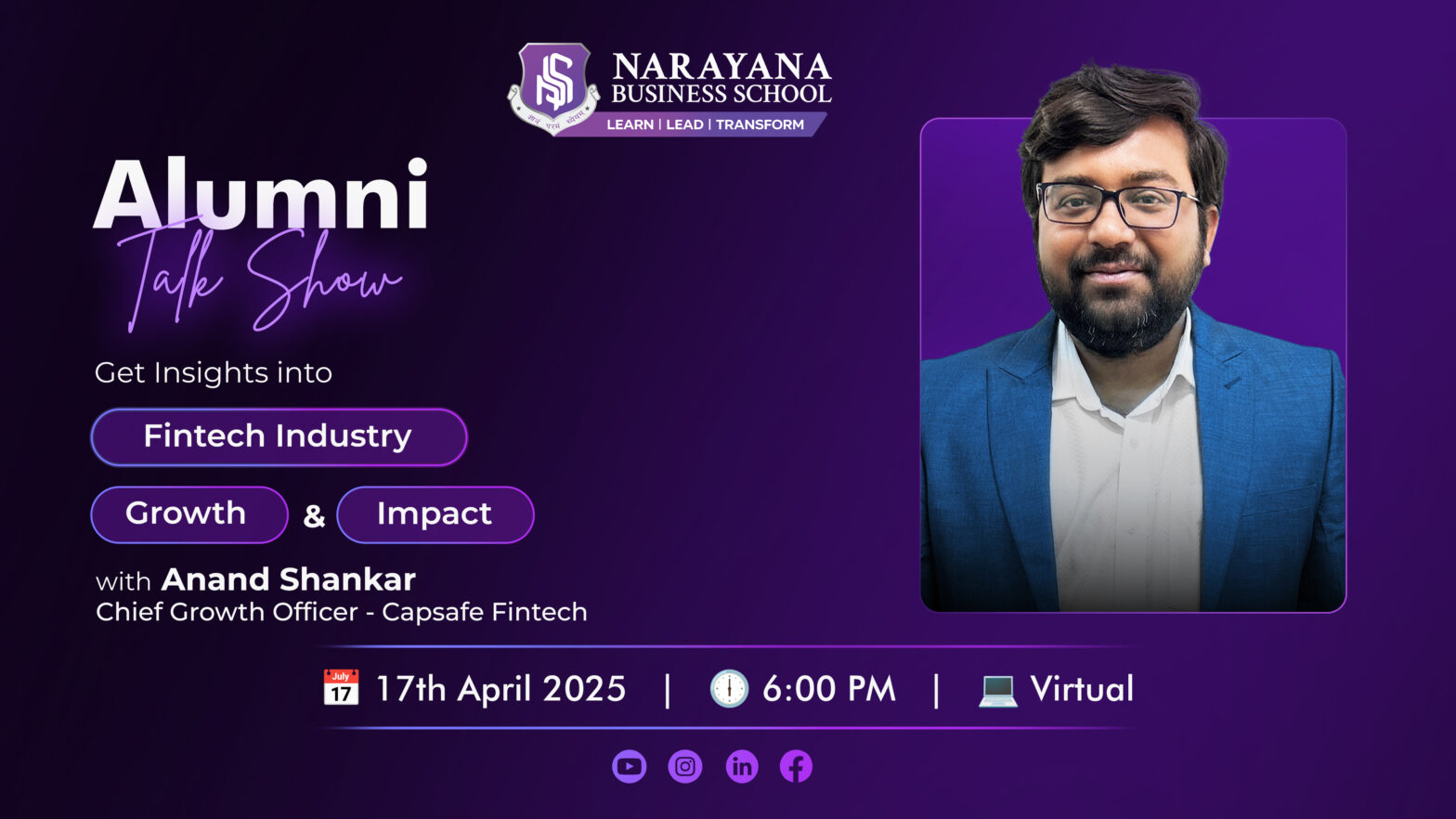
    The guest was none other than Anand Shankar, a proud NBS alumnus and Chief Growth Officer at Capsafe FinTech. Alumni Anand is a tangible proof of the culture and learning given at NBS and the outcomes which comes only with persistent effort and keeping the growth of a business at the centre of everything.  

    The talk show began with a note from Vishal Tiwari – VP Growth & Strategy that “I once heard the founder of InShorts Azhar Iqubal say, ‘curiosity is important, curiosity is the driving element that will always take you farther in life. You will definitely do something in life if you are a curious person’.” 

    Alumni talk show with Anand Shankar

    The note set the tone for the entire talk show to encourage current NBS students to ask even the silliest of question and not let the curiosity die throughout.  

    Opinions varied on this topic. While the development and innovation in the AI sector are rapid, its widespread adoption is still relatively new. AI can indeed act as a shortcut to outcomes; however, problems arise when its use becomes compulsive. Let us explain:

    • Fundamentals will always be fundamentals:

    Let’s say you’re trying to prepare your company’s balance sheet. Earlier, you’d go through each ledger, check every entry, and match the assets and liabilities yourself. It took time, but you learned a lot in the process – how numbers work, how mistakes happen, and how to fix them. 

    Today, you can just type a prompt into an AI tool, and it gives you the result in seconds. It’s fast, yes, but where’s the learning? If every task in your personal and professional life is just a prompt away, are you really preparing for your dream career or just getting better at talking to AI? 

    During the talk show, Anand and Vishal Tiwari highlighted why fundamentals still matter. Technology and AI are powerful tools, they should help you, not replace you. Real growth happens when you do the work, make mistakes, ask questions, and learn through experience. That’s how you build real knowledge and skill not just by getting the answers, but by understanding the “why” behind them.  

    Real learning, the kind that sticks comes from doing. It comes from struggling through mistakes, asking questions, trying again, and slowly building the muscle memory of your craft. Whether you’re in finance, marketing, coding, or design, it’s the hands-on experience, the human judgment, and the deep understanding of basics that truly set you apart. 

    You can’t replace experience with shortcuts. You can’t replace human thinking with just automation. You need both. 

    AI is amazing. It can do things faster and sometimes better. But it can’t think for you. It can’t learn for you. And it certainly can’t build your career for you. 

    So yes, use AI. Use it smartly. But don’t skip the fundamentals. Because in the end, it’s those basics that will keep you grounded, help you grow, and carry you forward no matter how advanced the tools get. 

     MSME landscape of India

    As an experienced finance professional and being associated with Capsafe Fintech which caters to MSMEs only, host Vishal Tiwari asked Anand Shankar to share his POV on the current landscape of MSMEs in India and what picture should a student draw about the MSME landscape in today’s India. 

    Anand Prakash knowingly formulated that the current scenario of MSMEs in India is not under the right spotlight while startups are stealing majority of it.  

    It is imperative to understand the difference between startups and MSMEs, two terms which are often used interchangeably but should not. Startups focus on rapid growth and disruptive innovation to reshape markets, while MSMEs prioritize steady and sustainable growth within established industries.  

    Startups are often characterized by high-growth potential and scalability, relying on external investments to fuel their ambitious plans and it is important to have the right knowledge on how to start a startup in India to make it succeed. MSMEs, on the other hand, focus on stability, gradual development, and sustainability, often relying on traditional funding sources.  

    Even in major cities like Ahmedabad, many MSMEs lack necessities such as current bank accounts, Aadhar cards, and UPI services. This deficiency leads traditional banks to deny financial aid and loans, leaving many MSMEs underfunded and struggling to scale their businesses. Consequently, numerous MSMEs either shut down or perpetually struggle due to a lack of financial support. 

    This is where organizations like Capsafe FinTech come into play, dedicated to catering only the MSMEs of India. Capsafe is dedicated to supporting Micro, Small, and Medium Enterprises (MSMEs) by facilitating access to credible financial information. This empowers Capsafe’s credit managers to make informed decisions when sanctioning loans to entrepreneurs as needed. 

    By leveraging the Open Credit Enablement Network (OCEN), Capsafe enables customers to apply for loans directly through its platform. OCEN serves as a standardized digital infrastructure that connects borrowers with a multitude of lenders, including banks, Non-Banking Financial Companies (NBFCs), and fintech institutions. This integration ensures that loan applications are disseminated across a broad network of potential lenders, allowing for competitive offers and the selection of the most suitable financing options for users. 

    The energy and gentleness that Anand brought for the talk show was exactly what our students needed to open up and learn from someone who’s already part of the industry. Alumni talk show dived deep into what is FinTech, the future of FinTech, MSMEs and how organizations like Capesafe Fintech are in the play to help MSMEs. To continue the momentum, Vishal Tiwari also invited Anand Shankar to become a mentor at our official Alumni Portal. This was born out of a realization that often students open better in one-on-one settings rather opening up on conclaves and seminars.  

    The alumni portal features a dedicated “Become a Mentor” section, inviting esteemed alumni like Anand to guide and inspire current students. Through this platform, students can connect with Anand for personalized, one-on-one mentoring sessions. They can easily view Anand’s availability, book time slots that fit their schedules, and engage in meaningful conversations to seek advice, ask questions, and gain insights into their academic and professional journeys. 

    NBS Ahmedabad Welcomes You To Its First Ever Alumni Talk Show – Connecting Students With Graduates Who Have Walked The Same Halls

    Narayana Business School Ahmedabad initiates its very first Alumni Talk show, a new way to bring together current students and successful graduates who once studied here. This event is the start of a series that will inspire, guide, and connect our community through real stories and useful advice.  

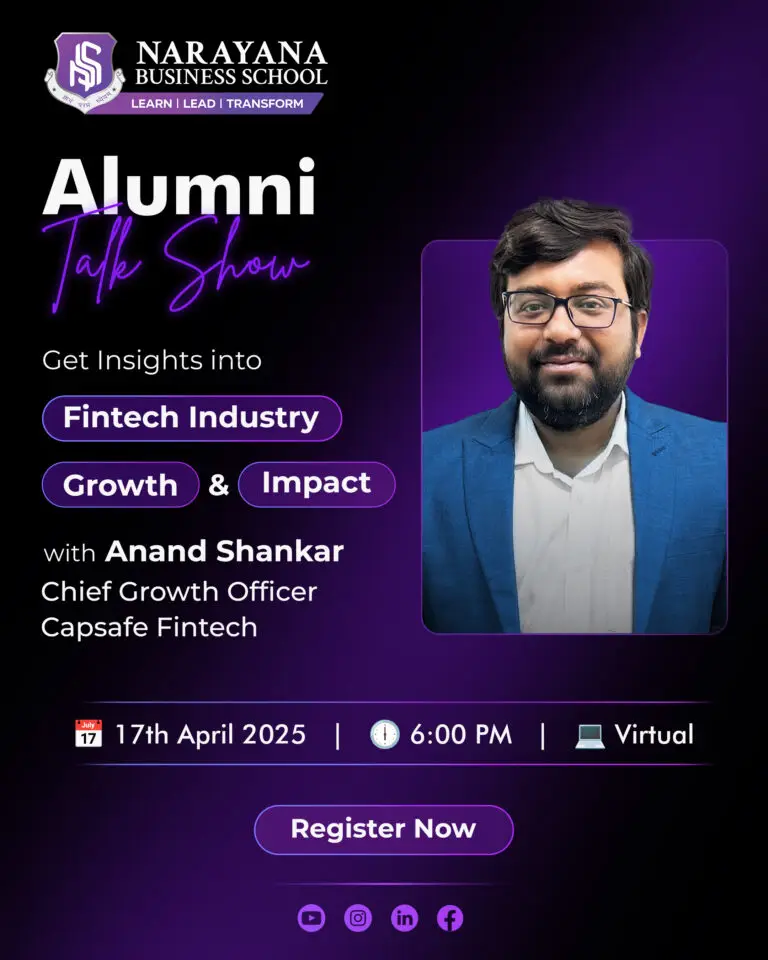
    For our very first session, Narayana Business School is honored to welcome Mr. Anand Shankar, a distinguished alumnus and the Chief Growth Officer at Capsafe Fintech. Anand’s deep understanding of financial markets, venture capital, and digital transformation equips him to demystify the rapidly evolving Fintech industry and offer actionable insights that students and young professionals can use. 

    Anand’s journey from a student at NBS to a leader in the Fintech space is an inspiring testament to the power of perseverance and learning. His strategic vision and hands-on expertise will guide attendees through the complexities of this fast-paced sector, shedding light on the growth opportunities and challenges it presents. 

    1. When alumni share their own career journeys, it shows students how the ideas they learn in class actually work in real life. These stories help students understand what to expect and how to handle real work situations.
    2. Starting a career can feel confusing. Hearing about the successes and challenges alumni have faced helps students see possible paths ahead. It gives them confidence and helps them set clear, doable goals for their future.
    3. Alumni talk shows create chances for students to meet professionals who can guide them, give advice, or even offer jobs and internships. These connections can open doors and make a big difference in a student’s career.
    4. Especially in fast-growing fields like Fintech, alumni share the latest news and changes happening in the industry. This helps students stay updated and ready for the jobs of tomorrow.
    5. These talks bring students and alumni closer together. They build pride in being part of Narayana Business School and create a supportive network where everyone helps each other grow. This version keeps the ideas friendly and easy to understand while staying interesting and meaningful. Would you like it even shorter or with more examples?

    By attending this talk show, students will: 

    • Gain a clear understanding of emerging Fintech trends and their impact on the financial world. 
    • Learn from Anand’s personal experiences in growing businesses and managing innovation. 
    • Discover practical tips on navigating career challenges in a competitive environment. 
    • Get inspired to think big and act boldly in their own professional journeys. 
    • Connect with the NBS alumni network, opening doors to mentorship and future opportunities. 
    • Date: April 17th, 2025 
    • Time: 6:00 PM 
    • Format: Virtual (Join from anywhere!) 
    • Registration: Open now 

    Register Here: https://events.teams.microsoft.com/event/9cfd3c67-3980-40ae-8ea6-5b9f34862d8c@16ae678f-190e-4165-b2ef-30332700f7ce  

    NBS Ahmedabad & NISM Sign An MoU To Further Boost Employability Of NBS Students With Dedicated Securities Market Training, NISM Certification Support & Study Tours

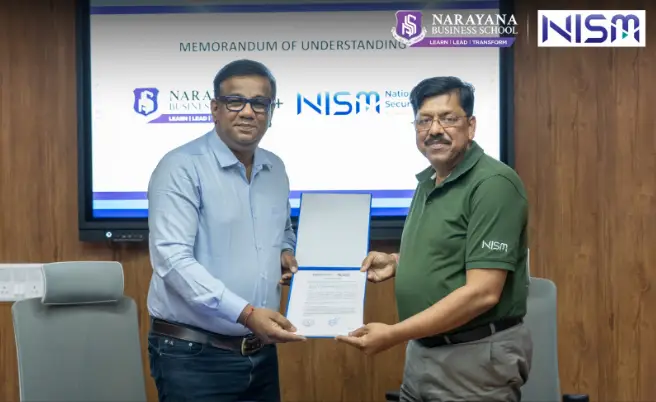
    Ahmedabad, Gujarat (9th April, 2025) – NBS Ahmedabad who is now a proud member of AACSB and BGA global B school networks has further elevated its fleet of industry partnerships with NISM being the newest entry. NBS Ahmedabad has signed an MoU with National Institute of Securities Market (NISM) to provide an edge to its students that are rarely provided by a B school.  

    This strategic collaboration is designed to equip students with specialized knowledge of securities markets and industry-recognized certifications, directly addressing the growing demand for skilled professionals in the financial sector.  

    The B school offers India’s First PGDM in Quantitative Finance integrated with EY CAFTA. A two-year full-time postgraduate diploma course designed to equip students with advanced financial theories and practical skills in quantitative analysis, financial modeling, risk management, and algorithmic trading.  

    The world narrative is constantly changing, and employers are looking for professionals who can adapt quickly and apply their learnings in real-world situations. NISM certifications are often required for roles like investment advisors and research analysts, and this partnership ensures NBS students graduate with these credentials. 

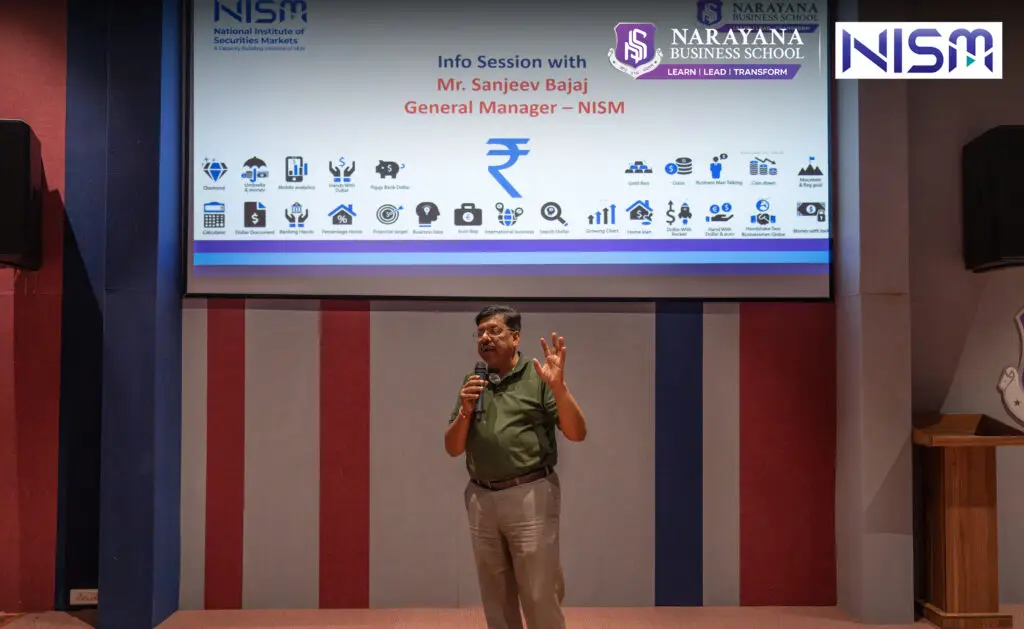
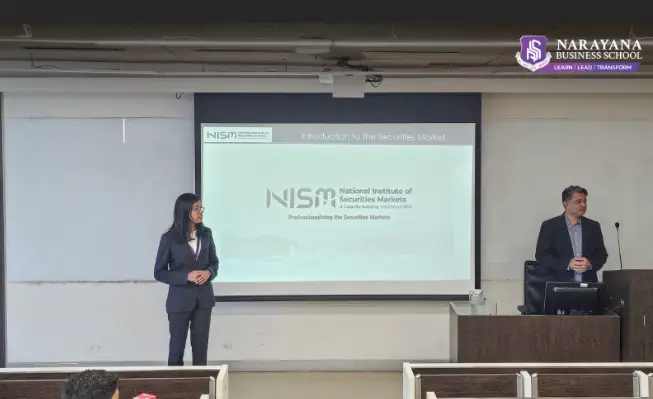
    Sanjeev Bajaj, General Manager at NISM took a dedicated session for our students explaining the dynamics of securities market, by SEBI promotes NISM at large and how NISM certifications can act as a catalyst in a students’ professional journey.

    Sanjeev Bajaj – GM at NISM at NBS Ahmedabad campus

    End-to-End NISM Certification Support 

    One of the most significant aspects of this partnership is the comprehensive support provided to NBS students for NISM certification exams. These exams are not just optional qualifications but regulatory requirements for many roles in the financial sector. 

    • Targeted Exam Preparation Courses: Students will receive specialized training tailored to NISM certification exams, blending conceptual rigor with exam-focused drills. 
    • Logistical Assistance: Support for exam registration, fee waivers, and access to NISM’s official study materials, ensuring students can focus entirely on their preparation. 

    Immersive Industry Exposure 

    Beyond certification support, the collaboration emphasizes experiential learning to bridge the gap between academic theory and industry practice. Key initiatives include: 

    • Study Tours: Visits to key financial institutions such as the NISM campus tour, NSE/BSE trading floors, SEBI headquarters, and asset management firms to provide firsthand insights into market operations. 
    • Industry Expert Lectures: Regular guest sessions by fund managers, fintech innovators, and regulatory experts on crucial topics.  

    Enhanced Employability 

    NISM certifications are not only advantageous, but they are also often mandatory for many roles in the financial sector. By ensuring students graduate with these certifications, NBS is giving them a significant edge in the job market. Partner financial institutions like Yes Bank, Bajaj finserve and HDFC securities can prioritize NBS students for roles in trading, compliance, and research, opening doors to exciting career opportunities. Additionally, the global recognition of NISM certifications in markets like GCC and ASEAN provides students with international career prospects, broadening their horizons beyond the domestic job market. 

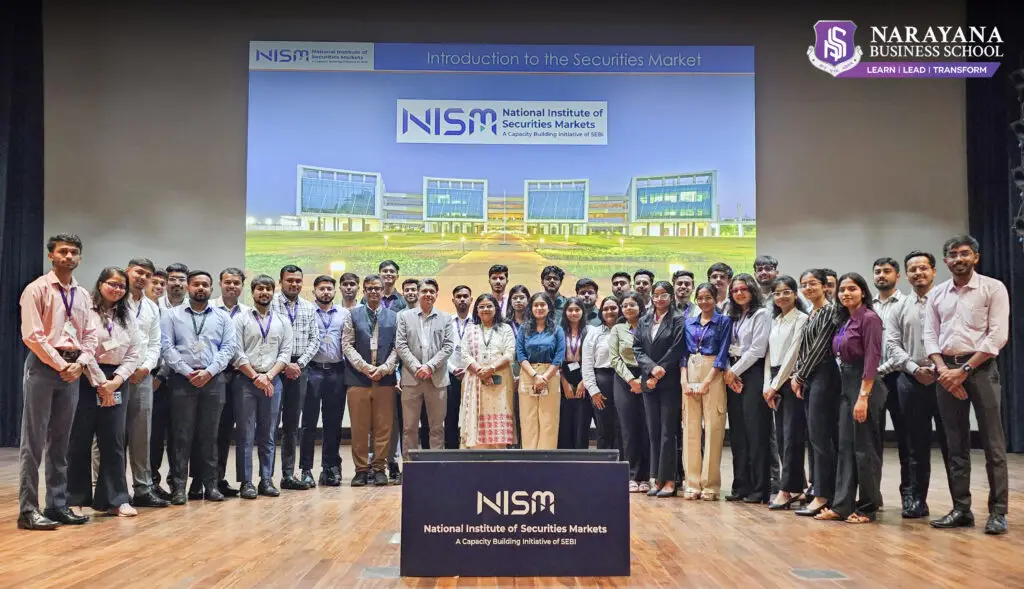
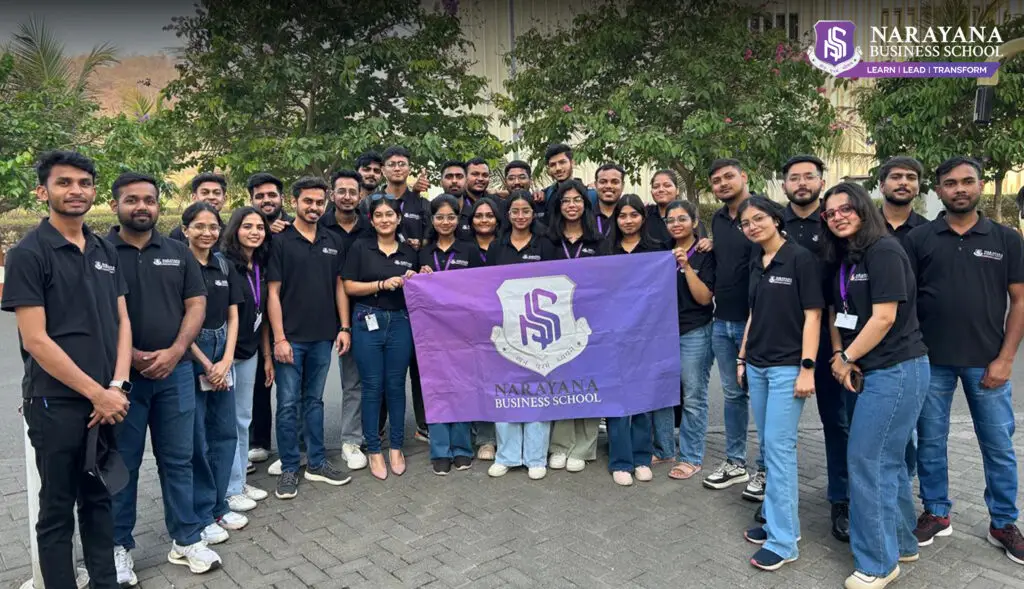
    NBS students at NISM campus

    There are nearly 18 lakh (1.8 million) unfulfilled jobs in the financial services sector due to skill gap and unemployability issues, said a top official of the FPSB India. 

    This collaboration directly addresses this gap by equipping students with the specialized knowledge and certifications required to fill these roles, ensuring they are job-ready upon graduation. 

    In an industry where ethical considerations are paramount, NISM certifications emphasize compliance and investor protection, aligning with SEBI’s focus on market integrity. This gives NBS students a reputation for ethical rigor, a key differentiator in a sector prone to scandals and regulatory scrutiny. 

    As technology continues to disrupt traditional financial practices, the program’s focus on fintech tools like TensorFlow for predictive analytics ensures that students stay ahead of the curve. By integrating these advanced topics into the curriculum, NBS is future proofing its students’ careers, equipping them with the knowledge and skills needed to thrive in an industry that is constantly evolving. 

    NISM patalganga campus visit

    Recently, NBS students went on a 3-day immersive study tour to NISM’s campus in Navi Mumbai. This trip was a direct result of our partnership with NISM and gave students a chance to learn in ways textbooks simply can’t provide.

    Day 1: Understanding SEBI’s Role in Market Regulation 

    Students gained invaluable insights into how the Securities and Exchange Board of India (SEBI) regulates and protects financial markets. This session provided a deep understanding of the regulatory framework that underpins India’s financial system, equipping students with knowledge that is essential for any career in finance.

    NBS students at NISM campus

    Day 2: Derivatives and the 2008 Financial Crisis

    Led by Dr. Dhiraj Jain, this engaging session explored the complexities of derivatives and their role in the 2008 financial crisis. Students learned how such events impact global markets and the lessons that can be drawn for future financial decision-making.

    Day 3: Commodities Market and Live Trading Simulation 

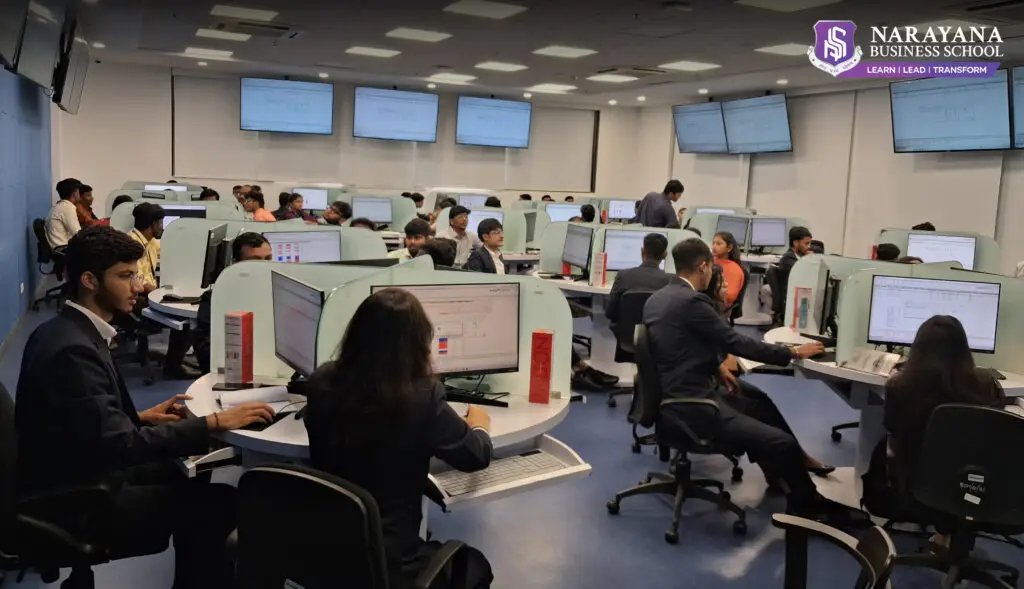
    The final day offered a hands-on experience of the commodities market, including a visit to the Multi Commodity Exchange (MCX). Students also participated in live trading simulations, where they practiced placing buy/sell orders, using stop-loss strategies, and managing risks. 

    According to recent industry reports, over 75% of job postings in the financial sector require NISM certifications, highlighting the growing demand for professionals with both technical expertise and regulatory knowledge. This study tour directly addresses this need by providing students with hands-on learning and industry-recognized credentials. 

    NBS quantitative finance batch of 2024

    At NBS, we believe that the best education is one that goes beyond the classroom. By partnering with NISM, we are ensuring that our students not only understand the theories but also know how to apply them in real-world scenarios. As the financial industry continues to evolve, NBS remains committed to providing our students with the skills, knowledge, and confidence they need to succeed, both in India and globally. 

    Startup Mahakumbh 2025 Was A March Towards Viksit Bharat, 3000 Startups Reaching 50+ Countries – NBS Ahmedabad At Startup Mahakumbh

    Held from April 3 to 5 at the sprawling Bharat Mandapam in New Delhi, the second edition of Startup Mahakumbh drew over 3,000 startups, 1,000 investors and incubators, 10,000 delegates from more than 50 countries, and an impressive 50,000 business visitors. As echoes of the inaugural event still linger, this year’s gathering has been crafted to ignite not only regional innovation but also global entrepreneurial synergies. The theme “Startup India @ 2047: Unfolding the Bharat Story”, aptly captures an ambition that stretches from humble district-level initiatives to impactful global ventures. 

    Inaugurated by our Prime Minister Narendra Modi, this platform was a statement to the community and beyond that today’s India is all about growth, innovation and solution. For years, and we mean it, for years, anything Indian was considered second, given side eyes while welcoming everything western with open arms.  

    India is a country which in many ways underwrote multiple global rules, regulations, gave ancient wisdom which turned into modern innovation likes of which are still being used to today worldwide. With Viksit Bharat, as they say, India is only beginning to rise.  

    We, Vishal Tiwari – VP Growth & Strategy along with Kushagra Agarwal – Content Marketing Lead from Narayana business school were present at the confluence as business delegates.  

    Our first observation was watching years of untapped innovation, potential coming together on a world stage. The energy of the arena, the delegates, startup owners running here and there, nonstop conversations moulding into business deals, a true gathering of bright minds and new ideas.  

    The phrase “Jile Se Jagat Tak” (From District to the World) perfectly captured this idea. Startups from rural areas shared the stage with those from big cities. Many participants were young entrepreneurs who are making great progress through simple, practical ideas that have the potential to change lives. 

    Visitors and we witnessed a variety of pavilions dedicated to important areas such as artificial intelligence, deep tech, health tech, AgriTech, fintech, and even defense and space technology. Each pavilion not only showcased new products and solutions but also provided a platform for detailed discussions about technology trends and market needs. Overall, the event was designed to push a statement, a statement to the global community, and to help participants understand that no matter where an idea comes from, it can have a global impact if given the right support and exposure. 

    Several key observations highlight the importance of Startup Mahakumbh 2025

    • Local to Global Impact: 
      The event showed how small-town ideas can reach global markets. Many booths featured products developed by entrepreneurs who had started in lesser-known regions, proving that innovation is not limited to metropolitan areas. This approach is designed to ensure that every part of the country contributes to building a self-reliant and thriving economy. 
    • Startup MahaRathi Challenge: 
      One of the highlights was the Startup MahaRathi Challenge. This contest provided a chance for early-stage startups to present their ideas to top investors. Winners received not only national recognition by DPIIT but also mentoring sessions and access to a large funding pool. In simple terms, this competition helps the best ideas get the help they need to grow. 
    • Energy Innovation and Support from PSUs: 
      An important observation from recent news is that the Ministry of Petroleum and Natural Gas (MoPNG) took part in the event. They showcased innovations coming from public sector units (PSUs) in the oil and gas sector. For instance, ONGC’s startup fund has grown by 450% in the past five years, and several PSU-backed startups participated in the event. This shows a strong push for energy innovation and highlights government support for new businesses. 
    • Academic and Institutional Engagement: 
      The event was also supported by reputable institutions. For example, the Institute of Chartered Accountants of India (ICAI) set up a stall to help startups with financial issues and regulatory compliance. Educational institutions and incubators are playing a big part by mentoring young innovators, ensuring that practical knowledge reaches aspiring entrepreneurs. 
    • Security and Infrastructure: 
      With over 50,000 business visitors expected, the event organizers increased safety measures and upgraded infrastructure. From a well-planned temporary city to enhanced transportation services, the preparations underline the event’s scale. More than 40,000 police officers, numerous cameras, and modern communication tools were in place to make sure everyone was safe and could move around easily.  
    • Global Exposure Through Networking and Panels: 
      Masterclasses, panel discussions, and fireside chats allowed participants to learn from some of the top leaders in technology and business. Notable speakers like Peyush Bansal (CEO of Lenskart) and Nithin Kamath (CEO of Zerodha) discussed trends, challenges, and strategies in simple, clear language. These sessions helped participants understand the practical steps needed for growth, from raising capital to scaling their business globally.  

    The vision behind Startup Mahakumbh 2025 was clear: to shape an India that is self-reliant and innovative by the time it celebrates 100 years of independence in 2047.  

    By supporting startups at every level, from small local initiatives to ideas with global ambitions, the event lays a strong foundation for a Viksit Bharat (developed India). 

    Collaboration between government bodies, industry leaders, academic institutions, and startups is key to this mission. This collaborative approach not only provides a platform for the exchange of ideas but also helps in the rapid scaling of innovations to meet both local and international needs.  

    We at Narayana Business School have been building this B school sustainably for the last 24 years and we our approach of nurturing students from tier 2 and tier 3 cities align directly with the narrative of rising India and the Viksit Bharat mission.  

    NBS Ahmedabad Honoured With Best Education Award For Second Time At ET Now Brand Awards 2025

    Narayana Business School Ahmedabad (NBS Ahmedabad) is delighted to announce that it has been awarded the prestigious “Best Education Brand Award” at the ET Now Brand Awards 2025. This marks the second consecutive year the B school has received this distinguished recognition, having previously been honoured with the same award in 2023. 

    The ET Now Brand Awards 2025, held in New Delhi on February 25, is among India’s most respected accolades in the education sector. This premier event brought together visionary leaders, policymakers, and industry experts to discuss India’s transformative growth journey and recognize institutions demonstrating excellence, innovation, and consistent performance. 

    Dr. Purvi Gupta, whose innovative curriculum designs have transformed student learning experiences, added: “To see our students excel in boardrooms across the globe brings us immense pride. This award belongs to every student who has walked these halls, every faculty member who has poured their knowledge into young minds, and every supporter who believed in our vision. Together, we’ve built something extraordinary.” 

    Dr. Amit Gupta, reflecting on the institution’s journey, shared: “What makes this award particularly meaningful is that it represents the collective effort of our entire NBS community. Every faculty member who has poured their expertise into our programs, every student who has embraced our challenging curriculum, and every industry partner who has supported our mission has contributed to this achievement. We take this honour as further motivation to continue preparing tomorrow’s business leaders with the skills, ethics, and vision needed to thrive in an increasingly complex global economy.” 

    Key highlights of Narayana Business School under their leadership include: 

    • Ranked 4th among Best Private B Schools in Gujarat by IIRF.  
    • Consistently strong placement records with top corporate recruiters. 
    • State-of-the-art infrastructure spanning over 10 acres. 
    • More than 60 industry-experienced faculty members. 
    • Over 9,000 distinguished alumni in prestigious organizations pan India.  

    The award ceremony, which focused on India’s journey towards becoming a $10 trillion economy by 2035, featured keynote addresses by Dr. Jitendra Singh, Union MoS for Science & Technology, and Rohit Chadda, President and COO of Times Network. NBS was represented by its senior leadership team, who accepted the award amidst enthusiastic applause. 

    To our entire NBS community – faculty, students, alumni, and supporters—thank you for being part of this remarkable journey. Together, we continue to shape the future of business leadership! 

    For more information on our awards and recognition, please visit: https://nbs.edu.in/awards-recognitions-b-school/

    HR Conclave 2025: A Forum On Data &Human-Centric HR, Sparks Dialogues On The Future Of Human Resource 

    We just had the most eye-opening experience at the HR Conclave 2025 at Narayana Business School in Ahmedabad. If you’ve ever wondered how to balance data analytics with human empathy in HR, this event had all the answers. 

    The theme was “HR Excellence and People Analytics: Leveraging Data for Smarter Decisions,” and it couldn’t have come at a better time. In today’s world where algorithms are everywhere, it’s refreshing to see a gathering that focuses on keeping the human touch alive in HR. 

    Lamp lighting ceremony by our Director Dr Amit Gupta.  

    Dr amit Gupta, Director NBS at HR conclave

    The essence of the conclave was built upon the belief that while numbers and metrics provide clarity, it is the human context behind these figures that fuels true progress. In today’s fast-paced business environment, organizations are increasingly reliant on data to steer decisions from talent acquisition to employee engagement. Yet, the voices at HR Conclave 2025 reminded us that data, when divorced from human context, is merely noise. They argued that by merging analytics with empathy, companies could unlock not only improved productivity but also a more engaged and fulfilled workforce. 

    In a session that felt as much like a storytelling forum as it did a professional seminar, speakers illustrated that every data point on an employee’s profile represents a human being with unique aspirations, challenges, and potential. This philosophy underpinned the entire day, with each presentation reinforcing the idea that the future of HR lies in harmonizing the objective clarity of analytics with the subjective beauty of human experience. 

    Harjeet Khaduja, senior VP HR at jio

    One of the most compelling moments of the day came from Harjeet Khanduja, Senior Vice President HR at Reliance Jio. Khanduja transformed the stage into a dynamic theater of ideas, interweaving cinematic metaphors with the science of human behavior. Drawing parallels with films like The Shawshank Redemption, he argued that recognition in the workplace isn’t merely a feel-good gesture—it is a catalyst for neurological transformation. 

    When we acknowledge someone’s effort, we’re not just boosting morale; we’re activating the brain’s chemistry,” Khanduja explained. He detailed how the release of dopamine and serotonin, often celebrated as the brain’s “feel-good” chemicals, can create a virtuous cycle of trust and productivity. By likening daily recognition to pivotal cinematic moments, he painted a vivid picture of workplaces where each act of appreciation ignites a spark of creativity and commitment. 

    Khanduja’s narrative was underpinned by scientific research that shows how positive reinforcement not only increases individual performance but also fosters a culture of collective achievement. His insights encouraged HR leaders to view employee recognition as a strategic imperative, a simple yet powerful tool that can transform the ordinary into the extraordinary.

    Sahil Nayar, HR influencer and leader

    In another thought-provoking session, HR influencer Sahil Nayar challenged conventional wisdom with a single, provocative question: “What if we designed systems where no one is left in the shadows?”  

    Nayar dissected the paradox inherent in traditional talent evaluations, where individuals often judge their own struggles through a lens of external pressures while attributing others’ challenges to personal failings. 

    He argued that this bias, often invisible in everyday interactions, stifles potential by reinforcing outdated hierarchies. Instead, Nayar advocated for an HR framework that prioritizes equitable growth opportunities. His call to “rethink talent hierarchies” resonated with many in the audience, as he suggested that every employee, regardless of their position on the corporate ladder, holds untapped potential waiting to be nurtured. 

    Nayar’s message was clear: By reimagining how we evaluate and support talent, organizations can build more inclusive environments where every individual is empowered to shine. His speech was not just a critique of the status quo but a rallying cry for a new era in HR—one that values potential over pedigree and inclusivity over hierarchy. 

    the panel discussion at HR conclave

    Mekhola Ganguly, SGM – HR Business Partner at Welspun One, provided a practical example of how data can expose uncomfortable truths. Sharing insights from her organization’s recruitment process, Ganguly revealed that candidates hailing from smaller cities were consistently undervalued despite possessing qualifications on par with their urban counterparts. 

    “Data doesn’t lie,” Ganguly asserted, highlighting how anonymizing location details during initial screening not only diversified their talent pool but also brought to light exceptional candidates who might otherwise have been overlooked. Her account served as a powerful reminder that biases—often ingrained and unchallenged—can be mitigated through thoughtful analysis and deliberate policy changes. 

    Ganguly’s story was a testament to the idea that ethical analytics can serve as a mirror, reflecting the hidden prejudices within recruitment processes. By removing unconscious barriers, her organization was able to foster a more equitable hiring process, one where excellence was recognized regardless of geography. This approach, she argued, is not about meeting quotas but about uncovering and nurturing genuine talent. 

    Another highlight of the conclave was the session led by Kshatriya Sundeep Singh, Head – People and Culture at Reneé Cosmetics. Singh took the audience on a journey into the realm of cross-functional secondments, a practice where employees are temporarily assigned to roles outside their primary job function. 

    Singh recounted a compelling case where a marketer, given the opportunity to work on a supply chain project, and an engineer who shadowed customer service teams, discovered renewed curiosity and purpose in their roles. “People don’t leave companies; they leave stagnation,” he emphasized, underscoring the transformative impact of interdisciplinary exposure. By breaking down silos, organizations can reinvigorate their workforce, reduce attrition, and foster a culture of continuous learning. 

    Singh’s narrative was rich with real-world implications. His example demonstrated that when employees are exposed to different facets of the organization, they not only gain new skills but also a deeper understanding of the business as a whole. This holistic approach to professional development, he argued, is essential in today’s rapidly evolving work environment. 

    The dialogue at HR Conclave 2025 was not limited to corporate strategies alone. Dr. Neelam Kshatriya, Associate Professor at NBS Ahmedabad, showcased how data analytics is revolutionizing the educational sphere. By monitoring class participation, assignment submissions, and peer interactions, the school has developed a proactive system to identify students at risk of falling behind. 

    Dr. Kshatriya’s insights revealed that early intervention, grounded in data, can make a significant difference in academic outcomes.  

    This approach mirrors the broader HR narrative: timely, data-informed decisions, when coupled with compassionate support, can foster an environment where every individual, be it a student or an employee, has the opportunity to succeed.

    Complementing the optimistic narratives was the cautionary note from Dr. Jeegnesh Trivedi, Examinations Head at NBS Ahmedabad. Dr. Trivedi warned against an overreliance on metrics, urging the audience to remember that numbers should guide questions, not provide definitive answers.

    NBS awarded with best brand award 2025 by IIRF

    In a heartfelt conclusion to an already remarkable day, Narayana Business School was honored with the Best Brand Award by the Indian Institutional Ranking Framework (IIRF). This prestigious accolade, coming as a direct recommendation from the IIRF Board of Directors, recognizes the institution’s relentless commitment to integrating real-world relevance into business education while maintaining the highest academic standards.

    As the day drew to a close, several universal truths emerged from the conclave—truths that continue to resonate in an era marked by digital disruption and shifting generational expectations. Among these were the notions that “Data Without Context Is Just Noise” and “Appreciation Costs Nothing, Changes Everything.” 

    The discussions converged on the idea that while Gen Z demands purpose as much as pay, the true challenge for organizations is to create environments where both data and human values are seamlessly integrated. Ethics, as many speakers pointed out, are the guardrails of innovation. Without them, even the most sophisticated analytics can lead to decisions that undermine trust and equity. 

    The event, co-hosted by the HRcomm club of Narayana Business School in collaboration with the Federation for World Academics and media partner EPN News, left a lasting impression on all who attended.  

    It was a day of revelations, a day when data was no longer seen as the enemy of empathy but as its enabler. 

    HR conclave 2025

    As we reflect on the transformative ideas shared at HR Conclave 2025, one message stands out: the future of HR is not a choice between technology and human touch, but a synthesis of both. In every employee recognition, every unbiased hiring decision, and every cross-departmental collaboration, there lies the potential to build workplaces that are both smart and soulful. 

    For HR professionals, educators, and industry leaders alike, the conclave’s insights are not just guidelines for better practices; they are a call to action. It is a reminder that while technology continues to reshape the workplace, the human spirit remains the true driver of innovation and progress. 

    In closing, as organizations navigate the ever-changing demands of a diverse workforce, let us remember that the most transformative decisions are those that blend the precision of analytics with the empathy of human connection. The future of work is unfolding before our eyes, and it is our responsibility to ensure that it is a future where every individual is seen, heard, and valued. 

    The journey toward HR excellence is just beginning, and it is a journey that demands not only smart decisions but also a compassionate approach. In the words of the thought-provoking speakers at Narayana Business School, let data illuminate the path and empathy fuel the progress, a harmonious blend that might just redefine the very nature of our workplaces.